
Key Takeaways
- AI model readiness begins before model development, with training data quality, coverage, and governance.
- Model deployment readiness depends on whether data inputs remain consistent, traceable, and representative over time.
- Production AI systems fail when training data is treated as a static asset rather than a managed infrastructure layer.
- Training data strategy is becoming an executive concern because poor data readiness increases model, compliance, and business risk.
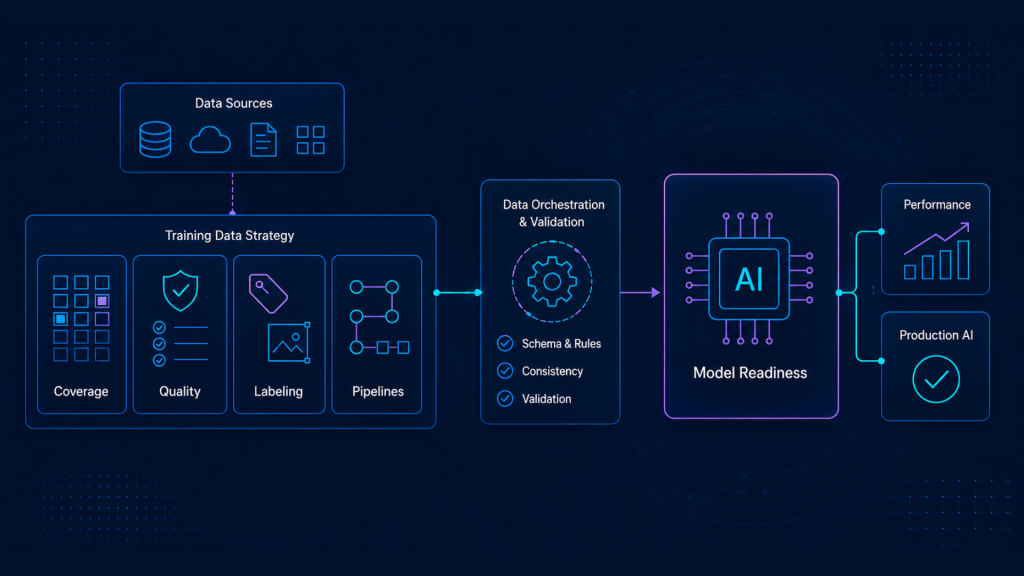
AI model readiness is often treated as a technical milestone reached near the end of development. A model is trained, evaluated, tested, and prepared for deployment. However, in enterprise environments, readiness begins much earlier. It begins with the strategy behind the data the model learns from, the systems that refresh that data, and the governance controls that determine whether the model can be trusted after deployment.
A weak training data strategy does not always prevent experimentation. It prevents the reliable production of AI systems. Models can perform well in controlled environments while failing when exposed to real market conditions, changing user behavior, new edge cases, inconsistent data flows, or poorly governed inputs. Therefore, AI Model Readiness depends less on the model artifact alone and more on whether the enterprise has built a data foundation capable of supporting continuous performance.
AI Model Readiness Begins Before Model Development
AI readiness is frequently discussed in terms of models, tools, compute, and deployment environments. Those elements matter, but they do not define the full readiness picture. A model can be technically sophisticated and still be unready for production if its training data is incomplete, biased, outdated, poorly documented, or disconnected from the environment where the model will operate.
McKinsey’s State of AI 2025 reports that AI use is widespread, yet many organizations still struggle to move from pilots to scaled enterprise impact. That gap is not only a deployment issue. It often reflects the difficulty of embedding AI into real workflows where data quality, process integration, and governance determine whether systems remain useful after launch.
Training Data Strategy Determines Whether Models Can Move Beyond Experimentation
AI experiments can tolerate imperfect data because the risk surface is limited. Teams can manually correct examples, tune prompts, adjust labels, or run controlled evaluations. Production environments are different. Once a model supports customer experiences, pricing, risk assessment, search, recommendations, automation, or operational workflows, a weak data strategy becomes a business risk.
Training data strategy defines what the model should learn, which sources are acceptable, how labels are created, how edge cases are represented, how data is refreshed, and how quality is measured. Without these decisions, models may perform well during testing but degrade when conditions change.
In practice, the training data strategy is the bridge between experimentation and model deployment readiness. It turns data from a one-time development input into a managed system of evidence.
Model Deployment Readiness Depends on Data Consistency, Coverage, and Traceability
Model deployment readiness requires more than benchmark performance. Enterprise teams need to know whether the model was trained on data that is consistent, representative, and traceable. Consistency ensures that inputs follow stable definitions. Coverage ensures that important scenarios, segments, languages, markets, and edge cases are represented. Traceability shows where data came from, how it was processed, and whether it can be audited.
These requirements become more important when AI systems affect decisions with financial, legal, operational, or customer consequences. A model trained on narrow or poorly documented data may pass internal tests while failing under real-world variation.
Accordingly, deployment readiness should be evaluated at the data layer before it is evaluated only at the model layer.
Why Production AI Systems Fail When Training Data Is Treated as a Static Input
Training data is often treated as a dataset prepared before modeling begins. That view is too limited for production AI. Real environments change continuously. Customers’ shift behavior, products change, markets evolve, fraud patterns adapt, language changes, regulations develop, and business priorities move. A training dataset that was representative during development may become incomplete after deployment.
IBM’s 2025 CDO Study states that organizations need high data quality and strong governance frameworks to unlock value from proprietary and ecosystem data. That finding reinforces a practical reality for AI: model performance depends on whether enterprise data strategy can keep pace with model ambition.
Models Built on Fragmented Datasets Struggle to Perform Reliably in Real Environments
Fragmented datasets create hidden weaknesses. One team may provide labeled examples. Another may contribute customer records. External data may be collected separately. Historical data may follow old schemas. New data may use different definitions. Labels may vary by team, geography, product line, or vendor.
A model trained on this foundation may learn patterns that do not generalize. It may overfit to dominant segments, underperform on edge cases, or behave inconsistently across markets. The problem may not be visible in aggregate evaluation metrics because failures often appear in specific contexts.
Production AI systems require training data pipelines that unify sources, standardize definitions, and preserve enough metadata to explain performance variation. Without that foundation, models can appear ready while remaining fragile.
Training Data Gaps Create Drift, Bias, and Weak Decision Confidence After Deployment
Training data gaps do not end at launch. They continue to affect model behavior after deployment. If the model was trained on outdated market conditions, it may drift as the real environment changes. When important populations or edge cases are underrepresented, outputs may become biased or unreliable. If data lineage is weak, teams may struggle to diagnose why performance changed.
Decision confidence declines when leaders cannot explain whether the model’s weakness comes from the model architecture, the training data, the feature pipeline, the labels, or the live input environment. This uncertainty slows adoption and increases governance pressure.
Therefore, the training data strategy must account for drift monitoring, refresh cycles, bias evaluation, data provenance, and ongoing validation. Production AI systems do not stay ready unless their data systems remain ready.
The Strategic Difference Between AI Prototypes and Production AI Systems
The gap between an AI prototype and a production AI system is often underestimated. Prototypes demonstrate potential. Production systems carry operational responsibility. The shift changes the standard for data quality, governance, monitoring, documentation, and accountability. What is acceptable in a controlled experiment may be unacceptable in a system that affects real customers, employees, markets, or financial decisions.
The World Economic Forum’s AI in Action 2025 report focuses on moving beyond experimentation toward responsible industry transformation. That framing matters because enterprise AI value is not created by pilots alone. It emerges when AI systems are integrated into business and operating models with the foundations required to scale responsibly.
Prototype Models Can Tolerate Data Weaknesses That Production Systems Cannot
Prototype models are often built to prove feasibility. Their data requirements are narrower because the goal is exploration. A team may use sampled records, manually prepared datasets, limited labeling, or a small group of test scenarios. This is appropriate for early learning.
Production AI systems face a different standard. They must handle real-world variation, changing inputs, user behavior, operational constraints, compliance requirements, and performance expectations. In that environment, data weaknesses become operational weaknesses.
A prototype may succeed because the test environment is controlled. The same model may fail in production because the data environment is uncontrolled. Consequently, AI model readiness must be judged by production conditions, not prototype performance.
Enterprise AI Requires Data Pipelines Built for Refresh, Validation, and Governance
Production readiness requires data pipelines that can refresh, validate, monitor, and govern training inputs continuously. Static datasets cannot support systems that operate in dynamic environments. Enterprise AI needs pipelines that can identify new examples, update labels, detect schema changes, monitor distribution shifts, preserve historical versions, and support retraining decisions.
This is where training data strategy becomes infrastructure. Orchestration systems such as Airflow can coordinate data workflows. Kafka can support continuous data movement. Spark can process large-scale training datasets. dbt can structure transformation logic into reusable models. Snowflake, BigQuery, and Databricks can support scalable storage and analytics.
These systems do not make a model ready by themselves. However, they create the environment in which readiness can be maintained.
Training Data Strategy Is Becoming a Core AI Infrastructure Discipline
Training data strategy is no longer a data science subtask. It is becoming a core AI infrastructure discipline because training data affects model performance, risk, compliance, explainability, monitoring, and long-term reliability. As enterprises deploy AI across more functions, the quality of training data becomes a shared responsibility across data, engineering, legal, compliance, product, security, and executive leadership.
NIST’s AI Risk Management Framework provides a structured approach to managing AI risks across the lifecycle, including governance, measurement, and management considerations. For enterprise teams, the relevance is clear: AI systems require traceable and governed inputs if they are expected to operate responsibly in real environments.
External and Internal Data Sources Must Be Structured into Reliable Training Pipelines
Enterprise AI rarely depends on one data source. Training data may include internal transactions, product data, customer interactions, support logs, documents, images, public information, partner data, synthetic data, and external market signals. Each source has different quality constraints, access rules, formats, update frequencies, and governance requirements.
A reliable training data strategy defines how these sources enter the pipeline. It clarifies what is acceptable, how data is cleaned, how labels are applied, how sensitive fields are handled, how source quality is scored, and how datasets are versioned.
External data adds additional complexity. Dynamic web sources may require browser automation frameworks such as Playwright. Enterprise-grade collection may require source monitoring, schema validation, proxy orchestration, extraction resilience, and change detection. Without these controls, external data can introduce instability into model development and retraining.
Validation, Lineage, and Metadata Determine Whether AI Inputs Can Be Trusted
AI inputs must be trusted before outputs can be trusted. Validation checks whether training data meets quality requirements. Lineage shows how data moved through the system. Metadata explains source, time, structure, ownership, label method, version, and processing history.
Frameworks such as Great Expectations can support schema validation, completeness checks, and anomaly detection. Observability systems such as Prometheus can monitor pipeline health, latency, coverage, and freshness. Data lineage tools and metadata systems help teams trace which datasets influenced which model versions.
In practice, these controls make AI readiness auditable. They allow teams to answer difficult questions: Which data trained this model? Were sensitive fields excluded? Which labels were used? When was the dataset refreshed? What changed between versions? Why did model performance shift?
The Infrastructure Layer Behind Model Deployment Readiness
Model deployment readiness depends on the infrastructure that supports training data before and after deployment. Enterprises need systems that continuously manage data flow, quality, representation, and governance. Without this infrastructure, AI systems may launch successfully but degrade as soon as real-world variation increases.
Gartner’s 2025 Data and Analytics Predictions state that by 2027, half of business decisions will be augmented or automated by AI agents for decision intelligence. Gartner also warns that failures in managing synthetic data can create risks for governance, model accuracy, and compliance. This reinforces the need to treat AI data readiness as an enterprise control layer, not an afterthought.
Continuous Data Capture, Normalization, and Quality Controls Improve AI System Reliability
Continuous data capture keeps AI systems connected to current conditions. Normalization ensures that data from different sources can be compared and used consistently. Quality controls prevent incomplete, corrupted, or structurally inconsistent inputs from entering training and retraining workflows.
These controls are especially important for AI systems that depend on changing external conditions. A pricing model may need fresh competitor data. A recommendation model may require current product availability. A risk model may need updated public signals. A support automation system may need recent customer issues and language patterns.
A Datamam-style training data readiness model can be understood in six stages: source qualification, signal capture, validation, normalization, dataset versioning, and governance. The purpose is not simply to collect more data. It is to convert raw inputs into training assets that can support reliable model behavior.
Observability and Governance Help Production AI Systems Remain Stable Over Time
Production AI systems require monitoring beyond model accuracy. Teams need visibility into data freshness, schema changes, missing values, source failures, label drift, distribution shifts, and pipeline latency. When performance declines, observability helps teams determine whether the issue comes from the model or the data environment.
Governance provides accountability. Audit logs, access controls, lineage records, documentation, legal review processes, and compliance architecture help ensure that training data can be defended. Cross-border considerations also matter when data flows across jurisdictions. GDPR, data residency rules, consent requirements, platform policies, and sourcing controls can all affect whether data is appropriate for training or evaluation.
Ultimately, governance and observability turn AI readiness into an operational capability. They help production systems remain stable after deployment rather than only appearing ready at launch.
Why AI Model Readiness Is Becoming an Executive Responsibility
AI model readiness is becoming an executive responsibility because the consequences of weak training data now extend beyond technical performance. Poor data readiness can affect customer trust, compliance posture, operational reliability, brand risk, financial decisions, and the ability to scale AI investments. As AI systems become embedded in business workflows, leaders need to understand whether the organization’s data foundation can support the ambition.
The World Economic Forum’s 2025 analysis on scaling AI with strategy, data, and workforce readiness argues that leaders must embed AI into strategy while building strong data foundations for enterprise-wide scale. That point aligns directly with model readiness: AI cannot become an enterprise capability if training data remains fragmented, ungoverned, or poorly connected to production systems.
Leaders Need to Evaluate Data Readiness Before Scaling AI Investments
Executives often evaluate AI investments through use cases, models, vendors, and expected productivity gains. Those factors are important, but they are incomplete without a data readiness assessment. Before scaling AI investments, leaders need to ask whether the organization has the training data coverage, quality controls, governance, refresh cycles, and monitoring systems required for production.
This evaluation should happen before deployment pressure increases. If data weaknesses are discovered late, teams may face delays, rework, compliance concerns, or unstable model performance. Earlier assessment reduces risk and clarifies where infrastructure must be strengthened.
In practice, AI model readiness should be treated as a readiness review across data, systems, governance, and business use case alignment.
Training Data Strategy Defines Whether AI Systems Can Operate Reliably at Enterprise Scale
Training data strategy defines whether AI systems can move from promising prototypes to a reliable enterprise infrastructure. Models need relevant data, but they also need traceable sources, representative coverage, version control, validation, monitoring, and governance. Without those elements, production AI systems remain fragile.
Ultimately, AI Model Readiness depends on the maturity of the data system behind the model. Model deployment readiness is not achieved when a model performs well in a limited test. It is achieved when the enterprise can explain, refresh, monitor, and govern the data that shapes model behavior over time.
Organizations that treat training data strategy as infrastructure will be better positioned to deploy AI systems that remain reliable under changing conditions. Those that treat training data as a static input may continue to produce prototypes, but they will struggle to sustain production AI systems at enterprise scale.