Key Takeaways
- How Compliance Data Delivery improves reporting across finance, risk, audit, legal, security, vendor, and operational systems
- Why compliance reporting systems require controlled refresh schedules, validation rules, lineage, and audit logs
- How regulatory reporting data depends on source ownership, evidence integrity, access control, and retention discipline
- Why audit reporting workflows fail when evidence is collected manually from disconnected systems
- How structured delivery pipelines reduce reporting delays, evidence gaps, compliance risk, and audit preparation burden
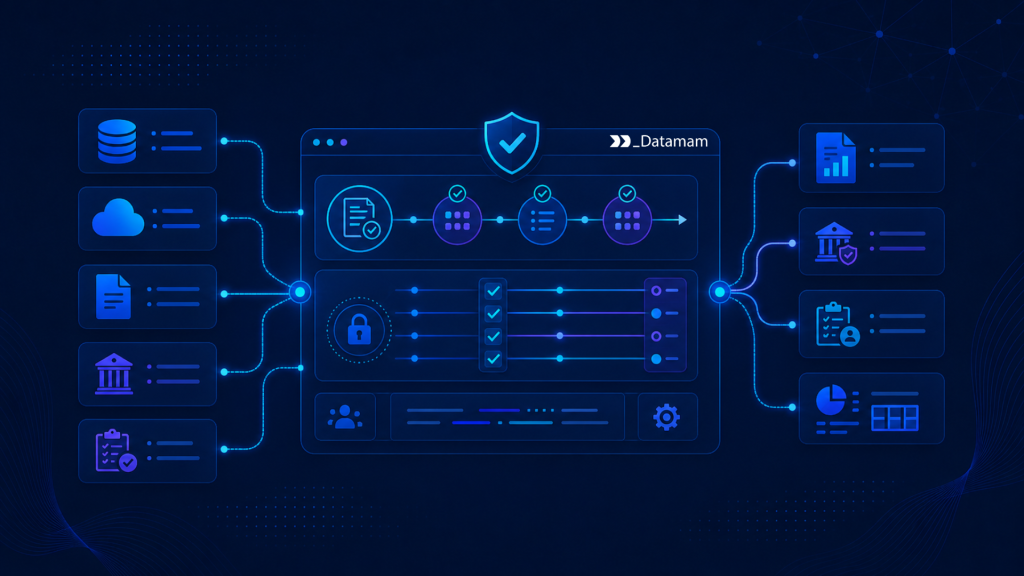
Compliance reporting depends on reliable data delivery across finance systems, ERP platforms, risk tools, audit systems, legal repositories, security platforms, policy management systems, vendor records, operational databases, and business intelligence environments. When compliance data delivery is inconsistent, teams face delayed evidence collection, incomplete regulatory reporting data, conflicting audit records, and manual reporting cycles that increase review risk. The issue is rarely the compliance report template alone. It is usually the delivery layer behind the reporting environment: source extraction, validation, lineage, refresh scheduling, access control, retention, and auditability. Compliance Data Delivery gives compliance, audit, legal, risk, finance, and operations teams a structured way to move regulated reporting data into controlled reporting workflows with accuracy, traceability, and governance.
The Reporting Gap Across Compliance Environments
Compliance reporting environments rarely depend on a single source system. Financial controls may rely on ERP data. Security reporting may rely on identity, access, vulnerability, and incident systems. Vendor compliance may rely on supplier records, contracts, due diligence files, and risk assessments. Operational compliance may rely on process logs, approvals, certifications, exceptions, and policy attestations.
This creates a reporting gap. Compliance teams may need to prove that a control was operating, that a policy was followed, or that a regulatory report was based on approved records. However, the supporting data may be spread across systems with different owners, formats, refresh cycles, and retention rules. NIST Cybersecurity Framework 2.0 is relevant because compliance reporting environments often depend on governance, asset visibility, monitoring, access control, and risk management across connected systems.
Why Compliance Reporting Data Becomes Fragmented
Compliance reporting data becomes fragmented because each function manages its own evidence. Finance may own journal approvals and reconciliation records. IT may own access logs and system change records. Procurement may own supplier due diligence and contract evidence. Legal may own policy documents, regulatory correspondence, and case files. Operations may own process exceptions and remediation evidence.
As these systems evolve separately, reporting context weakens. An access review may be completed on one platform but not linked to the employee record. A supplier certification may be uploaded but not reflected in risk reporting. A control exception may be resolved but not connected to audit evidence. Compliance Data Delivery reduces this fragmentation by creating controlled data movement into reporting layers.
Where Manual Compliance Reporting Breaks Down
Manual compliance reporting often depends on spreadsheets, screenshots, email requests, exported logs, shared folders, and analyst-owned trackers. These workflows may support occasional evidence collection, but they become fragile when reporting frequency increases or regulators, auditors, and executives require faster access to verified records.
Manual workflows also create repeatability risk. A screenshot may not show the full control history. A file may be renamed or overwritten. A report may be refreshed from the wrong period. A control owner may provide evidence after the review window closes. At scale, compliance reporting systems need repeatable delivery pipelines, not manual evidence assembly.
Compliance Data Delivery as an Operating Layer
Compliance Data Delivery becomes valuable when it operates as a controlled layer between source systems, evidence repositories, analytics platforms, and reporting workflows. The goal is not simply to move compliance records into dashboards. The goal is to deliver accurate, validated, permissioned, and traceable regulatory reporting data that can withstand internal review, audit inquiry, and governance scrutiny.
This operating layer should define which system owns each evidence record, how often data refreshes, which validation checks apply, which records require retention, and which teams can access sensitive compliance information. Without these controls, compliance reports may look complete while still lacking defensible evidence.
Defining Source Ownership Across Compliance Domains
Source ownership is the foundation of reliable compliance reporting. ERP may own financial approvals, journal entries, purchase orders, invoice records, and payment evidence. Identity systems may own access grants, role changes, termination status, and privileged access records. Risk systems may own control assessments, exceptions, remediation plans, and risk ratings. Legal systems may own policy approvals, regulatory submissions, and case documentation.
Clear ownership prevents disputes during audit review. For example, a compliance dashboard may show that a control is complete, but the source system should prove when it was completed, who approved it, and whether the underlying evidence changed later. The delivery layer should preserve this context before reports are published.
Creating a Common Compliance Evidence Model
A common compliance evidence model connects evidence ID, control ID, regulation or policy reference, source system, owner, reporting period, approval status, validation result, retention rule, and audit trail. This does not require every compliance system to store data identically. However, it does require consistent mapping before evidence is delivered into reporting systems.
For example, an access review report may need employee status, manager approval, system role, application ownership, review date, and exception resolution. A vendor compliance report may need supplier identity, contract status, certification status, risk rating, renewal date, and approval history. Compliance Data Delivery should preserve these relationships.
Connecting Audit Reporting Workflows to Decision Processes
Audit reporting workflows are valuable when they help teams identify control gaps earlier. Compliance leaders need to know which controls are complete, which evidence is missing, which owners are late, which exceptions remain open, and which regulatory deadlines are approaching.
In practice, audit reports should not rely only on static evidence folders. They should connect policy records, control tests, system logs, remediation tasks, ownership records, and approval history. This allows compliance and audit teams to see whether control activity is complete, current, and defensible.
Infrastructure Requirements for Regulatory Reporting Data
Regulatory reporting data depends on infrastructure that can collect, validate, transform, deliver, monitor, and govern evidence records across enterprise systems. The objective is not to create disconnected reporting extracts for each audit request. Teams need controlled delivery workflows that handle refresh dependencies, failed jobs, late-arriving evidence, source changes, schema changes, retention rules, and access restrictions.
Compliance data is sensitive because it can include financial controls, employee access, supplier risk, security incidents, legal matters, customer data, and regulatory submissions. ISO/IEC 27001 is relevant because compliance reporting environments require disciplined controls around access, confidentiality, auditability, monitoring, and risk treatment.
Continuous Delivery Across Risk, Audit, Finance, and Operational Systems
Compliance data may come from ERP, GRC platforms, audit tools, identity systems, ticketing platforms, contract systems, policy repositories, security tools, supplier systems, HRIS, and operational databases. Continuous delivery captures control evidence, access reviews, approvals, exceptions, remediation actions, policy attestations, vendor records, and reporting status.
Apache Airflow can orchestrate scheduled compliance reporting jobs, evidence refreshes, and exception alerts. Kafka can support event-driven delivery when control exceptions, access changes, remediation updates, or incident records need faster downstream visibility. Controlled delivery helps teams avoid stale evidence and delayed compliance reporting.
def route_compliance_record(event):

    if event["report_status"] == "validated":

        return {"action": "publish_to_audit_report", "control_id": event["control_id"]}

    if event["report_status"] == "failed":

        return {"action": "alert_compliance_owner", "control_id": event["control_id"]}

    return {"action": "hold_for_review", "control_id": event["control_id"]}


REQUIRED_COMPLIANCE_FIELDS = ["control_id", "evidence_id", "source_system", "report_status"]

def validate_compliance_record(record):

    missing = [field for field in REQUIRED_COMPLIANCE_FIELDS if not record.get(field)]

    if missing:

        return {"valid": False, "reason": "missing_fields", "fields": missing}

    if record["report_status"] == "validated" and not record.get("owner"):

        return {"valid": False, "reason": "control_owner_required"}

    return {"valid": True}


event = {

    "control_id": "CTRL-1042",

    "evidence_id": "EVD-78190",

    "source_system": "grc_platform",

    "report_status": "validated",

    "owner": "compliance_ops",

}

print(route_compliance_record(event))

print(validate_compliance_record(event))
This delivery logic keeps compliance reporting controlled before publication. Validated records can move into audit reports, failed refreshes can alert the compliance owner, and incomplete evidence can be blocked before it enters regulatory reporting data.
Normalizing Controls, Evidence, Owners, and Reporting Periods
Raw compliance data is rarely aligned across systems. One platform may identify controls by policy number, another by risk ID, another by audit test, and another by regulatory obligation. Owners may appear as names, emails, employee IDs, departments, or role groups. Reporting periods may differ by audit cycle, fiscal period, regulatory deadline, or control frequency.
Normalization aligns control IDs, evidence records, owners, departments, policy references, regulatory obligations, approval status, reporting period, remediation state, and audit references. Spark can process large evidence logs, access records, control results, and remediation datasets. dbt can manage repeatable transformation models for compliance reporting systems, exception tracking, audit readiness, and regulatory dashboards.
Validating Compliance Data Before Reporting Use
Validation controls prevent incomplete or unreliable records from entering compliance reports. These controls should check missing evidence IDs, duplicate control records, invalid reporting periods, unresolved exceptions, absent owners, incomplete approvals, expired certifications, unsupported policy references, and inconsistent remediation status.
Validation should occur before records are delivered into audit dashboards, regulatory submissions, evidence repositories, or executive compliance summaries. Data quality frameworks such as Great Expectations can support checks for completeness, uniqueness, accepted values, freshness, and cross-system consistency. Without validation, compliance reporting systems can create false assurance.
Technology Stack Behind Compliance Reporting Systems
Compliance reporting systems require a technology stack that supports scheduled pipelines, API delivery, event streams, evidence repositories, document metadata, validation checks, data warehouse tables, observability, and governance. The stack must support recurring control reporting, audit preparation, regulatory submissions, and operational exception monitoring.
A mature environment connects GRC platforms, ERP, IAM, ticketing systems, security tools, supplier systems, legal repositories, HR systems, and BI tools through governed workflows. It should reduce manual evidence work without weakening confidentiality, control ownership, or auditability. Data management solutions for retailers play a crucial role in optimizing inventory management and enhancing customer insights. These solutions enable seamless integration of sales data across multiple channels, providing retailers with real-time visibility. Additionally, they facilitate data-driven decision-making processes that can lead to improved operational efficiency and increased profitability.
Orchestration and Connectivity Using Airflow, Kafka, APIs, and Evidence Connectors
Compliance reporting workflows often use APIs for evidence extraction, control status updates, ticket retrieval, identity records, supplier documentation, and BI refresh triggers. Airflow can coordinate daily, weekly, monthly, or quarterly reporting schedules. Kafka can distribute exception events when near-real-time visibility is needed. Evidence connectors can deliver validated records into reporting systems and repositories.
The integration design should include retry logic, dependency checks, late-evidence handling, failure alerts, refresh monitoring, and access restrictions. These controls matter because compliance reports can fail quietly when upstream systems change, owners submit evidence late, or source jobs complete with missing records.
Processing and Transformation Through Spark, DBT, and Compliance ETL Pipelines
Processing layers convert raw control, evidence, audit, exception, and remediation records into structured compliance reporting datasets. Spark can process high-volume access logs, system events, ticket history, supplier records, and control test outputs. DBT can manage standardized models for control status, evidence completeness, remediation progress, audit scope, policy coverage, and regulatory reporting data.
Compliance ETL and ELT pipelines can normalize control IDs, map obligations, align reporting periods, classify exceptions, connect owners to departments, and calculate evidence completeness. This makes audit reporting workflows repeatable rather than dependent on manual file collection.
Storage, Analytics, and Governance in Snowflake, BigQuery, or Databricks
Snowflake, BigQuery, and Databricks can support integrated compliance reporting layers where compliance, audit, risk, finance, legal, and operations teams analyze control status, evidence completeness, exception trends, remediation progress, and regulatory reporting readiness.
Governance controls should include role-based access, audit logs, metadata catalogs, row-level security, data lineage, retention rules, legal hold support, evidence versioning, and report approval history. These controls matter because compliance reporting data affects regulatory confidence, audit outcomes, legal exposure, and executive risk visibility.
Commercial Impact of Compliance Data Delivery
The commercial value of Compliance Data Delivery appears when teams can trust the completeness, timing, and defensibility of compliance reporting data. Better delivery can reduce manual evidence collection, shorten audit preparation, improve control visibility, reduce reporting disputes, and support faster remediation. The result is not only cleaner reporting. It is a stronger compliance operating infrastructure.
For compliance leaders, audit teams, CFOs, CISOs, legal teams, and operations leaders, the practical value is confidence. Integrated compliance reporting data helps teams understand which controls are complete, which evidence is missing, which exceptions are overdue, and which regulatory obligations require attention.
Improving Audit Readiness and Evidence Availability
Audit readiness improves when evidence is collected, validated, and delivered on a predictable cadence. Teams can see whether control evidence exists, whether it is current, who owns it, and whether it passed validation before audit review begins.
This reduces last-minute evidence requests and improves audit response quality. Compliance teams can spend more time evaluating control performance and less time chasing documents.
Reducing Manual Compliance Reporting Burden
Compliance and audit teams often spend time exporting logs, collecting screenshots, matching evidence to controls, updating trackers, and preparing reports for auditors or regulators. This work is repetitive and creates dependency on individual control owners.
Compliance Data Delivery reduces that burden by automating refresh, validation, publication, and monitoring. Analysts can focus more on exception analysis, remediation quality, and regulatory interpretation rather than manual report preparation.
Supporting Faster Exception and Remediation Response
Compliance reporting becomes more useful when it connects exceptions to owners, deadlines, remediation tasks, and evidence updates. Teams can see which control failures are open, which are overdue, and which have been resolved but not yet validated.
This supports faster remediation. Risk and compliance teams can escalate unresolved issues earlier and give executives a clearer view of compliance posture.
Risk Exposure When Compliance Reporting Is Unreliable
Unreliable compliance reporting creates operational, regulatory, legal, and reputational risk. Teams may submit reports based on incomplete data. Auditors may challenge evidence quality. Control failures may remain hidden. Access violations may not be escalated. Regulatory deadlines may be missed because evidence was not delivered on time.
The risk increases as organizations add systems, jurisdictions, regulators, suppliers, controls, and reporting audiences. Manual evidence collection may work in smaller environments, but it becomes fragile when compliance reporting becomes enterprise-wide.
Missing Evidence and Audit Findings
Missing evidence can create audit findings even when the control activity occurred. If teams cannot prove that a review happened, who approved it, when it happened, and whether exceptions were resolved, the control may be judged ineffective.
Compliance Data Delivery should preserve evidence IDs, source timestamps, owner approvals, validation status, and retention records. This gives audit teams stronger proof and reduces preventable findings.
Regulatory Reporting Delays
Regulatory reporting delays often occur when evidence arrives late or must be reconciled across systems manually. A finance report may wait for ERP extracts. A security report may wait for access logs. A supplier compliance report may wait on certification records. These delays reduce response time and increase review pressure.
Structured delivery workflows reduce this risk by scheduling refreshes, monitoring failures, and routing missing records to owners before deadlines. Reliable enterprise data distribution solutions can further streamline the reporting process by ensuring timely access to critical data. By automating data transfers and improving accuracy, organizations can minimize the risk of delays. This proactive approach not only enhances compliance but also improves overall operational efficiency.
Governance Gaps in Compliance Reporting Data
Compliance reporting data can create governance issues if access rights, transformation logic, and report ownership are unclear. Reports may expose sensitive legal, financial, security, employee, or supplier information to unauthorized users. Evidence may be copied into uncontrolled folders or spreadsheets.
ISO 37301 is useful because compliance management systems require structured approaches to establishing, implementing, evaluating, maintaining, and improving compliance processes.
Governance Requirements for Compliance Reporting Environments
Compliance reporting environments must be governed because reporting data affects audit outcomes, regulatory obligations, legal exposure, risk posture, and executive accountability. Data may come from finance, security, identity, supplier, HR, legal, policy, and operational systems. Each source has different ownership, sensitivity, and retention requirements.
Governance should make compliance data easier to trust while protecting sensitive information. The goal is to give teams reliable reporting visibility without exposing confidential evidence or regulated data unnecessarily.
Source Documentation, Access Controls, and Audit Logs
Compliance datasets should document source system, control owner, refresh cadence, transformation logic, evidence type, retention rule, and known limitations. Access controls should restrict legal records, security findings, employee data, supplier risk evidence, financial controls, and regulatory submissions. Audit logs should record who changed, approved, exported, or refreshed compliance reports.
These controls help compliance, audit, legal, and risk teams demonstrate that reporting systems are based on approved and traceable workflows. Access control mechanisms in enterprises play a vital role in safeguarding sensitive information. By implementing strict protocols, organizations can ensure that only authorized personnel have access to critical data. This reduces the risk of unauthorized access and enhances overall data security compliance.
Data Lineage Across Controls, Evidence, and Reports
Data lineage allows teams to understand how compliance data moved from the source system to the report. Traceability should cover source extraction, evidence validation, control mapping, exception classification, remediation update, warehouse table, BI dataset, audit report, and regulatory submission.
Lineage also supports debugging. If control status changes unexpectedly, teams can determine whether the issue came from source data, late evidence, owner update, transformation logic, validation failure, or report refresh timing.
Multi-Region and Multi-Regulatory Reporting Considerations
Compliance Data Delivery becomes more complex across countries, legal entities, regulators, privacy rules, reporting calendars, and control frameworks. A control that supports one regulatory obligation may require different evidence, retention, or approval rules in another region.
Cross-regional controls should document regulatory scope, data storage location, access permissions, retention rules, legal hold requirements, reporting calendars, and permitted use. This reduces the risk that compliance reporting works technically but fails legally or operationally across jurisdictions.
Evaluating Compliance Data Delivery Readiness
Compliance Data Delivery becomes valuable when it supports repeatable reporting workflows, not simply when data appears in a compliance dashboard. Readiness depends on source ownership, control mapping, evidence definitions, refresh cadence, validation controls, governance, observability, retention rules, and report dependency mapping.
A readiness review helps identify where compliance reporting risk accumulates before it becomes audit findings, reporting delays, remediation gaps, or regulatory escalation.
How Teams Assess Compliance Data Quality
A structured assessment should evaluate missing evidence IDs, duplicate control records, unresolved exceptions, stale evidence, owner gaps, invalid reporting periods, incomplete approvals, expired certifications, failed refreshes, and inconsistent remediation status. It should also review source ownership, update cadence, validation coverage, access rights, exception volume, and lineage completeness.
For regulatory reporting data, quality must be evaluated operationally and evidentially. A report may look complete while still failing to support audit review because evidence lacks ownership, timestamp, approval, or retention context.
When Organizations Need a Compliance Delivery Architecture Review
A compliance delivery architecture review becomes useful when teams rely on manual evidence requests, disconnected compliance dashboards, inconsistent control reports, failed refreshes, or reports that do not reconcile with source systems. The review should assess source coverage, delivery workflows, transformation logic, validation controls, refresh cadence, storage architecture, lineage tracking, governance posture, retention design, and exception handling.
The output should clarify where compliance data risk accumulates, where compliance reporting systems may be incomplete, and which infrastructure improvements would make audit reporting workflows and regulatory reporting data more reliable for compliance, audit, legal, finance, and risk teams.
Conclusion: Compliance Data Delivery as Reporting Infrastructure
Compliance reporting depends on reliable data movement across finance, risk, audit, legal, security, supplier, HR, operational, and analytics systems. When delivery is inconsistent, teams spend excessive time chasing evidence, reconciling reports, explaining control gaps, and preparing for audits under pressure. Compliance Data Delivery creates the governed foundation needed to coordinate regulatory reporting data across the full compliance lifecycle.
Ultimately, organizations that treat compliance delivery as reporting infrastructure, not just dashboard connectivity, will be better positioned to improve compliance reporting systems, strengthen audit reporting workflows, reduce manual evidence collection, and build more reliable regulatory reporting data across enterprise governance operations.