
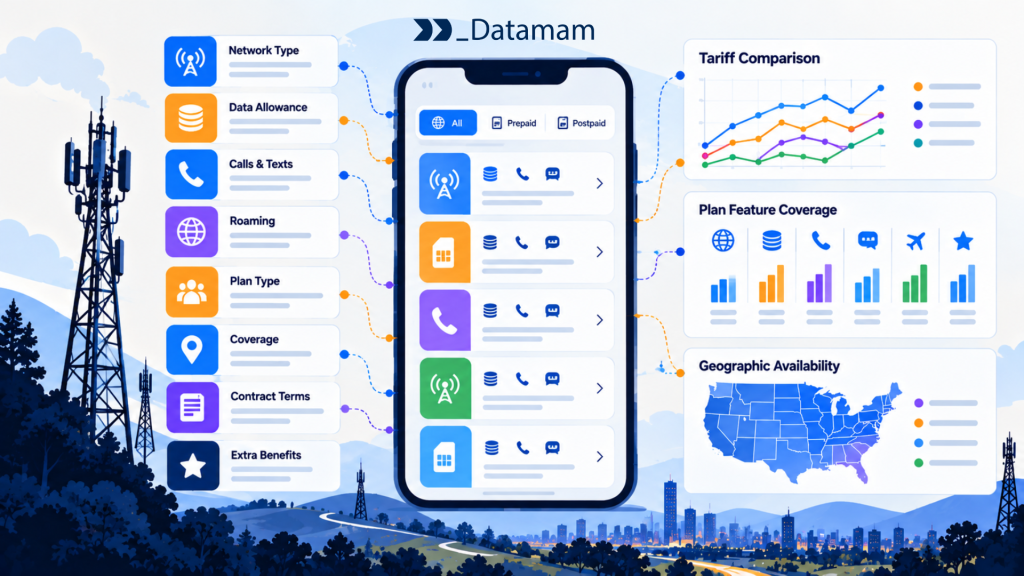
Mobile tariff benchmarking compares wireless plans under consistent assumptions about cost, service, eligibility, and usage. A reliable benchmark does not simply rank advertised monthly prices. It identifies who can buy each offer, which services are included, what restrictions apply, and how much a customer would spend over a defined period.
For US operators and telecom analysts, the key challenge is comparability. A four-line postpaid promotion, a single-line prepaid plan, and a low-cost MVNO offer can all appeal to different customers, but their advertised prices do not describe equivalent products. A defensible benchmark separates these cases rather than placing them in one misleading league table.
Key Takeaways
• Compare offers for the same number of lines, customer eligibility, observation date, and evaluation period.
• Record high-speed allowances, prioritization, hotspot access, and speed restrictions separately from the word “unlimited.”
• Keep service charges separate from device financing, credits, trade-in value, and one-time switching incentives.
• Evaluate prepaid and postpaid plans under explicit payment, renewal, credit, and cancellation assumptions.
• Maintain both a standard-price scenario and a promotion-qualified scenario; do not quietly assume every customer qualifies.
• Use ITU price baskets for standardized cross-country comparisons, not as substitutes for US household-level tariff analysis.
• Flag non-comparable offers rather than forcing an unsupported numerical ranking.
Why the Cheapest Mobile Plan Is Not Always the Best-Value Plan
The cheapest advertised mobile plan is not necessarily the best value because price does not measure the same service across carriers. A lower-cost plan can include a smaller high-speed data allowance, reduced mobile hotspot access, lower priority during congestion, fewer international benefits, or stronger eligibility conditions. A higher-priced plan may still be unnecessary for a low-usage customer, so “best value” must always be defined for a specific use case.
For example, a traveler who frequently uses international roaming and a family buying four lines should not be evaluated against the same reference scenario. Benchmarking begins with a customer profile: number of lines, monthly usage, network requirements, travel behavior, device requirements, and realistic payment preferences. Only then should analysts calculate a normalized cost. T-Mobile’s published network-management practices, for example, explain that prioritization differs by plan and brand and may affect user experience during congestion (https://www.t-mobile.com/home-internet/policies/internet-service/network-management-practices.html).
Eight Variables That Determine Mobile Tariff Comparability
The following eight variables help determine whether two mobile plans can fairly be placed in the same comparison group. Each should be stored as a separate field with a source date and evidence of the underlying plan conditions.
Monthly recurring cost and line count
Mobile prices must be compared at the same line count. A per-line rate for four lines should not be treated as the price of a standalone subscription. Capture the total household charge, number of eligible lines, marginal price of each extra line, and discounts that depend on simultaneous activation or a specific account configuration.
The benchmark should display both total account cost and price per line. The latter is a derived metric, not a replacement for the total cost a household must actually pay. When a carrier advertises a four-line offer, record that qualifying scenario explicitly rather than assuming it is available for one or two lines.
Data allowance and speed restrictions
Two plans described as unlimited may offer materially different experiences. Record any premium or high-priority data allowance, usage-triggered deprioritization, hard speed cap, mobile hotspot allowance, video optimization, and post-threshold behavior. Distinguish fixed speed reductions from potential congestion-related deprioritization, which may not affect every subscriber in every location.
A benchmark should not infer an exact network speed from marketing labels. Provider terms describe conditions; independent network measurements address observed performance. Treat them as different sources of evidence, and document when a specific restriction applies only to a device category or a particular plan variant.
Prepaid versus postpaid structure
Prepaid plans generally require payment before service periods, while postpaid plans are billed under the provider’s account and payment arrangement. But the meaningful comparison is not the label alone. Analysts should document renewal price, taxes, activation fees, credit-check conditions where relevant, automatic-renewal assumptions, cancellation flexibility, and whether the advertised deal requires multiple months paid in advance.
If an annual prepaid plan costs less only when a customer commits upfront, report the effective monthly amount alongside the actual required payment. An operator evaluating customer acquisition should also distinguish first-time promotional prepaid pricing from the rate at renewal.
Network access and coverage conditions
Network access includes the host network, supported technologies, available coverage, and applicable traffic-management rules. A retail brand using another company’s infrastructure is not automatically identical to that network owner’s premium plans. Distinguish the branded offer, its underlying network where disclosed, and any plan-level restrictions on priority, roaming, hotspot, or 5G access.
Use geographic coverage models only to check claimed service reach, not to declare a network winner. The FCC National Broadband Map represents modeled mobile broadband availability rather than a direct measure of subscriber experience (https://help.bdc.fcc.gov/hc/en-us/articles/13532984820379-What-s-on-the-National-Broadband-Map).
Roaming and international allowances
International roaming can change the effective value of a plan for frequent travelers. Capture included destination countries, voice and text conditions, high-speed data allotments, throttled-speed policies, pay-per-use rates after allowances, and whether benefits apply only to certain lines or devices.
Domestic roaming should also be distinguished from international travel. A carrier may describe broad national service through agreements or network access rules that are not identical across plan tiers. For a US-only benchmarking exercise, international benefits should remain an optional weighted dimension instead of artificially inflating the score for customers who never travel.
Device financing and trade-in credits
Service price and handset economics should be analyzed separately before being combined into a household cost scenario. A device financing offer may involve monthly installments, trade-in eligibility, and bill credits spread over a fixed term. Those credits may stop if the user cancels, changes to an ineligible plan, or pays the device balance early.
Verizon’s published device-deal guidance describes these conditions and the potential loss of future promotional credits (https://www.verizon.com/support/device-deals-faqs/). Do not subtract the full advertised trade-in value from the first month’s service price. Model its credit schedule, remaining device obligation, and realistic retention horizon instead.
Taxes, fees, and automatic-payment discounts
Benchmark the actual payable price under a stated jurisdiction and payment scenario. Taxes, government-imposed charges, carrier surcharges, activation fees, and optional services may vary, and some headline prices assume an eligible Auto Pay or paper-free billing arrangement.
The conditions matter: Verizon’s published Auto Pay guidance distinguishes eligible plans and payment methods (https://www.verizon.com/support/auto-pay-faqs/). Record both the undiscounted standard price and the qualified price when a discount is conditional. If a local tax cannot be determined, label the calculation as before-tax rather than presenting it as an exact household bill.
Bundle requirements and promotional duration
A discounted wireless plan may require home internet, another service, a new customer account, a minimum number of lines, or a limited promotion window. Preserve these conditions as structured fields. A bundled price should not be compared directly with standalone service unless the cost and value of the mandatory bundle components are incorporated.
Promotional duration is particularly important. An introductory discount lasting six months and another lasting 24 months do not create the same economic proposition. Distinguish permanent list-price changes from temporary incentives and record both the initial and post-promotion rates. For offer-event monitoring, see [INTERNAL LINK -> Blog 07 | telecom promotion monitoring | anchor: telecom promotion monitoring].
How to Normalize Carrier Pricing
Carrier pricing normalization translates different offer structures into a consistent calculation without stripping away important conditions. The objective is not to force every plan into one score; it is to compare defined customer scenarios and show which offers are eligible, economically comparable, or excluded.
Comparing one-line and family-plan economics
Define a separate benchmark cohort for one, two, three, and four lines when those customer types matter. For each cohort, calculate the total eligible account price, then show the effective per-line price as an additional metric. Do not extrapolate a four-line promotional rate to an unsupported five-line or single-line scenario.
A family comparison also needs to handle shared versus per-line allowances, mixed plan tiers, and household-specific discounts. If a carrier requires all lines to use the same tier while another allows a mixture, report the difference rather than forcing a fictitious equivalent configuration. This protects procurement and pricing teams from recommendations built on eligibility assumptions.
Computing total costs over a consistent period
A normalized 12-month calculation is the sum of all scheduled monthly service charges, required one-time charges, and applicable device obligations, minus only discounts that the defined customer scenario actually qualifies to receive. Use 24 or 36 months where handset credits or promotion duration make a longer horizon relevant.
Consider two illustrative, invented service-only offers, excluding taxes and device costs. Offer A is $35 per month for six months and $55 for the next six months, costing $540 in year one. Offer B is $47 per month throughout, costing $564. Offer A wins on 12-month cost, but its second-year cost is $660 versus $564 for Offer B. The ranking reverses when the evaluation period changes.
| Illustrative plan | First six months | Next six months | 12-month total | Months 13–24 |
| A, promotional | $35/month | $55/month | $540 | $660 |
| B, stable rate | $47/month | $47/month | $564 | $564 |
Handling unlimited plans with different fair-use policies
“Unlimited” should be retained as the provider’s marketing label, while the benchmark stores specific operational conditions in separate columns. Relevant fields include priority data threshold, hotspot cap, post-threshold speed, video policy, and whether the stated limitation applies at all times or only during congestion.
For business comparisons, create a limited set of usage profiles, such as light on-device use, heavy streaming, and significant tethering. A plan may be suitable for one profile and not another. Assigning one universal unlimited-plan score would conceal these differences, especially when provider terms change across versions or customer categories.
Benchmarking Major Carriers and MVNOs
A valid comparison includes both major network operators and mobile virtual network operators (MVNOs), but distinguishes retail competition from underlying network ownership. This allows pricing teams to assess what customers can buy without overstating how many independent infrastructure networks serve a location.
Distinguishing retail brands from underlying networks
Record at least three identities where the source permits: the retail brand selling the plan, its corporate owner, and the host or facilities-based network used to provide access. They are not always the same. A brand can change ownership or network arrangement while retaining the same public-facing name.
Host-network attribution may be conditional, undisclosed, or dependent on geography, device compatibility, and agreement terms. Mark uncertain relationships rather than resolving them by guesswork. For the broader brand and host-network landscape, see [INTERNAL LINK -> Blog 16 | MVNO market analysis | anchor: MVNO market analysis].
When lower prices reflect different service conditions
A lower MVNO price can reflect a leaner support model, different roaming rights, reduced bundled benefits, prepayment, or a plan-specific priority arrangement. It may also reflect a genuinely attractive proposition for the relevant user. The benchmark should identify what differs, not assume that a lower retail price means poor service or that access to a host network guarantees identical performance.
Report differences through a compact conditions matrix. If a required feature is unconfirmed, leave that feature unknown and prevent the plan from receiving an unsupported ‘equivalent’ designation. This is more informative than a generic cheapest-to-most-expensive ranking.
US Versus International Mobile Tariff Methodologies
US plan-level benchmarks and international tariff comparisons use different denominators and assumptions. A US pricing team commonly needs exact plan eligibility and household economics; cross-country researchers need standardized baskets that sacrifice some product specificity for comparability.
When ITU price baskets are appropriate
The International Telecommunication Union (ITU) price baskets are appropriate for standardized affordability comparisons across countries. The revised methodology used from the 2025 collection includes data-only mobile broadband and defined mobile data-and-voice baskets; it is not intended to identify the cheapest plan for every US family profile (https://www.itu.int/en/ITU-D/Statistics/Pages/ICTprices/default.aspx).
ITU publishes prices in US dollars, purchasing-power-parity-adjusted international dollars, and as a share of gross national income per capita. Researchers should use the documented basket definition and collection year and avoid treating it as a comprehensive census of all local plans (https://datahub.itu.int/about/).
Why international affordability comparisons require separate assumptions
A USD-converted price describes different purchasing conditions across countries. Affordability analysis may require purchasing power parity, income-based denominators, tax treatment, and comparable minimum service requirements. Market structure and currency timing can change the result even when the advertised prices appear similar.
ITU’s basket methodology has been revised, so historical time series also need attention to definition changes. A cross-country table should state the basket, reporting year, currency basis, and source coverage. It should not merge country-level basket prices with US promotional family pricing and imply that they measure the same product.
Building a Mobile Tariff Benchmarking Dashboard
A useful mobile tariff benchmarking dashboard separates product attributes, eligibility, normalized cost, and source confidence. Users should be able to filter a defined cohort and trace every comparison back to the published offer conditions and observation date.
Required data fields and refresh frequency
Minimum fields include brand, corporate owner, host network if known, plan identifier, line count, contract type, recurring price, taxes and fees status, one-time charges, data and hotspot conditions, promotion conditions, qualified payment method, device terms, geography, collection timestamp, and source URL. Store raw terms alongside standardized values.
Refresh high-priority plan catalogs and promotions as frequently as commercial decision needs justify; weekly monitoring may be sufficient for some base tariffs, while short-lived campaigns may need daily checks. Always distinguish source publication dates from collection dates. Archive prior plan versions so reviewers can explain a score change.
Flags for non-comparable offers
Use explicit flags such as ‘four-line price only,’ ‘device required,’ ‘new-customer only,’ ‘unknown tax treatment,’ ‘premium data not comparable,’ ‘bundle required,’ and ‘promotional rate expires.’ An exclusion should be visible, reversible, and documented. Unknown information should not be interpreted as a positive feature or a zero cost.
For large source portfolios, teams may use official structured feeds where available or commission managed collection and normalization. Datamam’s custom external-data infrastructure is relevant when plan terms must be captured repeatedly across many heterogeneous websites; a packaged data source is simpler if it already supplies the necessary coverage and rights. The benchmark succeeds when a buyer can reproduce the comparison and see exactly why one plan is suitable for a specific customer profile, not merely which offer has the smallest headline price.