
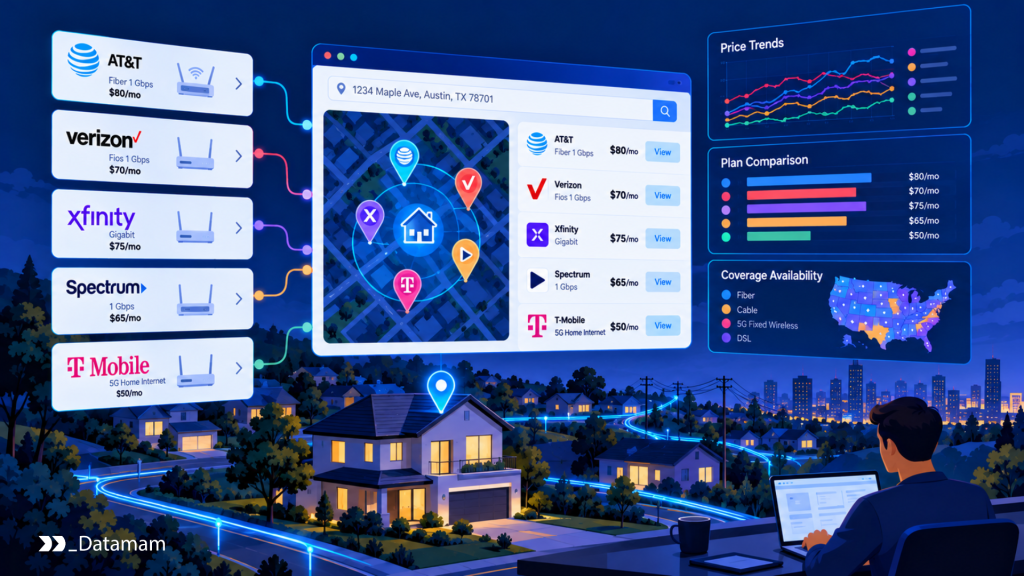
Broadband price monitoring is the recurring observation of internet service providers’ retail offers, including which plans are available at a specific address, what customers pay initially and later, and the conditions attached to each price. It gives pricing, product, and strategy teams a comparable history of competing offers rather than a collection of promotional headlines.
A nationwide advertised rate is rarely enough to establish the price a household can actually obtain. Availability, discounts, equipment, installation, contract conditions, and the end of introductory periods may vary by location and customer type. Effective monitoring therefore links each price to a provider, plan, location, eligibility scenario, and observation date. The result is a decision-ready view of broadband competitor pricing, not merely a list of rates.
Key Takeaways
• Broadband price monitoring should use address-plan observations, not assume that a price advertised nationally is available throughout a provider’s footprint.
• A comparison is meaningful only when recurring charges, promotional duration, standard rates, fees, service characteristics, and eligibility conditions are retained together.
• Twelve- and twenty-four-month cost calculations often reveal a different ranking than introductory advertised prices.
• FCC broadband consumer labels provide useful plan disclosures, but the National Broadband Map is an availability source, not a retail-pricing database.
• A missing quote, a confirmed ineligible address, and a failed collection are three different data states and must not be combined.
• Reliable alerts compare like-for-like offers, preserve source evidence, and distinguish true price changes from bundle or website-layout changes.
• The best commercial measure is whether the pricing evidence improves a decision, not how many plan cards a monitoring system collects.
Why Broadband Price Comparisons Often Misrepresent the Market
Broadband prices are conditional offers rather than universal product tags. A rate shown on a landing page may apply only to new customers, particular addresses, a limited promotion, or a specified billing arrangement. Without those conditions, different observers can report different prices for the same provider and both appear correct. For the broader analytical context, see [INTERNAL LINK -> Blog 01 | telecommunications market intelligence | suggested anchor: telecommunications market intelligence].
Advertised prices versus effective customer costs
An advertised monthly rate is the amount featured in marketing; effective customer cost is what a defined eligible customer would pay across a chosen period, given all disclosed mandatory charges and applicable discounts. The two may diverge substantially when an introductory rate expires or equipment, installation, and billing conditions are added.
Consider a plan advertised at $45 per month for twelve months. If the standard rate becomes $75 and a $10 monthly equipment charge applies throughout, the first-year recurring cost is $660 and the second-year cost is $1,020, before any taxes or one-time fees. Reporting the plan simply as a “$45 broadband service” would conceal most of the two-year obligation.
The FCC broadband consumer-label framework addresses categories including monthly prices, introductory periods, additional charges, typical speeds, and data allowances. The exact label and disclosures should be checked at the point of sale. Detailed automated acquisition methods belong in [INTERNAL LINK -> Blog 04 | web scraping in telecommunications | suggested anchor: telecom website monitoring]. Source: https://docs.fcc.gov/public/attachments/DA-24-459A1_Rcd.pdf
An analyst should define whether the comparison includes taxes, refundable deposits, optional add-ons, discounts requiring autopay, and early termination assumptions. If an amount cannot be verified for the chosen address, label it unknown rather than silently treating it as zero.
Why the same provider can quote different offers by address
One internet service provider can publish different plans or prices for addresses only a short distance apart. Network technology, competitive conditions, buildings, marketing regions, and qualification rules may all influence what appears in a location-specific checkout or availability tool.
A provider might advertise a fiber plan in one neighborhood while offering cable or fixed wireless at another. Even where the technology and marketed plan name match, the introductory rate or availability of a particular promotion may differ. An address-based price dataset should therefore store the exact location context or an authorized location identifier, the eligibility response, and the evidence used for the quote. The distinction between reported availability and retail eligibility is examined in [INTERNAL LINK -> Blog 08 | broadband availability data | suggested anchor: broadband availability data].
The FCC National Broadband Map can help identify providers reporting service at a location and their reported technologies and maximum advertised speeds. It does not supply the complete set of address-specific retail prices. Source: https://help.bdc.fcc.gov/hc/en-us/articles/10467446103579-How-to-Use-the-FCC-s-National-Broadband-Map
ZIP-code-only comparisons are convenient for broad screening but should not be presented as proof that a plan is purchasable at every address within that ZIP code.
Which Broadband Price Fields Should Be Captured?
A useful broadband rate comparison dataset must record the commercial offer and the evidence supporting it. At minimum, it needs plan identity, geographic eligibility, monthly and one-time charges, service specifications, conditions, and timestamps. Historical monitoring should also preserve the original observed representation so revised rules can be applied later.
Monthly recurring charges and promotional periods
Separate the introductory monthly price from the standard monthly price, and record when each applies. The recurring-charge record should also describe whether the price depends on autopay, paperless billing, mobile-service bundling, a contract, or new-customer status.
For every offer, capture the promotional duration in months, any stated price-guarantee period, the post-promotion amount, and the date a particular quote was observed. A “two-year price lock” is not the same as a two-year contract, and an autopay discount may require a specific payment method. A discount with unverified eligibility should never be assumed in the base comparison.
Where operators display broadband labels, use them as one source of plan terms and cross-check them against the retail journey. In August 2026, the FCC published changes involving separate machine-readable label files and other disclosure rules, but implementation of amendments to 47 CFR 8.1(a) was delayed pending a later effective-date notice. Data programs should not presume those requirements were already removed. Source: https://www.govinfo.gov/content/pkg/FR-2026-08-13/html/2026-16503.htm
Equipment fees, installation, and contract terms
Capture both recurring and one-time costs because they affect different customer horizons. Equipment rental, a mandatory gateway, installation, activation, shipping, and technician charges may be presented separately, waived temporarily, or included in the quoted plan.
Contract terms matter even when the rate looks attractive. A commitment period and an early termination fee influence the cost of switching; a price guarantee alone does not necessarily impose a minimum service term. For competitive benchmarking, compare a standardized assumption such as a full 12-month or 24-month tenure, then run a separate switching scenario if cancellation terms are material.
Keep optional services distinct. Do not add a consumer’s discretionary mesh Wi-Fi subscription or premium support package to every competing plan unless the comparison specifically concerns those configurations. Conversely, avoid excluding equipment charges that are necessary to receive the advertised service under the chosen scenario.
Speed tiers, data allowances, and bundles
A broadband plan is not a comparable unit if its technical and service characteristics are ignored. Record advertised download and upload rates separately, access technology, included data allowance, potential overage charges or throttling conditions, and relevant installation restrictions.
A 300 Mbps cable plan and a 1 Gbps fiber plan may both satisfy one household’s requirements but are not identical products. Price comparisons should show their service differences instead of automatically declaring the cheaper plan the better value. Advertised speeds also differ from independently measured performance.
For bundles, distinguish standalone internet pricing from internet plus mobile, television, or voice. Record the incremental broadband price, the total bundle price where applicable, required companion services, and discount eligibility. An operator’s bundled offer may be commercially powerful, but it cannot be compared fairly with another provider’s standalone plan without a stated scenario.
| Field group | Minimum example fields | Key validation question |
| Identity | Provider, brand, plan ID, product version | Is this the same offer as previously observed? |
| Location | Address sample ID, region, service response | Was this plan available for the tested location? |
| Price | Introductory rate, standard rate, monthly fees | Which amounts are mandatory, and when? |
| Conditions | Promotion term, autopay, contract, new-customer status | Who qualifies for the displayed price? |
| One-time cost | Installation, activation, equipment purchase | Which charges apply at signup? |
| Product | Technology, download/upload Mbps, data policy | Are the offers functionally comparable? |
| Evidence | Source URL, observed timestamp, effective date, capture ID | Can an analyst reproduce the conclusion? |
How to Compare Broadband Plans Fairly
Fair comparisons start with an explicit customer scenario and time horizon, then normalize costs under the same assumptions. Every published ranking should show the conditions used, because changing the address, contract length, or eligibility can change the result.
Calculating first-year and second-year costs
A practical calculation is: Total cost over N months = sum of each month’s eligible recurring charges + applicable one-time fees + modeled usage charges. Report the first 12 months, the next 12 months, and the combined 24-month total separately. Include taxes only when they are known for the geographic and customer scenario; otherwise disclose the exclusion.
The table illustrates two invented offers for one hypothetical serviceable address. It is a methodological example, not observed operator pricing. Plan A costs $45 per month for a year, then $75, with a $10 monthly equipment fee. Plan B is $65 per month for both years, with equipment included and a one-time $50 installation charge.
| Illustrative offer | Advertised price | First 12 months | Months 13-24 | 24-month total |
| Plan A | $45/mo introductory | $660 | $1,020 | $1,680 |
| Plan B | $65/mo standard | $830 | $780 | $1,610 |
Although Plan A advertises the lower monthly rate, Plan B costs $70 less over two years on these assumptions. Analysts should publish the assumptions alongside the calculation, particularly when variable taxes, optional charges, or uncertain future prices are excluded. For plans with month-to-month price changes, a monthly cash-flow schedule is safer than a single multiplied average.
Comparing price per speed tier
Price per unit of advertised bandwidth can be useful as a descriptive benchmark, but it should not be treated as a universal measure of value. The simplest ratio, monthly recurring price divided by advertised download Mbps, can make a high-speed plan appear inexpensive even when the customer has no need for that capacity.
Group plans into comparable speed classes and report upload capability, technology, latency expectations where disclosed, and data restrictions. For example, a symmetrical fiber offer may be commercially different from a cable offer with the same download tier but substantially lower upload capacity.
Comparisons should also identify the point in time: price per Mbps in the first promotional month may differ from the same metric after the promotion. A useful dashboard permits analysts to switch between introductory, standardized first-year, and second-year costs without changing the underlying records.
Handling fiber, cable, and fixed wireless offers
Fiber, cable, and fixed wireless access should be compared on a common customer outcome, not assumed to provide interchangeable experiences. A fair pricing table can include all three, but it should retain technology as a visible dimension and flag differences in availability, upload speeds, data policies, installation, and service conditions.
Fixed wireless eligibility may depend on local network capacity or address checks. Fiber availability may differ between adjacent buildings or units. Cable offers may be accompanied by distinct equipment and promotional conditions. None of these differences means one technology is categorically better or cheaper in every location.
For portfolio decisions, produce two views: a cross-technology comparison showing all realistic alternatives and a like-for-like comparison within the same service class. The first reflects customer choice; the second isolates competitive pricing pressure.
How Address-Level ISP Price Monitoring Works
Address-level ISP price monitoring samples a defined set of locations, records each provider’s eligible retail response, and repeats the observations according to the required cadence. Its quality depends more on deliberate geographic sampling and accurate outcome classification than on the raw number of pages collected.
Selecting representative serviceable locations
Choose sample addresses to reflect the markets the business is actually evaluating. Useful strata include urban versus rural locations, neighborhoods with different competitors, apartment buildings versus detached homes, and boundaries between service footprints. A small, well-designed panel often supports clearer interpretation than a large collection of unbalanced addresses.
Define the population being studied before sampling. If the goal is a metropolitan pricing index, estimate the relevant housing or address distribution and document how sampled locations represent it. If the goal is competitor response in a particular expansion corridor, intentionally oversampling contested locations may be appropriate, but do not generalize that result to the whole state.
Use permitted sources and location data, minimize personally identifying information, and preserve the sample design. Review changes in the sample over time, since newly added addresses should not be mistaken for price movements at the original locations.
Recording address-specific eligibility
An eligibility result should be an explicit data field, separate from any price returned. A provider may report an address as serviceable, require a manual inquiry, offer a different technology, or reject the address for the selected plan. Each outcome changes which prices belong in the comparison.
Record the query context: normalized address or approved location key, service unit where necessary, existing versus new customer assumption, selected products, observation time, and any publicly shown conditions. An address-level rate is not valid evidence for another location simply because the two have the same ZIP code.
FCC availability data can help build a preliminary candidate list, but its service availability filings are distinct from a live retail quote. A provider’s online eligibility tool is another observation, not independent proof that installation will succeed. When conflicting results affect an investment decision, a verified sales or engineering inquiry may be necessary.
Separating unavailable plans from missing observations
A missing price must never automatically mean that a service or plan is unavailable. At least four statuses are useful: available with quoted price, explicitly unavailable, eligibility unresolved, and collection failed or not attempted.
Suppose an address displayed three offers yesterday and no offers today because the operator’s website timed out. Recording a disappearance would create a false competitor withdrawal. Instead, keep the previous observation, mark today’s attempt as failed, and retry under the permitted collection process.
If a provider explicitly reports that a plan cannot serve the location, store that negative observation with its own timestamp. Negative evidence can later support footprint-change analysis, but it should be interpreted within the limitations of the retail channel. Unknown is a legitimate analytical category; replacing it with zero or no service produces misleading market statistics.
What Broadband Price Histories Reveal
A broadband price history preserves successive, comparable observations so teams can distinguish temporary offers from persistent strategy. Historical data is especially valuable when operators change product names, bundle requirements, or eligibility rules without changing their homepage headline.
Regional price movements and competitor responses
Regional histories reveal whether a tariff change occurs broadly or only in selected competitive markets. An ISP may keep one advertised national message while changing address-level prices, credits, or installation waivers in particular neighborhoods.
To analyze this properly, create a stable panel of addresses and normalize plans into comparable service classes. Calculate price changes for the same offer and same address first. Then aggregate by market, technology, or competitor density using documented weights. Avoid inferring a statewide price movement from a handful of newly sampled high-competition locations.
When operators appear to respond to each other, the timing can support a hypothesis about competitive pressure. It is not proof of causation. Internal campaign schedules, seasonal marketing, network rollouts, and changing eligibility can create similar patterns. Keep the chronology and the alternative explanations visible.
Identifying price increases after promotional periods
A post-promotion increase is a scheduled step in an offer’s price path, not necessarily an unexpected new price change. Histories must therefore distinguish a newly revised standard rate from the previously disclosed expiration of a discount.
Two useful measures are the intro-to-standard uplift for each plan and the total 24-month cost for the chosen customer scenario. Tracking both prevents a low introductory number from masking a higher ongoing commitment. For a portfolio, analysts can monitor how often offers rely on large initial discounts and whether competitors change the standard rate while retaining an unchanged promotional headline.
Discontinued plans also require careful treatment. New-customer market monitoring records what prospective subscribers can buy today; it does not establish what existing customers currently pay. Historic offers may remain relevant to churn risk but should be kept separate from live acquisition pricing.
Designing Reliable Price Change Alerts
A useful alert system identifies changes that could justify commercial action, verifies them, and sends each finding to a named owner. Alert volume should be controlled through comparable plan matching, evidence checks, and materiality thresholds selected by the business.
Identifying material changes rather than website noise
An alert should trigger on a meaningful change in the customer offer, not a cosmetic revision to a page. Separate promotional-event logic is covered in [INTERNAL LINK -> Blog 07 | telecom promotion monitoring | suggested anchor: telecom promotion monitoring]. Useful event types include a verified recurring-price change, new or expired promotion, updated post-promotion rate, meaningful fee modification, added or withdrawn address eligibility, or changed service conditions.
Thresholds may combine absolute and relative amounts, for example an internally defined dollar or percentage shift in first-year cost. These thresholds are operational choices, not industry standards. Require a valid before-and-after observation for the same address, eligibility scenario, and equivalent product; confirm high-impact changes with a second observation or another reliable source where possible.
Alerts should include the old and new values, calculated effect on standardized cost, affected geography, confidence level, original source, and observation dates. A screenshot or source snapshot helps reviewers distinguish extraction defects from genuine movement.
Avoiding false alerts caused by changing bundles
Bundles, discounts, and product names can change while the underlying broadband cost remains broadly similar. An offer that adds a mobile-line requirement may appear cheaper, but it is no longer equivalent to standalone broadband. Likewise, a new plan ID may simply represent a renamed service tier.
Maintain stable provider and service-class identifiers alongside the source’s raw plan names. When eligibility or bundle requirements change, create a conditions-changed event instead of automatically claiming a pure price decrease. For multi-line or multi-product incentives, compare a defined household scenario that consistently includes the companion services.
Separating price, product, and eligibility events allows pricing analysts to prioritize genuine competitive threats. It also makes the monitoring history auditable when a source’s website structure or labeling practices change.
How Pricing Teams Can Use Broadband Monitoring Data
Pricing teams can use broadband price monitoring to compare the customer proposition at contested addresses, identify where competitors have a sustained cost advantage, and decide whether a response should involve price, packaging, sales messaging, or service differentiation. A useful dashboard should display offer economics and evidence, not just rankings.
For a regional ISP, the operating workflow might begin with a stable panel of serviceable locations. Each week, the team reviews material changes in comparable first-year and second-year costs, checks whether the affected locations overlap its footprint, and examines how those changes relate to customer acquisition or retention trends. A promotion launched in an irrelevant market would receive less priority than a persistent effective-price change in a high-churn service area.
A practical decision record should state the monitored competitor, eligible locations, affected service class, change in normalized cost, evidence confidence, proposed action, and follow-up date. Performance can then be evaluated using measures such as alert precision, review time, coverage of priority markets, and whether the resulting decisions met their objectives. A price cut should not automatically be credited with improving acquisition without additional evidence.
Collection technology should match the source mix. Official downloads and authorized APIs are usually simpler when they supply the required data. For heterogeneous operator websites, customized monitoring may be useful when it can maintain address-specific extraction, normalization, validation, and delivery. Datamam offers customized web data acquisition and structuring services for such requirements; the appropriate choice depends on scope, source permissions, refresh expectations, and the internal team’s maintenance capacity. Source: https://datamam.com/web-scraping-services/
Ultimately, broadband price monitoring works when every headline price can be traced to a comparable plan, an eligible address, a defined time horizon, and sufficient evidence. That discipline turns internet plan price tracking into a repeatable commercial decision process rather than an unreliable collection of promotional numbers.