
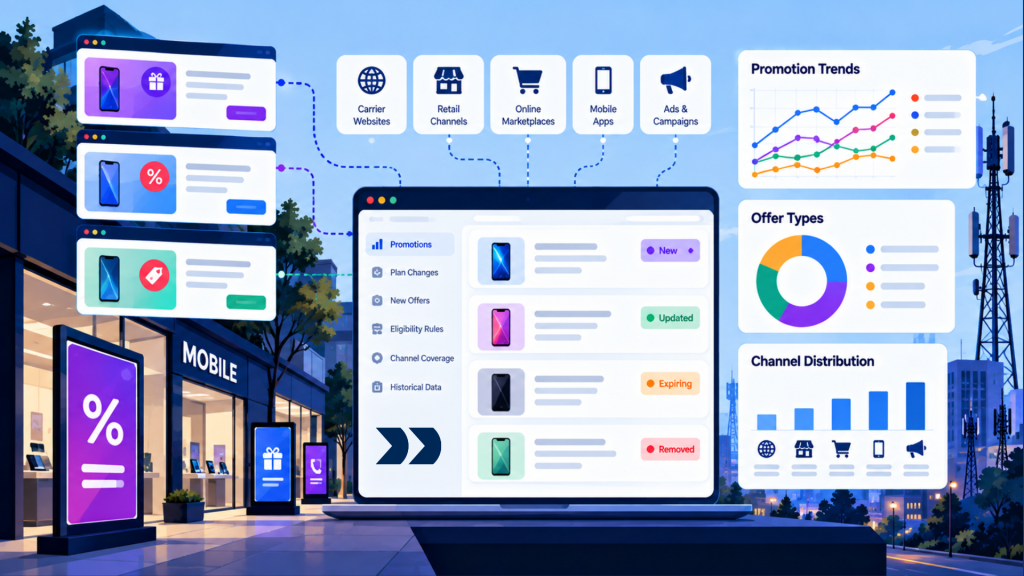
Telecom promotion monitoring is the systematic observation of carrier offers, eligibility rules, benefit values, and expiration conditions across websites and sales channels. Unlike a basic price tracker, it follows the complete customer incentive: what is promised, who qualifies, when the value is delivered, and which changes cause it to disappear.
The distinction matters to mobile operators, broadband providers, and competitive-intelligence teams. A rival may advertise a ‘free’ handset, a switching credit, or discounted home internet without reducing the underlying tariff. A system that records only the headline will misstate both the consumer proposition and the competitor’s likely acquisition strategy. Useful monitoring requires a time-stamped, terms-aware record of each offer.
Key Takeaways
• Treat promotions as distinct commercial events, not automatically as permanent tariff reductions.
• Record benefit type, total value, delivery schedule, qualifying plan, customer status, device conditions, and expiration date.
• Device trade-in credits spread over many billing cycles are not equivalent to immediate cash discounts.
• Compare promotions using a defined customer scenario and time horizon rather than relying on the largest advertised incentive.
• Monitor landing pages, plan details, terms, and relevant channel differences because eligibility can change without a new headline.
• Preserve prior versions and source evidence to distinguish genuine changes from temporary collection errors.
• Send decision-ready alerts only when the change is material, verified, and relevant to the operator’s competitive footprint.
Why Promotions Need Their Own Monitoring System
Promotions require dedicated monitoring because their conditions, value delivery, and expiry can change independently of standard service prices. A broadband or mobile tariff may stay constant while an operator adds a handset trade-in offer, a prepaid activation discount, a limited-time bundle, or a bill credit for switching.
Promotions versus permanent price changes
A promotion is a conditional or time-limited incentive; a permanent price change alters the underlying standard price of a service. Monitoring software should store these as different event types. An operator advertising ‘$15 off for six months’ has not necessarily reduced its published monthly rate by $15 for all customers.
Capture both the undiscounted reference price and the qualified promotional price, with dates and conditions. This allows analysts to compare strategies without confusing acquisition incentives with ongoing revenue expectations. For a complete standardized tariff comparison, see [INTERNAL LINK -> Blog 06 | mobile tariff benchmarking | anchor: mobile tariff benchmarking].
Why discount amount alone is an unreliable comparison
The advertised discount is not a reliable measure of customer value because promotions differ in eligibility, payment timing, contract obligations, and total commitment. A $600 device credit paid over 36 months is not economically identical to $600 received immediately. The former depends on staying eligible for the full term.
An offer described as ‘up to $800’ may require a particular trade-in model and service tier. Record the minimum and maximum observed values only if the conditions behind those figures are known. A meaningful comparison evaluates the benefit for a specific eligible customer and highlights what changes if that customer exits early.
Types of Carrier Promotions to Track
Telecom promotion tracking should use a consistent classification system so that offers from different carriers and channels can be compared without collapsing unlike incentives into a single discount field.
Device trade-in credits and installment discounts
Device incentives may provide a reduced up-front handset price, monthly installment credits, trade-in allowances, or combinations of these. Record original device price, installment duration, credit amount per billing cycle, eligible trade-in models, device-condition rules, and plan requirements. Distinguish a trade-in credit tied to a service commitment from ordinary device resale value.
Verizon explains that device promotion credits can stop when a customer cancels, changes to a nonqualifying plan, upgrades early, or pays off the device agreement early (https://www.verizon.com/support/device-deals-faqs/). Such restrictions belong in the data record because they affect realized rather than advertised savings.
Switching incentives and bill credits
Switching incentives can include a one-time service credit, reimbursement of eligible termination costs, waived activation charges, or credits distributed across several bills. Each has different economic value and eligibility. A reimbursement that requires proof of a prior carrier balance is not the same as an unconditional signup payment.
Record whether the incentive requires number transfer, port-in from an eligible competitor, new-line activation, an eligible device, or submission of a claim within a deadline. Store the time between qualification and payout when the source states it. Distinguish a benefit available to any new customer from a targeted competitor-switching offer.
Multi-line, broadband, and entertainment bundles
Bundles may reduce a wireless bill only when a household maintains multiple lines, broadband, or a subscription to another product. Monitoring should capture all mandatory components and the allocated discount, not just the cheaper wireless line displayed on a marketing card.
For instance, a home-internet discount available only with an eligible mobile account cannot fairly be compared with standalone broadband unless analysts account for the extra service. Entertainment benefits may be valuable for some segments but should not be assigned their retail sticker price as guaranteed customer savings. Separate the cost of mandatory products from optional add-on benefits.
How to Record Promotion Eligibility Correctly
Eligibility is the core of telecom offer intelligence. A promotion record without qualification rules is incomplete even when the headline amount is accurate. The minimum unit should be an offer version tied to a target customer scenario, eligible geography, and observed source.
New versus existing customer requirements
Classify promotions by customer lifecycle: new-to-brand, adding a line, porting a number, upgrading an existing line, returning customer, or targeted retention offer. A ‘new line’ condition should not be interpreted as ‘new customer’ unless the offer states so. Existing customers may receive a similar-looking discount under different rules.
If a website requires account authentication to show loyalty offers, mark those offers as account-specific rather than inferring that the public catalog is complete. Separate observed public eligibility from speculative customer-service exceptions. Without this distinction, competitor monitoring tends to overestimate the reach of high-value promotions.
Geographic, plan, and device conditions
Promotions may depend on ZIP code, address, network availability, selected rate plan, financing approval, device model, or device condition. Normalize locations and product names while retaining exact terms. A discount available only with a premium mobile tier should not be attributed to the carrier’s entry-level plan.
Where eligibility depends on a device being returned, store deadlines and evidence requirements. When source copy changes between a general landing page and fine print, preserve both observations rather than silently choosing one. Such discrepancies should be queued for review before the promotion is treated as confirmed.
Payment timing, credits, and early termination
Time is an essential promotion field. Record whether value arrives at checkout, on the next invoice, as a rebate after verification, or through recurring credits over 24 or 36 months. Capture minimum commitment, forfeited future credits, remaining financing balance, and any disclosed clawback condition. These are distinct legal and commercial mechanisms.
Verizon’s support materials describe credits that may take one or two billing periods to appear and that may cease when terms are no longer met (https://www.verizon.com/support/device-deals-faqs/). For monitoring, the correct value is a schedule of possible realized benefits, not merely an advertised lump sum.
| Promotion type | Required fields | Typical comparison error |
| Monthly device credit | Credit/month, months, eligible device, plan, cancellation rules | Counting full credit as cash now |
| Switching reimbursement | Qualifying carrier, evidence, maximum amount, claim deadline | Assuming every switcher receives maximum |
| Multi-line discount | Eligible line counts, account total, promotion window | Applying four-line price to one line |
| Broadband bundle | Required services, locations, discount allocation | Comparing bundle with standalone plan |
Monitoring Promotion Launches, Modifications, and Expirations
A trustworthy promotion history shows what changed and when, rather than storing only the offer currently visible on a website. It separates newly launched campaigns from a revision to an existing campaign and from an expired or withdrawn offer.
Establishing a historical offer record
Assign each promotion a stable internal identity plus versioned observations. Preserve the carrier, brand, channel, campaign title, eligible plans, benefit schedule, source URL, collection time, effective dates where published, and original terms. A source snapshot or archived quotation of non-protected factual conditions can help reviewers reconstruct past decisions.
When a carrier renames a campaign, determine whether the eligibility and economics remain the same. Do not create a new ‘launch’ merely because the page layout or campaign banner changed. Historical records make it possible to measure promotion duration, recurrence, geographic scope, and competitor reaction without counting duplicates.
Detecting changes in terms, not just headline prices
Change detection should compare structured fields, including eligibility, term length, available devices, credit timing, and qualifying plans. A promotion may retain the ‘up to $1,000’ headline while excluding an older trade-in model or changing the required unlimited tier. That is commercially meaningful even when its marketing title is unchanged.
A reliable pipeline compares before-and-after values and checks whether the updated terms can be reproduced. Avoid promoting a change into a confirmed business event when it might be caused by missing page elements, personalization, or failed extraction. Store a confidence label and conduct targeted verification for material changes.
Measuring Promotional Intensity Across Competitors
Promotional intensity describes how actively a carrier is using incentives in a defined market and segment. It is more informative than simply counting visible banners because repeated or narrowly targeted campaigns can distort the comparison.
Effective incentive value and promotion frequency
Use standardized scenarios to estimate conditional value. An illustrative offer that pays $10 per month for 24 months has a nominal maximum of $240 if the customer remains eligible throughout. A competitor offering a $100 one-time credit may deliver less nominal total value but more immediately. The comparison needs both benefit timing and customer constraints.
Frequency metrics can include verified launches per month, average visible duration, share of monitored plans with an active offer, and changes in the eligible customer base. These are monitoring metrics, not proof of marketing spend or campaign effectiveness. Preserve a consistent set of observed sources to reduce measurement bias.
Comparing promotional strategies by customer segment
Segment promotions by prepaid and postpaid, single-line and family, existing and new customer, device upgrade and bring-your-own-device, and broadband-only versus converged households. A carrier that concentrates credits on premium-plan trade-ins may be pursuing a different acquisition mix from one offering inexpensive prepaid service.
These patterns can support hypotheses about targeting, but public offers alone cannot establish internal strategy, margins, or actual conversion performance. Report a clear distinction between ‘observed targeted offer’ and ‘analyst inference about intent.’ Validate important hypotheses with operator disclosures or other supporting evidence before communicating them as conclusions.
Turning Promotion Changes Into Commercial Alerts
The final purpose of telecom promotional benchmarking is to notify teams when a verified competitor change may justify commercial review. A high-volume alert feed that nobody trusts has limited value, even if its underlying extraction process is technically sophisticated.
Which changes require pricing-team attention?
Pricing teams should receive alerts when changes materially affect a relevant customer segment, geography, or normalized total cost. Examples include the launch of a new-market switching incentive, a substantial increase in credit value for a contested device category, or a previously broad promotion becoming restricted to premium service plans.
An alert should state what changed, which customers qualify, how the economics compare over the selected period, how strong the evidence is, and which actions might be considered. Geographic overlap with the operator’s actual footprint helps prioritize events rather than treating every national marketing update as urgent.
How to reduce false-positive alerts
False positives arise from page redesigns, rotating banners, personalized offers, incomplete captures, duplicate plan names, and changes that apply to a different customer cohort. Limit them through stable offer identities, normalized fields, repeat observations, comparison of official terms, and thresholds chosen by the commercial team.
Record three separate outcomes: confirmed commercial change, source or extraction change, and unresolved discrepancy. Review alert precision periodically and tune the rules based on decisions made, not raw event counts. Where multiple public carrier sites must be tracked, a managed external-data pipeline such as Datamam’s may support consistent collection and validation; existing authorized feeds are preferable when they already supply complete terms and history. The monitoring system is successful when it delivers fewer, better-supported decisions rather than merely more alerts.