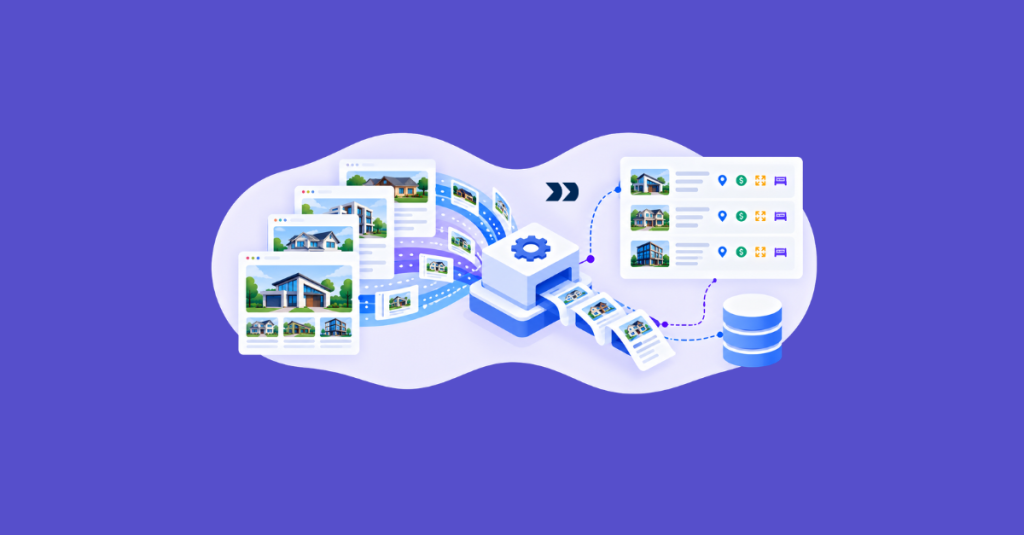

Web scraping in telecommunications is the automated extraction of information published on operator, retailer, regulator, and related websites. It helps telecom teams monitor publicly advertised broadband and mobile plans, promotions, service availability, retail locations, and product changes across competitors and regions. Its value depends less on how many pages a scraper visits than on whether the extracted records are comparable, traceable, legally appropriate, and current enough to support decisions.
A regional internet provider may need to compare hundreds of address-specific offers. A mobile strategy team may need to notice when rivals change data allowances or device credits. Manual reviews can identify examples, but they do not produce dependable historical monitoring at that scale. A well-designed collection process preserves each source, observation date, geographic condition, and relevant offer term, then feeds validated changes into the organization’s analytics workflow.
Key Takeaways
• Telecom website scraping is most useful for frequently changing commercial information that public regulatory datasets do not provide at the required detail or cadence.
• An advertised price is not a comparable price until promotional periods, fees, eligibility, speed, and bundles are recorded alongside it.
• Address-level availability checks reflect a website’s retail response at an observed time; they are not substitutes for official availability data or network-performance measurements.
• Reliable monitoring stores original evidence, distinguishes a genuine change from an extraction failure, and maintains historical versions of offers.
• Website terms, access restrictions, copyright, privacy, and intended reuse require source-specific review; public visibility is not blanket authorization.
• APIs and authorized structured downloads are preferable when they satisfy the data need; custom managed collection becomes relevant when sources and maintenance requirements are unusually fragmented.
Where Web Scraping Fits Into Telecommunications Intelligence
Telecom web scraping is one acquisition method inside a broader market-intelligence system. It is especially suited to observable changes in consumer-facing and business-facing websites, but it cannot replace every regulatory, licensed, or measured source. Teams should select sources according to the question: what service is advertised, where it is offered, what it costs, and what changed since the last observation.
Public website data versus regulatory and licensed datasets
Website data describes the content an operator or distributor publishes to prospective customers. That can include retail plan cards, promotion terms, eligibility responses, service directories, and launch announcements. These observations establish what a source displayed at a particular time, not necessarily what every customer can buy or what a network can technically deliver.
Regulatory datasets follow a different model. For example, the FCC National Broadband Map shows provider-reported fixed availability at serviceable locations and modeled mobile coverage. The FCC explicitly says the map measures availability, not adoption, affordability, or actual network performance (https://help.bdc.fcc.gov/hc/en-us/articles/10476040597787-How-to-Submit-an-Availability-Challenge). A commercial site may list an address-specific introductory deal that never appears in such records.
Licensed research and commercial APIs can add historical coverage, proprietary mappings, or specialist measurements, subject to their rights and definitions. The strongest intelligence systems preserve the distinctions between an observed webpage claim, a regulatory filing, and an independently measured result rather than merging them into an apparently equivalent fact.
When automated collection offers a meaningful advantage
Automated collection is valuable when relevant information changes frequently, exists across many sites or local markets, and must be compared consistently over time. Consider a pricing analyst tracking competing broadband plans across selected ZIP codes. Periodic visits might identify a new discount, but they may miss when that discount started, whether it was geographically limited, and when it ended.
A controlled monitoring workflow can capture comparable fields on a schedule, retain prior observations, and flag changes that meet an agreed materiality threshold. However, scraping is not justified merely because a page can be fetched. A stable CSV download or authorized API may be cheaper, more accurate, and easier to govern. Before building a collector, define the required fields, geography, update interval, permitted usage, and downstream decision. [INTERNAL LINK -> Blog 01 | telecommunications market intelligence | suggested anchor: telecommunications market intelligence framework]
Seven Categories of Telecom Website Data Worth Monitoring
The most useful categories depend on whether the buyer is investigating acquisition, retention, expansion, or competitor positioning. Each category should have a separate schema: a mobile promotion, a broadband address check, and a retail location are not interchangeable observations.
Broadband and mobile service pricing
Operator plan catalogs can reveal listed monthly prices, data allowances, advertised speeds, contract periods, line-count discounts, and included services. These fields support competitor positioning analysis only when a comparison is like for like. A fixed broadband offer for a new customer at one address should not be placed beside an existing-customer renewal price for a different market as though they describe the same proposition.
Capture the displayed currency, tax treatment where stated, activation or equipment charges, promotional period, standard rate, and any condition required to receive the price. Preserve a source snapshot or documented evidence reference. For recurring monitoring, keep the offer’s first-seen and last-seen dates separate from its stated validity dates. More detailed cost normalization belongs in [INTERNAL LINK -> Blog 05 | broadband price monitoring | suggested anchor: broadband price monitoring methodology].
Carrier promotions and device offers
Mobile and broadband carriers use promotions to influence switching, upgrades, and customer acquisition. A landing page may advertise a free device, but the underlying mechanism could be installment credits conditional on a qualifying plan, trade-in, or continued service. Recording only the headline incentive would make the promotion appear more generous and less restrictive than it is.
A useful record includes the eligible device or service, required plan, new-versus-existing-customer status, number of billing credits, trade-in condition, expiration date if stated, and termination consequences. Analysts should monitor changes to terms as carefully as changes to advertised discounts. For strategic comparisons, distinguish a permanent tariff change from a temporary acquisition offer. [INTERNAL LINK -> Blog 07 | telecom promotion monitoring | suggested anchor: carrier promotion monitoring]
Service availability and address-level offers
Some provider websites allow visitors to enter an address and see whether the provider offers service or which plans can be purchased at that location. Where testing is permitted, a defined sample of representative addresses can help reveal regional offer variation and changes in the retail proposition. The sample should be designed rather than collected opportunistically.
An eligibility response is evidence of the site’s response at the time of observation, not proof of installed capacity or a completed order. A timeout, failed validation, or inconclusive response must be classified as unknown, not unavailable. The FCC describes separate official location-level broadband availability records and data downloads, which can serve as complementary context (https://help.bdc.fcc.gov/hc/en-us/articles/10467446103579-How-to-Use-the-FCC-s-National-Broadband-Map). Avoid submitting sensitive real household information or violating a site’s access rules to perform checks.
Retail locations and service directories
Store locators, dealer directories, installation-partner pages, and service-contact listings can show where a telecom brand maintains a commercial presence. Relevant fields include store name, address, geographic coordinates when published, channel type, opening status, and a last-observed date. The same location may appear under a corporate store, authorized retailer, and brand alias, so entity resolution is essential.
A newly listed shop is a useful distribution signal, but it is not proof of an increase in network coverage or sales. Likewise, a disappeared directory listing may indicate a site redesign, duplicate removal, or business closure. Confirm material events against a second source where practical. These records are most helpful when connected to existing market geographies and competitor entities, not when treated as an unfiltered list of addresses.
Product launches and public network announcements
Operator newsrooms, product pages, investor updates, and regional announcements provide evidence of new packages, partnerships, fiber initiatives, enterprise services, and network plans. A change detector can identify when an operator publishes a new service category or begins marketing it in a named location before the next quarterly reporting cycle.
The key is to preserve the status of the claim. An announced rollout, construction project, completed deployment, and purchasable service are different stages. Label each observation as announced, planned, marketed, or independently confirmed, with dates and geographic scope. Do not infer subscriber additions or operational coverage from a press release alone. This classification helps business teams evaluate competitor behavior without promoting an announcement into an unverified market fact.
Customer feedback and published reviews
Publicly accessible reviews and feedback pages may show recurring issues such as installation delays, billing confusion, service disruptions, coverage complaints, or poor support. Structured issue tagging is often more informative than a single positive-or-negative sentiment score. For example, dissatisfaction with a device-trade-in credit is not the same product problem as low broadband throughput.
Use only feedback that can be collected and processed under applicable terms and privacy rules. Where personal data is not essential to the research question, avoid capturing usernames, contact information, and other identifying details. Review platforms differ in user population and incentives, so complaint frequency must not be interpreted as a representative customer incidence rate. Findings should prompt investigation, not automatically determine an operator ranking. [INTERNAL LINK -> Blog 22 | telecom customer sentiment analysis | suggested anchor: telecom customer sentiment analysis]
Regulatory notices and public disclosures
Regulator websites, public consultation pages, operator disclosures, and official notice feeds may publish changes affecting licenses, pricing rules, consumer disclosure obligations, or proposed transactions. These can be monitored alongside operator announcements to identify developments relevant to a geographic or service segment.
For regulatory information, the authoritative document and effective date matter more than the earliest scraped headline. The FCC’s 2026 broadband-label order, published in the Federal Register on August 13, 2026, revised certain presentation and machine-readable requirements; its rule text specifies an effective date of September 14, 2026, except a designated amendment subject to a delayed effective date. Monitoring teams should verify the provision applicable to their collection method rather than assuming every announced change took effect immediately (https://www.govinfo.gov/content/pkg/FR-2026-08-13/html/2026-16503.htm). Regulatory monitoring is a complement to legal review, not a substitute for it.
Designing a Reliable Telecom Data Collection Pipeline
A successful telecom collection pipeline produces a durable, interpretable record, not merely a successful HTTP response. It should be able to answer which public source was observed, what field was extracted, how the value was normalized, and whether the observation passed validation. Reliability also requires a way to detect upstream website changes before false findings reach an analyst.
Source discovery and geographic coverage planning
Start with an inventory of sources matched to use cases: mobile price cards, broadband eligibility pages, promotion terms, store directories, and official publications. For each source record the operator or brand, available markets, access conditions, permitted use, relevant pages or feeds, and likely change frequency. Avoid treating national homepages as proof of complete local-market coverage.
For location-dependent research, design a geographic sample that reflects intended markets: urban, suburban, rural, technology-specific, and economically relevant service areas. Define an approved method for using representative locations and document known sampling limitations. Keep a source-rights register, since a technical ability to access a page is not a license to collect and repurpose everything on it. A small, verified pilot should precede broad deployment.
Structured extraction and field-level validation
A useful telecom offer schema separates price, plan, location, eligibility, promotion, and evidence attributes. For example, `operator_id`, `retail_brand`, `offer_id`, `location_scope`, `service_type`, `download_mbps`, `monthly_price`, `currency`, `promotion_end`, `qualifying_conditions`, `observed_at`, and `source_url` serve different analytical purposes. Where a source does not supply a value, preserve null rather than inventing a default.
Validation should test data types, accepted currencies, positive speeds, plausible price changes, mandatory conditions, and stable entity identifiers. A price change of several orders of magnitude may reflect a parsing error, a change from monthly to annual units, or a genuine product rewrite; it warrants review before an alert is issued. The table below gives a practical starting point.
| Field group | Example fields | Validation question |
| Identity | Operator, retail brand, offer ID | Is this the same entity and plan as before? |
| Geography | Market, address sample, ZIP or region | Where was the offer actually observed? |
| Commercial terms | Price, fees, duration, discount | Are recurring and introductory prices distinct? |
| Service features | Technology, speed, data allowance | Do units and restrictions match the source? |
| Provenance | Source URL, observed date, evidence ID | Can an analyst reproduce the observation? |
Change detection, historical snapshots, and refresh scheduling
Monitoring needs an immutable observation history. Capture each meaningful source version, use stable identifiers, and compare normalized fields rather than raw page markup alone. Navigation changes, banner rotation, and tracking parameters can alter HTML without changing a customer’s offer. Conversely, a small eligibility sentence may materially change what a quoted price means.
Schedule updates according to the signal and business need. Short promotions may justify daily observation where allowed; stable store listings and policy pages may warrant less frequent checks. Introduce error budgets, collection-health checks, and alert thresholds. Distinguish `not observed`, `temporarily inaccessible`, `discontinued`, and `confirmed changed`. Preserve both the webpage observation time and the business-effective date when stated. This reduces false positives and improves historical comparisons.
[Suggested image: compact flow diagram from public telecom page to extraction, normalized offer record, validation, historical store, and change alert. Alt text: “Telecom website monitoring pipeline with source evidence, field normalization, validation, and change detection.”]
Why Telecom Website Data Is Difficult to Standardize
The central challenge in telecommunications data scraping is meaning, not format conversion. Two sites may use identical words for different commercial conditions, while the same operator may describe equivalent products differently across markets. Normalization requires business rules, transparent exceptions, and a controlled approach to uncertainty.
Regional offers and eligibility conditions
Regional prices can depend on postal code, exact address, serviceable technology, new-customer status, household eligibility, sales channel, or an existing bundle. A collector that records only the operator and monthly price can accidentally compare offers that are not available to the same audience. Keep the geographic scope and eligibility status as first-class attributes.
For address-specific checks, capture the complete request context where permissible without retaining unnecessary personal information. If the response says that service must be confirmed by a representative, classify it as conditional. Do not infer universal availability from one positive address or infer universal absence from one negative response. Compare geographic observations only across compatible source methods and collection periods.
Plan naming, product bundles, and device financing
Plan names are unstable identifiers. A carrier may rename an existing plan, keep a name while changing its features, or sell the same plan with multiple promotional terms. Bundled broadband, mobile, television, and streaming products further complicate simple price-to-price comparisons. Store a product identity separately from each publicly observed offer version.
Mobile device incentives add payment mechanics. An advertised zero-cost phone may require installment financing and monthly credits that stop when a customer cancels service. A market-intelligence record should retain the effective customer commitment and credit conditions rather than converting every headline into a one-time cash discount. Offer matching should use combined evidence from feature sets, eligibility conditions, and source history, with uncertain matches marked for review.
Missing, inconsistent, or changing information
A field may disappear because the operator changed its template, moved terms to another page, restricted access, or stopped publishing the information. That does not automatically mean the underlying commercial feature ended. Reliable systems treat extraction completeness and market availability as separate outcomes.
Maintain quality indicators at field and source level, including `observed`, `missing`, `ambiguous`, `collection_failed`, and `source_changed`. Where data conflicts, retain the original observations and investigate the explanation. For example, an annual-price display should not silently overwrite a monthly recurring price. These safeguards allow analysts to report uncertainty honestly and prevent a broken parser from becoming a false competitor-intelligence event.
Legal and Operational Considerations
Publicly visible information is not automatically free of contractual, copyright, privacy, or operational constraints. Appropriate collection depends on the source, jurisdiction, access method, data category, and intended use. A scalable program should review these matters before collecting and again when a source’s terms change.
Source terms, access restrictions, and permitted usage
Review a website’s terms, published usage policies, robots directives, technical restrictions, and any offered licensed access channel. A robots.txt file can communicate crawling preferences but is not itself a comprehensive license or a substitute for legal analysis. Google’s documentation explains that robots rules regulate crawler access behavior and are not a security control (https://developers.google.com/crawling/docs/robots-txt/robots-txt-spec).
Set conservative request rates, respect permitted access boundaries, avoid interfering with source services, and maintain logs demonstrating the collection scope. Do not use account impersonation, unauthorized access, or technical workarounds to retrieve restricted material. Where an operator provides an official API or a direct download with acceptable terms, evaluate it first. The appropriate collection method may vary by jurisdiction and the user’s contractual rights.
Privacy, intellectual property, and commercial reuse
Telecom data programs may encounter customer names, comments, addresses, or other information that can identify individuals. Even when text is publicly visible, its collection and further processing may trigger data-protection obligations. Minimize personal data, define retention rules, protect access, and separate consumer feedback analysis from unnecessary identity profiling. California privacy law guidance is available from the California Attorney General (https://oag.ca.gov/privacy/ccpa); European personal-data rules are explained by the European Commission (https://commission.europa.eu/law/law-topic/data-protection/data-protection-eu_en).
Copyright, database rights in some jurisdictions, website contracts, and content redistribution terms also require review. Internal analysis and resale of source content are not necessarily covered by the same rights. Record what data was acquired, its source terms, allowed transformations, and downstream usage restrictions. Have legal counsel assess uncertain cases rather than assuming the accessibility of a webpage resolves ownership or reuse questions.
When an API or licensed source is preferable
An API or licensed dataset is preferable when it provides sufficiently complete fields, geographic coverage, acceptable refresh frequency, usable rights, and predictable operational performance. Official source channels can reduce parser maintenance and often make schema changes easier to manage, although their coverage and terms still need validation.
Custom scraping is more defensible when essential public commercial signals are distributed across multiple websites, the available APIs omit required conditions, or a buyer needs recurring source-specific monitoring. The choice should be determined by measurable fit and total operating cost rather than a blanket preference for scraping. Where multiple methods are used, preserve provenance so an analyst can tell which values came from the provider’s structured feed, its website, or a third-party dataset. [INTERNAL LINK -> Blog 21 | telecom data licensing | suggested anchor: telecom data licensing considerations]
Build Internally or Use Managed Telecom Data Collection?
The build-versus-buy decision depends on the expected lifecycle of monitoring, not simply the initial cost of a scraper. A prototype for a few stable pages may be straightforward to maintain internally. A recurring multi-operator system with geographic sampling, validation, changing layouts, and service-level reporting creates continuing responsibilities that should be costed explicitly.
Maintenance, monitoring, and data quality responsibilities
An internal team needs owners for source review, collector health, schema evolution, access compliance, geographic and entity matching, incident response, and historical data quality. It also needs an escalation path when a site changes its terms or begins presenting incomplete responses. Without those controls, collection may continue technically while the resulting market indicators deteriorate.
Evaluate the system through observable measures: percentage of required sources covered, valid-observation rate, field completeness, source-to-delivery latency, analyst-reviewed change accuracy, and time to repair a broken collector. Data volume alone is a poor performance metric. The biggest operational risk is often silent failure, when a pipeline delivers plausible-looking data that no longer represents the website accurately.
Selecting a delivery model for enterprise teams
For small or stable research programs, a permitted API, a structured download, or a narrowly scoped internal collector may be the most efficient option. Managed collection becomes more relevant when many named sources require different parsing logic, local-market coverage, recurring quality assurance, integration with enterprise systems, and an accountable maintenance process.
Datamam offers customized public web-data acquisition and structured delivery designed around client-specific collection and integration requirements (https://datamam.com/web-scraping-services/). For telecom buyers, the relevant question is whether the required sources, fields, frequency, data rights, quality rules, and delivery method fit that managed model. A prospective engagement should begin with a representative source sample and measurable acceptance criteria, not an assumption that every website can or should be scraped.
The useful output is a dependable external-data feed: an operator and offer inventory, dated observations, documented limitations, validated changes, and delivery into pricing, market research, or strategy workflows. When those foundations exist, telecom website monitoring can support decisions without confusing website claims with confirmed coverage, subscriber behavior, or network performance.