Key Takeaways
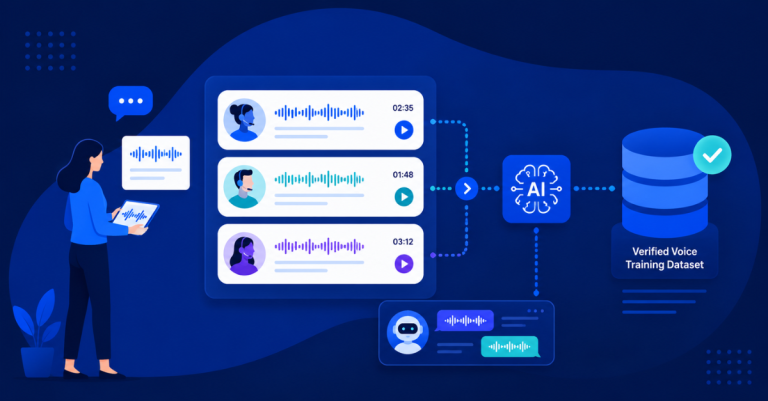
- How Voice AI Training Data improves speech recognition, intent detection, call routing, and agent-assist workflows
- Why speech training data must reflect accents, languages, background noise, call quality, customer emotion, and contact center terminology
- How audio data annotation supports intent classification, sentiment detection, entity extraction, compliance monitoring, and escalation prediction
- Why call center AI systems require governance, auditability, data lineage, privacy controls, and secure handling of customer audio
- How structured voice data pipelines reduce annotation rework, improve automation reliability, and support scalable contact center AI deployment
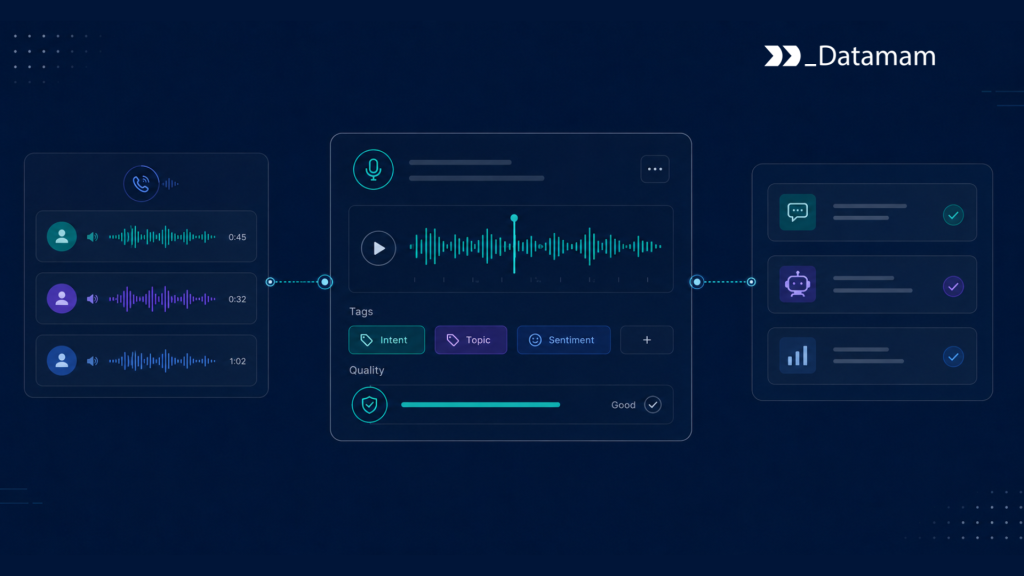
Contact center automation depends on voice AI systems that can understand real customer speech, route intent accurately, support agents in real time, and resolve routine issues without damaging customer experience. However, call recordings, transcripts, IVR logs, and agent notes do not become reliable AI inputs automatically. Voice AI Training Data must be collected, labeled, validated, versioned, and governed so models can handle accents, interruptions, noise, emotion, domain-specific language, compliance language, and escalation scenarios across real customer conversations.
The Training Data Gap in Contact Center Automation
Contact centers are high-variation speech environments. Customers call from cars, offices, homes, noisy public spaces, poor mobile connections, or international numbers. They speak with different accents, emotional states, levels of urgency, vocabulary, and expectations. A voice AI system trained on clean or narrow audio may perform well in testing but fail when deployed across real support queues. McKinsey’s 2025 analysis of AI in customer care highlights how AI is changing customer care operations, but the effectiveness of that transformation depends heavily on operational readiness and trustworthy deployment.
Voice AI Training Data is the foundation behind that readiness. It determines whether automated systems can understand customers accurately, detect intent, summarize calls, guide agents, and escalate sensitive cases at the right time.
Why Contact Center AI Depends on Voice AI Training Data
Call center AI systems learn from examples of real conversations. If the training data underrepresents certain accents, languages, product categories, complaint types, call quality conditions, or emotional states, the system may misinterpret customers in production. This can lead to poor routing, failed self-service, inaccurate transcription, weak summaries, or missed compliance issues.
Voice AI Training Data must therefore represent the customer environment where automation will operate. A billing automation model needs different examples from a technical support assistant. A healthcare contact center needs different terminology from an airline service line. The commercial value of call center AI depends on how accurately the dataset reflects real operational conversations.
Where Raw Call Recordings Fall Short for AI Development
Raw call recordings are valuable, but they are rarely AI-ready. Audio may contain overlapping speakers, hold music, long silences, poor microphone quality, background noise, personally identifiable information, agent script variation, and inconsistent metadata. Transcripts may contain speech recognition errors, missing punctuation, or inaccurate speaker separation.
As a result, raw recordings must be cleaned, segmented, transcribed, labeled, and validated before they become usable speech training data. Without this preparation layer, models may learn from noisy labels, incomplete customer intents, or compliance-sensitive content that was not handled correctly. The issue is not the absence of call data. It is the shortage of structured, governed, model-ready voice data.
Voice AI Training Data as an Automation Foundation
Voice AI Training Data becomes commercially useful when it is treated as a governed AI asset rather than an archive of recordings. Contact center automation requires datasets that connect audio, transcripts, speaker roles, intent labels, sentiment markers, entities, outcomes, agent actions, and escalation status. NIST’s AI Risk Management Framework is relevant because it emphasizes trustworthiness, governance, measurement, and risk management across AI system lifecycles.
For voice automation, these principles translate into data practices that make the system measurable. Teams need to know which calls trained the model, which labels were applied, how sensitive data was handled, and whether the dataset reflects the business workflows being automated.
Building Representative Speech Training Data Across Customer Scenarios
Representative speech training data must include the real variation found inside contact center operations. This includes account inquiries, billing disputes, cancellation attempts, complaints, password resets, claims questions, delivery issues, appointment scheduling, refund requests, and escalation scenarios. It should also include different call lengths, emotional tones, customer demographics, accents, languages, and audio conditions.
Dataset design should reflect call priority and business risk. A simple FAQ automation model may require broad intent coverage. A collections, healthcare, insurance, or banking voice AI system may require deeper coverage of compliance language, consent capture, authentication flows, and escalation triggers. Volume alone is not enough. Scenario coverage determines operational reliability.
Structuring Call Audio, Transcripts, and Outcome Labels
Speech training data must preserve the relationship between what was said, who said it, when it was said, and what happened next. A useful dataset may include audio segments, timestamps, speaker turns, transcript text, intent labels, sentiment markers, entities, agent actions, resolution status, transfer outcome, compliance flags, and customer satisfaction indicators.
This structure allows AI teams to train and evaluate models for specific tasks: automatic speech recognition, intent routing, summarization, sentiment detection, agent assist, quality assurance, or churn-risk detection. Without structured relationships between audio, transcript, and outcome data, call center AI development becomes difficult to reproduce and difficult to evaluate.
Using Audio Data Annotation to Improve Conversation Understanding
Audio data annotation converts raw conversations into training signals. Depending on the use case, annotation may include intent classification, speaker diarization, sentiment labeling, emotion tagging, entity extraction, call reason classification, silence detection, interruption tagging, escalation labeling, compliance phrase detection, or resolution outcome classification.
High-quality annotation requires clear instructions and quality controls. For example, labeling customer frustration should distinguish between mild dissatisfaction, urgent escalation, abusive language, and compliance-sensitive distress. Labeling intent should distinguish between a billing question, a refund request, a cancellation risk, and a dispute. These distinctions directly affect automation accuracy and agent support quality.
External Data Requirements for Speech Training Data
Contact center AI often requires more than one internal call archive. Some teams need multilingual speech samples, synthetic augmentation, domain-specific terminology, third-party call datasets, product documentation, CRM outcomes, chat transcripts, and quality assurance records. The challenge is combining these inputs into a reliable training corpus without weakening governance or model relevance.
External and supplemental sources should be evaluated by language coverage, licensing rights, consent basis, audio quality, speaker diversity, domain similarity, and permitted use. Speech training data becomes useful only when it is aligned with the actual contact center workflows the AI system must support.
Sourcing Data Across Calls, Chats, IVR Logs, and CRM Outcomes
Voice AI systems often need multiple data types. Call audio provides real speech patterns. Transcripts provide text for language understanding. IVR logs show routing pathways. CRM records show customer context and outcome. Quality assurance notes show compliance and service quality patterns. Chat transcripts can help expand intent coverage, although they must be treated separately because written customer language differs from spoken language.
Sourcing must document where each dataset came from, how it was collected, whether it can be used for model training, and what restrictions apply. Without this documentation, organizations may build automation systems on data that is commercially valuable but legally or operationally difficult to scale.
Normalizing Audio Metadata, Intent Taxonomies, and Call Outcomes
Contact center data is often inconsistent across business units, vendors, regions, and systems. One team may classify “billing issue” differently from another. One CRM may use structured outcome fields, while another depends on agent notes. Call recordings may use different audio formats, sampling rates, storage paths, or metadata schemas.
Normalization aligns audio metadata, customer journey stages, intent taxonomies, product categories, call outcomes, timestamps, speaker roles, and queue definitions. This allows teams to compare performance across support lines and train models on consistent labels. Without normalization, call center AI systems may learn fragmented definitions that do not match enterprise workflows.
Managing Data Diversity Across Languages, Accents, and Audio Conditions
Speech diversity is central to voice AI reliability. A model that performs well for one accent, language, or audio condition may perform poorly for another. Contact centers often serve customers across regions, mobile networks, age groups, and dialects. Audio may include background noise, poor connectivity, overlapping speech, call transfers, and agent interruptions.
Accordingly, speech training data should be profiled across language, accent, queue type, audio quality, device type, call reason, and customer outcome. This helps identify gaps before they become automation failures. Diversity analysis also supports fairness and customer experience because poor recognition performance often affects specific customer groups unevenly.
Infrastructure Requirements for Voice AI Training Data Pipelines
Voice AI Training Data pipelines must manage sensitive audio, transcripts, labels, metadata, privacy controls, and model evaluation outputs. The pipeline must also support reproducibility because model behavior can change when transcript versions, intent labels, annotation rules, or call outcome mappings change.
For contact center automation, these controls are not theoretical. Voice AI systems interact directly with customers, influence service outcomes, and may handle regulated information. Training data pipelines must therefore operate as controlled infrastructure.
Continuous Data Intake for Audio, Transcripts, and Metadata
Voice training pipelines must ingest recordings, transcripts, IVR logs, CRM outcomes, QA records, agent notes, and annotation outputs through controlled workflows. Intake may involve secure transfer from contact center platforms, cloud storage, telephony systems, speech-to-text services, or enterprise data warehouses. Apache Airflow can orchestrate recurring ingestion, transcription, redaction, validation, and routing into annotation environments.
At scale, continuous intake helps teams keep training datasets current. This is important because new products, policies, call scripts, customer issues, and seasonal demand patterns can change what customers say and how agents respond.
Validation Controls for Audio Quality, Labels, and Transcripts
Validation controls prevent unreliable data from entering model training workflows. Audio checks may evaluate file corruption, sampling rate, duration, silence ratio, channel separation, noise level, and speaker overlap. Transcript checks may evaluate word error patterns, missing segments, punctuation quality, and speaker diarization accuracy. Label checks may evaluate intent consistency, entity completeness, sentiment agreement, and escalation tagging.
These controls reduce the risk that model performance is limited by data defects rather than model design. For audio data annotation, validation should include reviewer agreement, label audits, adjudication workflows, and sampling across high-risk call categories.
Versioning, Lineage, and Reproducibility for Voice AI Models
Voice AI teams need to know exactly which dataset version trained a model. This requires lineage across raw recordings, transcript versions, redaction steps, annotation batches, intent taxonomies, transformation logic, and train-validation-test splits. If a model improves, teams need to know whether the change came from better transcription, more labeled examples, revised labels, or model architecture.
Versioning should track source system, call date, queue, language, transcript engine, annotation protocol, reviewer status, redaction method, and dataset split. Without lineage, automation performance becomes difficult to reproduce, explain, or govern.
Technology Stack Behind Voice AI Training Data Systems
A mature voice AI data system operates across secure intake, transcription, annotation, transformation, storage, governance, and model integration. It must support audio files, transcripts, speaker turns, call metadata, labels, redaction outputs, QA records, and model predictions. The stack must also support privacy controls because contact center conversations can include financial, health, identity, and personal information.
The strongest systems connect data engineering, speech science, contact center operations, compliance, and MLOps into one controlled workflow rather than allowing each team to manage its own dataset separately.
Collection and Orchestration Using Airflow, Kafka, and Controlled Intake Pipelines
Collection workflows may use secure transfer from telephony platforms, call recording systems, CRM exports, IVR systems, and speech-to-text services. Apache Airflow can orchestrate ingestion, transcription, redaction, label routing, validation, and dataset publication. Kafka can support streaming ingestion where real-time transcription, agent assist, or call monitoring requires fast movement of audio-derived signals into downstream systems.
These tools help teams move from ad hoc call exports to repeatable data intake. Repeatability matters because contact center automation requires continuous learning from new customer issues, policy changes, and agent behavior.
Processing and Transformation Through Spark, dbt, and Speech ETL Workflows
Processing layers transform raw audio-derived data into structured datasets. Spark can process large transcript tables, call metadata, annotation outputs, and model scoring records at scale. Speech ETL workflows can segment calls, remove silence, align transcripts with timestamps, detect speaker turns, redact sensitive entities, and connect calls to CRM outcomes.
dbt can manage standardized analytical models for intent taxonomies, QA metrics, annotation reporting, and dataset documentation. This allows AI and operations teams to understand dataset composition before training or deploying call center AI systems.
Storage, Analytics, and Governance in Databricks, Snowflake, BigQuery, or Lakehouse Environments
Voice AI datasets often require object storage for recordings and analytical storage for transcripts, labels, metadata, QA records, and audit logs. Databricks, Snowflake, BigQuery, or lakehouse environments can support dataset profiling, training set construction, annotation analytics, and model evaluation workflows.
Governance controls should include role-based access, encryption, audit logs, retention policies, redaction status, source documentation, and lineage tracking. These controls matter because customer conversations are sensitive and because voice automation directly affects customer experience, compliance, and brand trust.
Commercial Impact of High-Quality Voice AI Training Data
The commercial value of Voice AI Training Data appears when better datasets improve automation accuracy, agent efficiency, customer resolution, and compliance confidence. Strong data does not guarantee success, but weak data almost always increases escalation rates, rework, poor routing, customer frustration, and governance risk. For contact center leaders, training data quality determines whether AI reduces friction or creates a new operational burden.
High-quality datasets also improve collaboration between operations, compliance, analytics, and AI teams because model behavior can be tied back to known call categories, labels, and outcomes.
Improving Intent Detection and Call Routing Accuracy
Intent detection improves when speech training data reflects real customer language rather than idealized scripts. Customers may describe the same issue in many ways. A billing dispute may sound like a refund request, cancellation threat, complaint, or account access issue. If the model cannot distinguish these patterns, routing accuracy suffers.
Representative training data helps AI systems classify call reasons more accurately and route customers to the right workflow or agent group. Commercial impact often appears as fewer misroutes, lower repeat contacts, and faster triage of routine requests.
Reducing Agent Workload With Better Summaries and Assistive AI
Agent-assist systems rely on accurate transcription, entity extraction, conversation state tracking, and summarization. Weak training data can produce incomplete summaries, missed customer commitments, or irrelevant recommendations. High-quality voice datasets improve the model’s ability to identify customer intent, capture key facts, summarize next steps, and suggest relevant knowledge base content.
This can reduce after-call work and improve consistency, especially for long or complex interactions. The practical value is not replacing every agent. It is reducing avoidable cognitive load and helping agents resolve issues more consistently.
Supporting Compliance Monitoring and Quality Assurance
Contact centers in finance, healthcare, insurance, telecommunications, and utilities often operate under strict compliance requirements. Voice AI can support quality assurance by detecting required disclosures, consent statements, escalation triggers, prohibited phrases, and complaint handling obligations. However, this requires carefully labeled audio data annotation and validated compliance taxonomies.
Strong training data helps QA teams review higher-risk calls more efficiently and identify patterns across agents, queues, and customer segments. It also supports audit readiness because compliance signals are tied to documented labels and source records.
Risk Exposure When Voice AI Training Data Is Incomplete
Incomplete voice training data creates operational, commercial, compliance, and customer experience risk. A voice bot may misunderstand an upset customer, fail to detect a complaint, route a vulnerable customer incorrectly, produce a poor summary, or miss a required disclosure. These failures often originate from dataset gaps rather than model limitations alone.
When voice AI systems interact directly with customers, data quality becomes a risk control. The organization must understand what the model has learned, what scenarios it has not seen, and where escalation is required.
Bias and Performance Drift Across Accents, Languages, and Channels
Speech recognition and voice AI models can perform unevenly across accents, dialects, languages, age groups, audio channels, and background conditions. A system that works well for one customer group may perform poorly for another. Performance drift can also occur when call volume changes, products change, agents revise scripts, or customers adopt new language around issues.
Teams should monitor performance by language, accent, queue, call reason, device type, and audio quality. Without this monitoring, poor automation performance may remain hidden inside average success metrics while specific customer groups experience worse service.
Reliability Gaps From Weak Annotation and Intent Taxonomies
Weak annotation standards create reliability gaps. If one reviewer labels a call as “billing inquiry” and another labels the same pattern as “refund dispute,” the model receives inconsistent training signals. If escalation labels are vague, the system may fail to transfer high-risk calls quickly. Also, if sentiment labels are overgeneralized, agent-assist tools may miss signs of frustration.
Strong intent taxonomies, clear annotation guidelines, reviewer calibration, and adjudication workflows are essential. Audio data annotation should be treated as a structured operational quality process, not a generic labeling task.
Privacy, Consent, and Auditability Risks in Customer Audio
Customer audio can contain names, addresses, payment information, health information, account identifiers, and sensitive personal details. If data provenance, consent basis, redaction status, or retention rules are unclear, organizations may expose themselves to compliance and reputational risk. This becomes more serious when recordings are used for model training across vendors, regions, or business units.
Auditability depends on source documentation, access logs, redaction records, dataset approvals, and retention controls. Without these controls, even useful call center AI datasets can become difficult to scale responsibly.
Governance Requirements for Contact Center AI Datasets
Governance must be embedded throughout the voice dataset lifecycle. Contact center data combines sensitive customer audio, transcripts, CRM outcomes, agent behavior, quality assurance records, and sometimes regulated information. OECD’s AI Principles provide a strong international reference for trustworthy AI, including transparency, robustness, accountability, and human-centered values.
For contact center automation, these principles translate into practical dataset controls: access management, audit trails, redaction, escalation policies, human review, and traceability from call data to model behavior.
Redaction, Access Controls, and Secure Audio Handling
Voice datasets should include clear redaction workflows for personally identifiable information, payment details, health information, authentication details, and other sensitive content. Access controls should restrict who can listen to recordings, view transcripts, export datasets, or modify labels. Encryption and retention policies should apply across raw audio, derived transcripts, annotation files, and model training sets.
Secure audio handling is especially important when data moves between contact center platforms, cloud environments, annotation teams, and model development workflows. Every movement should be logged and governed.
Data Lineage Across Training, Validation, and Testing Sets
Data lineage allows teams to understand how each call moved from raw recording to the model training set. Traceability should cover call source, queue, date, language, transcript version, redaction status, annotation batch, reviewer status, transformation logic, validation result, and dataset split. This matters because leakage between training and testing data can inflate performance metrics.
Lineage also supports debugging. If a voice AI system fails to detect a cancellation request, teams can review whether the dataset included enough similar calls, whether labels were consistent, or whether transcript quality caused the failure.
Cross-Border Data Considerations in Voice AI Development
Contact centers often operate across countries, languages, outsourcing partners, and cloud regions. Customer audio may be subject to different privacy, consent, transfer, and retention requirements depending on jurisdiction. A dataset that can be used for quality monitoring in one region may need additional review before it can be used for model training elsewhere.
Cross-border controls should document source rights, permitted use, storage location, transfer basis, access roles, and deletion policies. This reduces the risk that valuable speech training data becomes operationally useful but legally constrained.
Evaluating Voice AI Training Data Readiness
Voice AI Training Data becomes valuable when it supports repeatable model improvement, not simply when recordings exist in storage. Readiness depends on scenario coverage, audio quality, transcript accuracy, annotation consistency, privacy controls, governance, and workflow integration. Contact center teams should evaluate whether datasets represent target queues, customer groups, escalation scenarios, and languages before using them for automation.
A readiness review helps identify dataset gaps before they become failed self-service flows, poor routing accuracy, compliance incidents, or customer dissatisfaction.
How Contact Center AI Teams Assess Dataset Coverage and Quality
A structured assessment should evaluate call reason coverage, language and accent diversity, queue representation, audio quality, transcript accuracy, sentiment distribution, escalation examples, compliance scenarios, and resolution outcomes. It should also measure annotation consistency, reviewer agreement, missing metadata, redaction quality, and dataset split integrity.
For voice AI, quality must be evaluated by the business workflow. A dataset may contain thousands of calls while still lacking enough examples of cancellations, vulnerable customers, fraud signals, complaints, or high-value escalation paths.
When Organizations Need a Voice Dataset Architecture Review
A dataset architecture review becomes useful when teams rely on fragmented call exports, inconsistent transcription outputs, unclear intent taxonomies, manual annotation spreadsheets, or disconnected QA records. The review should assess intake workflows, transcription quality, annotation process design, validation controls, storage architecture, lineage tracking, governance posture, and model integration readiness.
The output should clarify where dataset risk accumulates, where speech training data may limit automation performance, and which infrastructure improvements would make call center AI systems more reliable.
Conclusion: Voice AI Training Data as Contact Center Automation Infrastructure
Contact center automation depends on voice data infrastructure as much as model sophistication. Voice AI Training Data must be representative, annotated, normalized, validated, versioned, and governed before it can reliably support customer-facing AI. Speech training data provides the linguistic and acoustic foundation. Audio data annotation provides the operational signal. Call center AI systems convert those signals into routing, summaries, agent assistance, compliance monitoring, and self-service workflows.
Ultimately, organizations that treat customer audio as governed AI infrastructure will be better positioned to deploy voice automation that is accurate, auditable, scalable, and aligned with real customer service conditions.