Key Takeaways
- Gold Standard Datasets provide expert-reviewed evaluation benchmarks for enterprise AI systems.
- AI evaluation datasets must remain separate from general training data to prevent benchmark leakage and inflated performance results.
- Benchmark datasets help teams compare model versions, detect regressions, and support deployment approval decisions.
- Model testing data should include common cases, edge cases, high-risk categories, and production-relevant examples.
- Evaluation data governance requires access controls, lineage, versioning, audit logs, and controlled benchmark update processes.
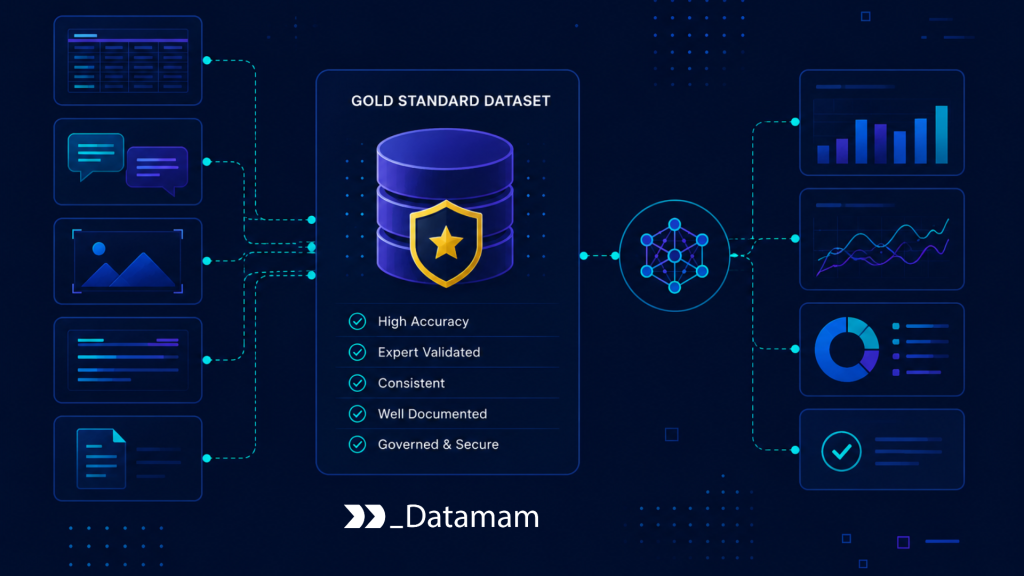
Enterprise AI systems require more than strong models and large training datasets. They require stable, protected, and trusted benchmarks that show whether the model actually performs well under the conditions that matter to the business. Without reliable evaluation data, teams may approve models that appear accurate in testing but fail in production.
Gold Standard Datasets are curated, expert-reviewed datasets used to evaluate AI systems with consistency and confidence. They are not ordinary training samples. They are protected reference benchmarks used for model testing, regression analysis, deployment approval, monitoring, and long-term performance comparison.
In enterprise environments, gold standard dataset design becomes part of AI governance. It determines how performance is measured, how models are compared, how risk is reviewed, and how deployment decisions are justified.
Why Gold Standard Datasets Matter in Enterprise AI Systems
Gold Standard Datasets matter because AI evaluation depends on trusted evidence. A model can only be judged against the data used to test it. If the evaluation dataset is noisy, outdated, leaked into training, or poorly reviewed, performance metrics become unreliable.
IBM defines AI data quality as the degree to which data is accurate, complete, reliable, and fit for use across the AI lifecycle, including training, validation, and deployment. Gold standard datasets apply that principle specifically to model evaluation. They create a controlled benchmark for measuring whether the system is ready for operational use.
Why Model Evaluation Requires Protected Reference Benchmarks
Model evaluation requires protected benchmarks because teams need a stable basis for comparison. If each model version is tested against a different dataset, performance changes may reflect benchmark variation rather than model improvement. If evaluation records are reused in training, the model may learn the answers before testing.
Protected benchmarks solve this problem by creating a trusted evaluation set that remains separate from everyday training data. These records should be carefully selected, reviewed, versioned, and access-controlled. They should represent the types of examples the model must handle in production, including routine cases and difficult edge cases.
In practice, Gold Standard Datasets function as enterprise AI control points. They help teams decide whether a model is better, whether a release is safe, and whether performance claims are supported by reliable evidence.
How Weak Evaluation Data Creates False Confidence in AI Performance
Weak evaluation data creates false confidence because the model may appear strong against an unrepresentative or contaminated benchmark. A classifier may achieve high accuracy because the test set contains mostly easy examples. A matching system may perform well because duplicates leaked between training and testing. A generative AI evaluation may appear stable because difficult cases were never included.
False confidence is dangerous in enterprise settings. Models may move into production with hidden weaknesses. Business teams may trust outputs that were never tested against realistic failures. Governance teams may approve deployment based on incomplete evidence.
NIST’s AI Risk Management Framework emphasizes governance, risk management, measurement, and monitoring across AI systems. Gold standard datasets support these practices by creating a controlled way to measure model behavior before and after deployment.
Operational Problems Created by Uncontrolled Benchmark Data
Uncontrolled benchmark data weakens model evaluation. The problem often starts quietly. A benchmark file is copied into a training workflow. Test examples are reused during tuning. A few records are relabeled without a version history. New examples are added without review. Over time, the benchmark stops functioning as an independent reference.
Enterprise AI teams need to treat evaluation data as protected infrastructure. The benchmark should have defined ownership, access control, versioning, lineage, update rules, and audit records.
When Training Data and Evaluation Data Become Blended
Training data and evaluation data serve different purposes. Training data teaches the model. Evaluation data tests whether the model generalizes. When these roles become blended, model metrics become unreliable.
Blending can happen in several ways. Records may appear in both training and test sets. Near-duplicates may cross dataset boundaries. Evaluation examples may be used repeatedly during prompt tuning, model selection, or feature engineering. Human reviewers may correct the model based on benchmark results and then reuse the same benchmark for final approval.
The result is evaluation contamination. The model may perform well because it has already been exposed to the benchmark. That does not prove readiness. It proves the benchmark has lost independence.
Gold standard dataset management prevents this by assigning dataset roles, enforcing access controls, detecting overlap, and preserving evaluation set boundaries.
How Benchmark Leakage Distorts Model Approval Decisions
Benchmark leakage distorts deployment decisions because it inflates performance metrics. Teams may believe a model is ready for production when it is actually overfit to the evaluation set. This is especially risky when model approvals depend on fixed thresholds for accuracy, recall, precision, ranking quality, safety behavior, or classification consistency.
Leakage can also hide regression. If a benchmark has been indirectly optimized through repeated tuning, it may no longer reveal weaknesses in new model versions. The organization may approve releases that perform well on familiar records but fail on fresh production data.
Gartner’s 2025 research on the data and analytics governance reset with AI states that generative AI and the need to govern unstructured data are straining governance efforts. Benchmark leakage is one example of that strain: evaluation data must be governed as carefully as training data because it shapes deployment confidence.
Designing Gold Standard Datasets for Enterprise AI Evaluation
Gold standard dataset design begins with the evaluation question. The organization must define what the benchmark is supposed to measure, which risks it should reveal, which production conditions it should represent, and how it will support approval decisions.
A good benchmark is not simply a random sample of labeled data. It is a curated reference set with expert review, coverage planning, source context, stable labels, and documented inclusion rules.
Selecting Expert-Reviewed Records for Evaluation Benchmarks
Gold standard records should be expert-reviewed because they become the reference point for model correctness. Routine annotation may be sufficient for broad training data, but evaluation benchmarks require stronger confidence. The benchmark should represent examples where the correct answer is reviewable, defensible, and aligned with business rules.
Expert review is especially important for ambiguous, high-impact, or domain-specific records. In customer support, this may include escalation scenarios, policy exceptions, and multi-intent messages. In product data, it may include variants, bundles, replacements, and duplicate candidates. Also, in market intelligence, it may include competitor launches, promotional signals, pricing changes, and source-noise examples.
Expert-reviewed benchmarks reduce evaluation ambiguity. They also improve trust when results are discussed with leadership, compliance, procurement, or operational stakeholders.
Defining Coverage Across Use Cases, Markets, Domains, and Edge Cases
Gold standard datasets should be designed for coverage. The benchmark must include the cases that matter for the AI system’s intended use. This includes common cases, difficult cases, high-risk categories, underrepresented segments, language variation, market-specific patterns, and production-relevant edge cases.
A benchmark that only contains easy examples will overstate performance. A benchmark that contains only hard examples may underrepresent routine production behavior. The dataset should balance realism with diagnostic value.
Coverage should be documented. Teams should know which categories, markets, sources, languages, time periods, and risk segments are included. They should also know what is excluded. Without coverage documentation, benchmark results are difficult to interpret.
Separating Benchmark Datasets from General Training Data
Benchmark datasets must be separated from general training data through technical and procedural controls. Dataset role metadata should clearly identify whether records are used for training, validation, testing, regression testing, monitoring, or gold standard evaluation.
Separation also requires access control. Engineers and model developers may need benchmark-level results, but they should not freely inspect protected benchmark labels during model tuning unless the workflow is designed for that purpose. Repeated exposure can create informal leakage.
A protected benchmark should be treated as an approval asset. It supports final evaluation, regression testing, and release comparison. It should not become another pool of examples for training convenience.
AI Evaluation Datasets and Model Testing Data Design
AI evaluation datasets serve different purposes across the model lifecycle. Validation sets support development decisions. Test sets measure generalization. Regression benchmarks compare model versions. Monitoring sets evaluate production behavior. Gold standard datasets may serve as protected evaluation anchors across these stages.
Model testing data must be structured with these roles in mind. If every evaluation dataset is treated the same way, teams lose control over what each metric means.
Structuring Evaluation Sets for Training, Validation, Testing, and Regression Review
Training sets, validation sets, test sets, and regression benchmarks should be clearly separated. Validation data helps tune the model. Test data measures performance after development decisions are made. Regression benchmarks verify that new model versions do not degrade previously accepted behavior.
Gold standard datasets often serve as high-confidence test or regression sets. They should include stable, reviewed labels and strong metadata. In some cases, enterprises maintain multiple gold standard sets: one for general performance, one for high-risk categories, one for edge cases, and one for production regression.
Structuring evaluation sets this way gives teams clearer performance signals. A model can improve on general testing but regress on high-risk categories. A regression benchmark can detect that difference before deployment.
Using Model Testing Data to Measure Real Production Readiness
Model testing data should reflect production readiness, not only academic performance. It should include examples that represent the operational environment: noisy inputs, incomplete records, uncommon categories, changing language, source variation, and business-critical failure modes.
For example, a model used in enterprise product matching should be tested against clean matches, near matches, non-matches, bundles, variants, localized titles, and incomplete metadata. A model used for customer classification should be tested against short messages, mixed intent, long-form complaints, policy edge cases, and multilingual examples.
IBM’s 2025 discussion of enhanced data provenance and transparency notes that AI systems can only be as trustworthy as the data used to develop them. For evaluation, that means model testing data must carry enough source, label, review, and transformation context to support confident approval decisions.
Preserving Stable Benchmarks Across Model Versions
Stable benchmarks allow teams to compare model versions over time. If the benchmark changes every release, performance trends become difficult to interpret. A model may appear better because the benchmark became easier, or worse. After all, the newly added examples are more difficult.
Preserving stable benchmarks does not mean benchmarks never change. It means updates are controlled, versioned, and documented. Enterprises may maintain a stable core benchmark for long-term comparison and a rolling benchmark for recent production patterns. Both are useful, but they answer different questions.
A stable benchmark answers: Did this model improve against the same accepted standard? A rolling benchmark answers: Does this model still perform against current conditions? Gold standard dataset management should support both without mixing them accidentally.
Benchmark Datasets for Regression Testing and Approval Gates
Benchmark datasets are essential for regression testing. A new model version should not only improve average performance. It should also avoid degrading important categories, edge cases, protected workflows, or high-risk outputs. Regression testing helps detect these failures before deployment.
Approval gates use benchmark results to decide whether a model can move forward. These gates should be based on metrics that reflect the model’s operational role and risk profile.
Testing New Model Versions Against Historical Performance Baselines
Historical performance baselines show how previous model versions performed against accepted benchmarks. New model versions should be compared against these baselines. If a model improves overall but performs worse on important segments, the deployment decision should account for that tradeoff.
Regression testing may include aggregate metrics, category-level metrics, segment-level metrics, edge-case performance, latency, stability, calibration, and error analysis. For enterprise AI systems, a single headline score is rarely enough.
Benchmark datasets make these comparisons possible because they provide consistent test conditions. Without stable benchmark data, teams cannot determine whether performance changes are meaningful.
Detecting Performance Regression Across High-Risk Categories
High-risk categories require specific regression controls. These may include compliance-sensitive labels, customer-impacting classifications, safety-related outputs, fraud patterns, market-critical signals, financial-risk categories, or executive decision inputs.
A model can show overall improvement while regressing in a high-risk category. For example, a classifier may improve on common support tickets but worsen on escalation detection. A market signal model may improve on price changes but miss competitor launches. A document classifier may improve on routine documents but fail on regulatory categories.
Gold Standard Datasets should include enough high-risk examples to detect these regressions. If a category is too important to fail silently, it must be represented explicitly in benchmark testing.
Connecting Benchmark Results to Deployment Approval Decisions
Benchmark results should connect directly to approval gates. The organization should define what performance is required for deployment, what regressions are unacceptable, what exceptions require review, and who has the authority to approve release decisions.
Approval gates may include minimum accuracy, recall thresholds, false-positive limits, false-negative limits, segment-level performance, fairness checks, robustness checks, and expert review of failure cases. The specific metrics depend on the AI system’s purpose.
The important point is that benchmark results must be actionable. Evaluation should not be an isolated technical report. It should inform deployment, rollback, retraining, review, or additional dataset expansion.
Evaluation Data Governance and Leakage Prevention
Evaluation data governance protects the integrity of benchmark datasets. It defines who can access benchmark records, how updates are approved, how dataset roles are enforced, how leakage is detected, and how evaluation history is preserved.
Without governance, gold standard datasets degrade over time. They become copied, reused, modified, exposed, or blended into training workflows. Once that happens, the organization loses a reliable evaluation anchor.
Protecting Gold Standard Records from Training Pipeline Exposure
Gold standard records should be protected from training pipeline exposure. This requires dataset role controls, access restrictions, data catalog labels, lineage checks, and overlap detection. Training workflows should reject protected evaluation records automatically.
Protection should also cover near-duplicates. A benchmark record may not appear exactly in training data, but a nearly identical version may. Entity-level and similarity-based checks help reduce this risk, especially in text, image, product, document, or customer interaction datasets.
Leakage prevention is not only a technical control. It is also a workflow discipline. Teams should understand that gold standard records are evaluation assets, not convenient training examples.
Managing Access Controls, Reviewer Permissions, and Dataset Roles
Access controls should define who can view gold standard records, labels, metadata, and results. Some teams may need aggregate performance reports without seeing individual benchmark labels. Domain experts may need access for review. Governance owners may approve changes. Model developers may need restricted access to error summaries.
Reviewer permissions matter because benchmark quality depends on expert validation. Not every annotator should be able to modify gold standard labels. Changes should require review, justification, and version control.
Dataset roles should be explicit. A record should not move from test to training without governance approval. If a benchmark record is retired or reclassified, the system should preserve its history.
Versioning Benchmark Updates Without Breaking Historical Comparability
Gold standard datasets must evolve as production conditions change. New products, new policies, new language patterns, new market behaviors, and new failure modes may require benchmark updates. However, updates must not break historical comparability.
A common approach is to maintain benchmark versions. Version 1 may remain the baseline for long-term comparison, while Version 2 adds new categories or recent edge cases. Teams can compare models against both to understand historical improvement and current readiness.
Versioning should document which records were added, removed, changed, or relabeled. It should also record why the update occurred, who approved it, and which model evaluations were affected.
Technology Stack Behind Gold Standard Dataset Management
Gold standard dataset management requires infrastructure that supports storage, access control, versioning, lineage, benchmark execution, observability, and governance review. The system must preserve benchmark integrity while allowing controlled evaluation workflows.
In enterprise environments, gold standard datasets often interact with broader AI data platforms, feature stores, annotation systems, data warehouses, model registries, and evaluation pipelines.
Orchestration, Storage, and Processing for Evaluation Data Pipelines
Airflow can orchestrate benchmark evaluation workflows, including dataset retrieval, model scoring, metric calculation, regression comparison, approval checks, and reporting. Spark can process large benchmark sets, run distributed evaluation, detect duplicates, and compare segment-level results across model versions.
Storage systems such as Snowflake, BigQuery, and Databricks can preserve benchmark records, labels, metadata, evaluation outputs, and historical results. These platforms allow teams to analyze performance by category, market, source, language, reviewer status, and model version.
Kafka may support production feedback loops, routing newly discovered failure cases into review before they become part of future benchmark versions. This helps benchmark data evolve through controlled processes rather than informal additions.
Metadata, Lineage, and Versioning Across Benchmark Workflows
Metadata should include source origin, label, reviewer status, confidence score, dataset role, benchmark version, inclusion reason, category, segment, and access restrictions. Lineage should connect benchmark records to source data, review decisions, model evaluations, approval gates, and deployment decisions.
Versioning should apply to the benchmark dataset, labels, evaluation scripts, metric definitions, and model outputs. If any of these changes, teams need to know whether performance differences are due to the model or the evaluation system.
dbt can support structured benchmark reporting models, while data catalogs and lineage systems can make evaluation assets discoverable and governed. The goal is to ensure that benchmark workflows remain reproducible and auditable.
Observability, Audit Logs, and Governance Controls for AI Evaluation
Observability tools such as Prometheus can monitor evaluation pipeline success, scoring latency, benchmark freshness, model comparison jobs, and approval workflow status. Validation frameworks can check whether benchmark records meet schema, label, coverage, and role requirements before evaluation.
Audit logs should preserve benchmark access, label changes, dataset updates, reviewer approvals, evaluation runs, metric outputs, and deployment decisions. Governance controls should define who can modify benchmarks, approve updates, access protected labels, and release model versions.
OECD’s 2025 Digital Government Index and Open, Useful and Re-usable Data Index emphasize coherent data foundations and reusable data practices in digital systems. Enterprise benchmark management follows the same principle: evaluation data becomes more useful when it is governed, reusable, and traceable.
Gold Standard Datasets as AI Evaluation Infrastructure
Gold Standard Datasets become an AI evaluation infrastructure when they are embedded into model development, release management, monitoring, and governance review. They are not static files kept aside for occasional testing. They are controlled benchmarks that support repeatable evaluation across the AI lifecycle.
At scale, these datasets help enterprises compare model versions, detect regressions, approve releases, investigate failures, and improve future training data. They create continuity between experimentation and production governance.
Strengthening Model Benchmarking, Regression Testing, and Approval Gates
Benchmarking depends on stable evaluation conditions. Regression testing depends on historical comparison. Approval gates depend on trusted evidence. Gold Standard Datasets support all three by providing expert-reviewed records and controlled evaluation workflows.
For example, a new model version may outperform the previous version overall but regress on one high-risk class. A benchmark evaluation should reveal that before release. A model may improve on recent production examples but perform worse on the stable baseline. The benchmark should reveal that tradeoff.
This makes deployment decisions more disciplined. Teams can approve, reject, or conditionally release models based on evidence rather than broad performance claims.
Building Long-Term Trust in Enterprise AI Performance Measurement
Long-term trust in AI performance requires consistency. Business users need confidence that reported improvements are real. AI teams need confidence that benchmarks have not been contaminated. Governance teams need evidence that evaluation data was protected and reviewed. Executives need performance measures that can be explained.
Gold Standard Datasets provide that trust layer. They preserve the benchmark logic behind model evaluation and create a stable foundation for comparing performance over time.
Ultimately, enterprise AI systems are only as trustworthy as the evidence used to evaluate them. Protected, expert-reviewed benchmarks make that evidence stronger.
Conclusion: Turning Expert-Reviewed Benchmarks into Reliable AI Evaluation Systems
Enterprise AI evaluation requires controlled benchmark data. Without protected evaluation sets, teams risk benchmark leakage, inflated performance metrics, weak regression testing, and deployment decisions based on unreliable evidence.
Gold Standard Datasets provide the evaluation infrastructure needed to test AI systems with confidence. They support AI evaluation datasets, benchmark datasets, model testing data, and evaluation data governance across the full model lifecycle. When designed correctly, they separate evaluation from training, protect benchmark integrity, preserve historical comparability, and connect results to approval decisions.
The capability matters because model performance must be measured against trusted reference data. If the benchmark is weak, the approval decision is weak. If the benchmark is expert-reviewed, versioned, protected, and governed, AI teams gain a stronger basis for deployment and long-term monitoring.
A structured review can help evaluate whether current AI data workflows have protected benchmark datasets, leakage controls, model testing data, versioned evaluation sets, and audit-ready governance records. You can run an external data infrastructure audit with our team to review your current setup and understand what is required to build a reliable, enterprise-scale external data infrastructure.