Key Takeaways
- How Cloud Warehouse Migration supports data warehouse modernization across legacy databases, ETL workflows, BI tools, and analytics systems
- Why warehouse migration strategy depends on schema profiling, mapping, validation, reconciliation, and cutover control
- How cloud warehouse upgrade programs reduce legacy reporting risk when transformation logic, access rules, and lineage are preserved
- Why warehouse migrations fail when teams rely on lift-and-shift exports without testing downstream reporting dependencies
- How structured migration pipelines improve reporting continuity, analytics trust, and post-migration operating stability
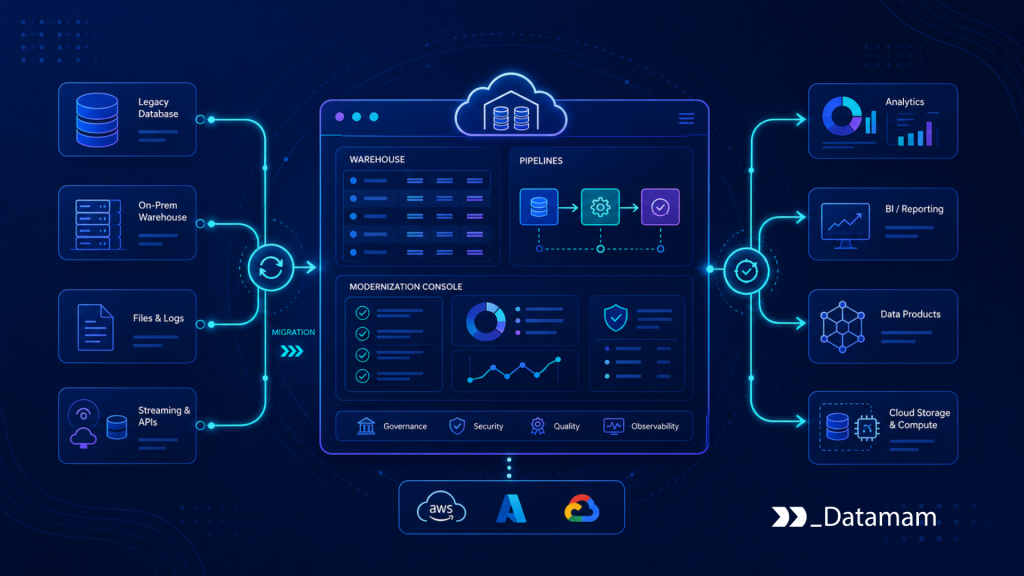
Cloud warehouse modernization depends on accurate data movement across legacy data warehouses, on-premise databases, ETL jobs, BI platforms, reporting marts, data lakes, operational systems, and downstream analytics environments. When Cloud Warehouse Migration is poorly controlled, teams face broken dashboards, missing historical records, incompatible schemas, failed reconciliations, delayed cutovers, and business users who lose trust in the new analytics platform. The issue is rarely only the target warehouse. It is usually the migration operating layer behind the program: source profiling, schema mapping, transformation redesign, validation, reconciliation, access control, lineage, and cutover governance. Cloud Warehouse Migration gives data, analytics, finance, operations, product, and executive teams a structured way to modernize warehouse infrastructure without weakening reporting continuity.
The Migration Risk Gap in Data Warehouse Modernization
Data warehouse modernization is often framed as a platform upgrade, but the highest operational risk usually sits in data continuity. Legacy warehouses contain years of reporting tables, stored procedures, transformation jobs, historical snapshots, semantic models, access rules, business logic, and dashboard dependencies. Some assets may be undocumented, duplicated, obsolete, or heavily customized around old business processes.
This creates a migration risk gap. A target cloud warehouse may be provisioned correctly while the reporting ecosystem remains unresolved. Finance needs reconciled historical metrics. Operations needs stable performance dashboards. Product teams need usage history. Executives need continuity across old and new KPI definitions. NIST Cybersecurity Framework 2.0 is relevant because warehouse modernization requires governance, access control, monitoring, and risk management across connected enterprise data systems.
Why Warehouse Data Becomes Difficult to Move
Warehouse data becomes difficult to move because it is rarely only raw data. It contains embedded business logic. Legacy tables may include denormalized reporting structures, historical calculations, old fiscal calendars, undocumented joins, regional filters, and inherited naming conventions. Some reports may depend on transformations that no longer match current business definitions.
During a cloud warehouse upgrade, these issues become migration defects. A revenue dashboard may change because a transformation was interpreted differently. A customer table may lose historical fields. A finance report may fail because decimal precision changed. Cloud Warehouse Migration reduces this risk by exposing schema, logic, and reporting dependencies before the target environment becomes the new source of truth.
Where Warehouse Migration Strategy Breaks Down
Warehouse migration strategy breaks down when teams treat the project as infrastructure relocation. Moving tables from one platform to another is not enough if dashboards, transformations, access rules, and reconciliation logic are not tested. A technically successful load can still fail commercially if business reports no longer match expected results.
Late discovery creates pressure. If executive dashboards do not reconcile near go-live, leadership may delay cutover. If access rules are incomplete, sensitive data may be overexposed. Also, if transformation jobs fail in the cloud environment, analytics teams may revert to legacy reports. At scale, warehouse migration strategy must treat data, logic, and reporting dependencies as one controlled transition.
Cloud Warehouse Migration as an Operating Layer
Cloud Warehouse Migration becomes valuable when it operates as a controlled layer between legacy warehouse assets, transformation workflows, validation processes, and the target cloud platform. The goal is not simply to copy tables. The goal is to deliver accurate, reconciled, documented, and permissioned data into a modern analytics environment.
This operating layer should define which datasets are migrated, which are retired, which schemas require redesign, which transformations must be rewritten, which reports require reconciliation, and which business owners must approve cutover. Without these controls, data warehouse modernization can move old complexity into a newer platform. Data migration strategies for enterprises are essential to ensure a seamless transition from legacy systems to modern cloud infrastructures. They focus on minimizing downtime during the migration process while maximizing data integrity and accessibility. Implementing a comprehensive strategy involves careful planning, efficient resource allocation, and stakeholder engagement to align the migration objectives with business goals.
Defining Ownership Across Warehouse Assets
Source ownership is the foundation of reliable warehouse migration. Finance may own revenue, margin, expense, and close reporting datasets. Sales may own pipeline, bookings, territory, and account reporting logic. Operations may own fulfillment, inventory, SLA, and capacity metrics. Product may own usage, activation, retention, and feature and event models. IT and data engineering may own ingestion pipelines, orchestration, permissions, and platform controls.
Clear ownership prevents migration disputes. Data engineering can migrate tables, but business teams must approve whether metrics remain accurate. Analytics teams can rebuild dashboards, but functional owners must confirm that the migrated data supports decision workflows. The migration layer should preserve this accountability before legacy systems are retired.
Creating a Source-to-Target Warehouse Model
A source-to-target warehouse model connects legacy database, schema, table, field, target dataset, transformation rule, owner, validation rule, dependency, dashboard, and reconciliation requirement. This model does not require every old asset to survive migration. However, it does require explicit decisions before data is loaded into the cloud warehouse.
For example, a legacy sales mart may include account, opportunity, region, quota, and bookings fields that map into several target models. A finance table may need precision, currency, and fiscal-period rules preserved exactly. A historical snapshot table may need partitioning and retention logic. Cloud Warehouse Migration should make these decisions visible before test loads begin.
Infrastructure Requirements for Cloud Warehouse Upgrade Programs
Cloud warehouse upgrade programs depend on infrastructure that can extract, profile, transform, validate, load, reconcile, monitor, and govern datasets across legacy and target platforms. The objective is not to create one-time scripts that only technical teams understand. Teams need repeatable migration workflows that handle schema drift, pipeline dependencies, failed loads, data type differences, access rules, and audit evidence.
Warehouse data is sensitive because it can include financial results, customer records, product usage, employee-related data, supplier information, commercial forecasts, and executive reporting. ISO/IEC 27001 is relevant because warehouse migration programs require disciplined controls around confidentiality, access management, auditability, and risk treatment.
Profiling, Mapping, and Validating Warehouse Data
Migration data may come from legacy warehouses, operational databases, data lakes, BI extracts, SaaS sources, reporting marts, and flat files maintained by business teams. Profiling should identify missing fields, duplicate records, invalid data types, stale tables, unused datasets, broken joins, inconsistent timestamps, orphaned dimensions, and unmapped reporting fields.
Apache Airflow can orchestrate recurring extracts, profiling jobs, transformation runs, and test loads. Spark can process high-volume historical tables, event logs, transaction records, and analytical snapshots. dbt can manage repeatable transformation models, business logic documentation, and reconciliation-ready tables. Data migration solutions for financial systems are critical for ensuring compliance and efficiency. They help organizations streamline their processes while maintaining data integrity across various platforms. A robust strategy can facilitate smoother transitions and enhance overall financial reporting capabilities.
def route_warehouse_dataset(dataset):

    if dataset["migration_status"] == "validated":

        return {"action": "load_to_cloud_warehouse", "dataset": dataset["dataset_name"]}

    if dataset["migration_status"] == "failed":

        return {"action": "send_to_data_owner", "dataset": dataset["dataset_name"]}

    return {"action": "hold_for_review", "dataset": dataset["dataset_name"]}


REQUIRED_WAREHOUSE_FIELDS = ["dataset_name", "source_system", "owner", "migration_status"]


def validate_warehouse_dataset(dataset):

    missing = [field for field in REQUIRED_WAREHOUSE_FIELDS if not dataset.get(field)]

    if missing:

        return {"valid": False, "reason": "missing_fields", "fields": missing}

    if dataset["migration_status"] == "validated" and not dataset.get("reconciliation_passed"):

        return {"valid": False, "reason": "reconciliation_required"}

    return {"valid": True}


dataset = {

    "dataset_name": "finance_revenue_mart",

    "source_system": "legacy_warehouse",

    "owner": "finance_analytics",

    "migration_status": "validated",

    "reconciliation_passed": True,

}


print(route_warehouse_dataset(dataset))

print(validate_warehouse_dataset(dataset))
This migration logic keeps warehouse datasets controlled before cloud loading. Validated datasets can move into the target warehouse, failed datasets can be routed to owners, and unreconciled reporting tables can be blocked before they affect executive dashboards.
Normalizing Schemas, Transformations, and Historical Data
Raw warehouse structures rarely align cleanly with the target architecture. Legacy environments may contain nested reporting tables, stored procedures, materialized views, custom SQL logic, old data types, local time zones, and inconsistent partitioning. A cloud warehouse migration may require redesign rather than direct copying.
Normalization aligns schemas, table names, data types, primary keys, dimensional models, event timestamps, historical snapshots, fiscal calendars, access groups, and downstream BI models. Snowflake, BigQuery, and Databricks can support staging, comparison, partitioning, workload testing, and governed analytics layers during migration.
Validating Reporting Continuity Before Cutover
Validation controls prevent incomplete or inconsistent data from becoming the new reporting foundation. These controls should check row counts, record totals, null rates, duplicate keys, metric differences, table freshness, data type changes, permission gaps, and dashboard output differences.
Validation should occur before mock cutovers and the final production cutover. Data quality frameworks such as Great Expectations can support completeness, uniqueness, accepted-value, freshness, and referential integrity checks. Without validation, data warehouse modernization can create invisible reporting defects.
Technology Stack Behind Data Warehouse Modernization
Data warehouse modernization requires a technology stack that supports extraction, staging, transformation, validation, reconciliation, loading, monitoring, and governance. The stack must support repeated test migrations before final cutover, not a single production load.
A mature environment connects legacy warehouse databases, ETL/ELT pipelines, orchestration tools, cloud storage, transformation frameworks, BI tools, data quality checks, target warehouse environments, and audit repositories. It should reduce manual correction without weakening analytics governance or reporting accountability.
Orchestration, Transformation, and Loading
Migration workflows often use database extracts, APIs, secure file transfers, cloud storage stages, and target warehouse loaders. Airflow can coordinate extraction schedules, dependency chains, validation jobs, load batches, and exception reports. Kafka may support streaming migration patterns when near-real-time operational datasets need continuity during transition.
Processing layers convert legacy analytical structures into target-ready models. Spark can process high-volume transaction history, product events, customer records, and operational logs. dbt can standardize transformation logic, metric definitions, lineage documentation, and reconciliation-ready tables. The migration design should include retry logic, idempotency, failed-load handling, dependency sequencing, and batch monitoring.
Governance, Lineage, and Access Control
Warehouse migration governance should include role-based access, audit logs, metadata catalogs, data lineage, retention rules, source documentation, and cutover versioning. These controls matter because analytics data affects executive reporting, finance reviews, operational dashboards, customer analytics, and regulatory reporting.
Data lineage should trace each migrated dataset from source extraction through profiling, transformation, validation, staging, target load, BI model, and dashboard publication. If a metric changes after migration, teams need to determine whether the issue came from source data, SQL logic, transformation rules, permission filters, or target platform behavior.
Commercial Impact of Cloud Warehouse Migration
The commercial value of Cloud Warehouse Migration appears when teams can trust the accuracy, completeness, and usability of data after modernization. Better migration control can reduce cutover delays, preserve reporting continuity, improve analytics performance, lower manual reconciliation, and support faster adoption of the new cloud warehouse. The result is not only cleaner data movement. It is stronger analytics modernization execution.
For CIOs, CDOs, CFOs, analytics leaders, data engineering teams, and business unit leaders, the practical value is confidence. Integrated migration data helps teams understand which datasets are ready, which failed, which reports reconcile, and which business rules need approval.
Improving Reporting Continuity and User Trust
Business users adopt a modern warehouse faster when reports, dashboards, and key metrics remain trustworthy. If users see missing history, changed calculations, or dashboard differences after cutover, they may continue relying on legacy exports.
Cloud Warehouse Migration supports reporting continuity by validating datasets before cutover and preserving the business logic behind critical metrics. It also reduces post-migration report repair, which can otherwise consume analytics capacity for months.
Supporting Analytics Performance and Scalability
Cloud warehouse modernization often aims to improve scalability, query performance, data sharing, and analytics flexibility. However, performance improvements only matter if the migrated data is accurate and usable. A faster query against incorrectly mapped data does not improve decision quality.
A controlled migration allows teams to redesign storage, partitioning, transformation logic, and analytical models while preserving business continuity. This helps the cloud warehouse become a stronger operating platform rather than just a new data storage location. Cloud data migration strategies for enterprises play a critical role in achieving successful modernization initiatives. By developing a clear roadmap and understanding the unique requirements of their businesses, enterprises can ensure a smooth transition to the cloud. This approach not only optimizes data management but also enhances analytical capabilities, allowing organizations to leverage their data effectively.
Risk Exposure When Warehouse Migration Is Poorly Controlled
Poorly controlled warehouse migration creates reporting, operational, financial, and governance risk. Executive dashboards may not reconcile. Historical reports may change unexpectedly. Users may lose access to required datasets. Sensitive data may be overexposed. Data engineering teams may spend months fixing defects after go-live.
The risk increases when legacy environments include many reporting marts, custom SQL jobs, undocumented dashboards, acquired systems, regional models, and long-running manual workarounds. Manual migration methods may work for small datasets, but they become fragile in enterprise data warehouse modernization.
Broken Dashboards and Metric Drift
Broken dashboards create immediate trust problems. Metric drift is more subtle. A revenue metric may appear close but not exact. A customer count may change because identity logic was rewritten. A margin report may shift because cost allocation logic was interpreted differently.
Warehouse migration workflows should preserve source totals, transformation rules, reconciliation outputs, and dashboard comparison results. This allows teams to identify whether differences come from source data, mapping logic, target SQL behavior, or intentional redesign.
Access, Privacy, and Sensitive Data Risk
Warehouse platforms often centralize sensitive information across customers, employees, suppliers, financials, product usage, and operations. Migration can create risk if permissions, masking rules, row-level filters, or data-sharing controls are not mapped correctly.
NIST SP 800-53 is useful because warehouse migration environments often require access control, audit logging, monitoring, and security governance across sensitive enterprise data.
Evaluating Cloud Warehouse Migration Readiness
Cloud Warehouse Migration becomes valuable when it supports repeatable migration workflows, not simply when tables can be copied. Readiness depends on source ownership, schema mapping, transformation redesign, validation controls, reconciliation, governance, workload testing, cutover planning, and exception handling.
A readiness review helps identify where migration risk accumulates before it becomes a dashboard failure, reconciliation issue, user adoption problem, or post-migration support burden.
How Teams Assess Warehouse Migration Data Quality
A structured assessment should evaluate row-count consistency, duplicate keys, null rates, unmapped fields, invalid data types, stale tables, missing history, broken joins, failed transformations, dashboard differences, and source-to-target mapping completeness. It should also review ownership, validation coverage, exception volume, reconciliation results, access controls, and lineage completeness.
For cloud warehouse migration, quality must be evaluated analytically and operationally. A dataset may load successfully while still failing to support reporting, forecasting, segmentation, compliance, or executive dashboards.
When Organizations Need a Warehouse Migration Architecture Review
A warehouse migration architecture review becomes useful when teams rely on manual extracts, incomplete dependency inventories, inconsistent transformation logic, failed test loads, or dashboard reports that do not reconcile after migration. The review should assess source coverage, migration workflows, schema design, transformation logic, validation controls, staging architecture, lineage tracking, governance posture, and cutover execution.
The output should clarify where warehouse migration risk accumulates, where data warehouse modernization may be incomplete, and which infrastructure improvements would make cloud warehouse upgrade execution more reliable for analytics, finance, data engineering, and business teams.
Conclusion: Cloud Warehouse Migration as Analytics Modernization Infrastructure
Cloud warehouse modernization depends on reliable data movement across legacy warehouses, ETL pipelines, BI tools, reporting marts, data lakes, operational systems, and target cloud platforms. When migration is inconsistent, teams spend excessive time reconciling dashboards, repairing broken models, rebuilding trust, and supporting legacy environments longer than planned. Cloud Warehouse Migration creates the governed foundation needed to coordinate data warehouse modernization across the full migration lifecycle.
Ultimately, organizations that treat warehouse migration as analytics modernization infrastructure, not just table movement, will be better positioned to improve warehouse migration strategy, protect reporting continuity, reduce cutover risk, and build more reliable cloud warehouse upgrade outcomes across the enterprise.