Key Takeaways
- API Dependency Risk determines whether connected operations can remain stable as systems scale.
- API dependency mapping shows which workflows depend on critical internal and external APIs.
- Third party api risk increases when business processes rely on systems outside direct enterprise control.
- Dependency failure analysis helps teams understand downstream impact before outages spread across AI, analytics, customer, product, and finance workflows.
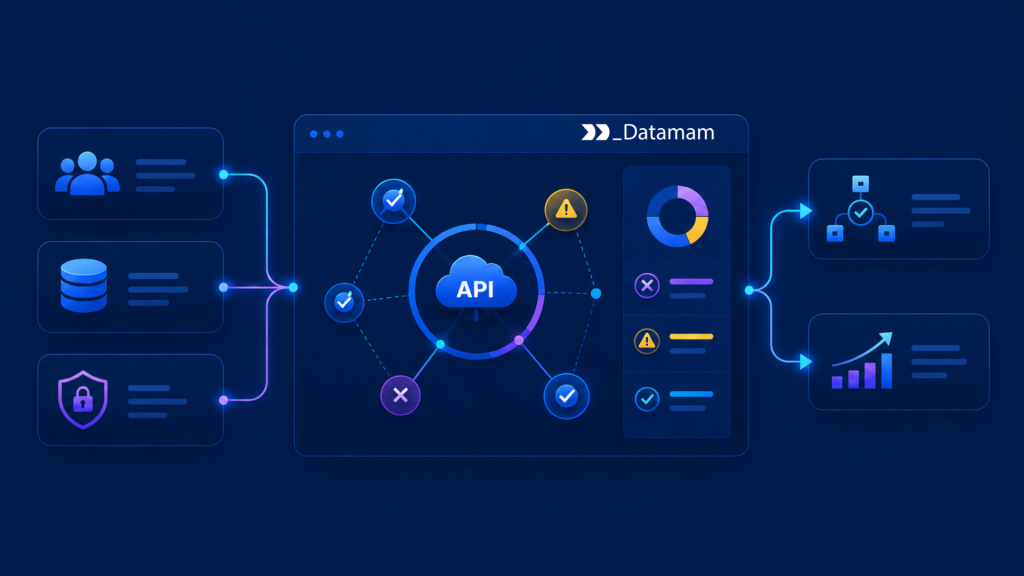
API dependency risk becomes visible when connected systems stop behaving like one operating environment. A CRM may be available, an ERP may be available, a billing platform may be available, and an analytics warehouse may still refresh. However, if the APIs connecting those systems slow down, fail, change schema, return incomplete payloads, or become unavailable, operational stability weakens across the enterprise.
API Dependency Risk refers to the exposure created when business workflows rely on internal or third-party APIs whose reliability, ownership, versioning, access, and downstream impact are not fully understood. In modern enterprises, APIs support customer 360 workflows, product publication, finance synchronization, AI pipelines, reporting systems, external data feeds, and operational automation. When dependencies are hidden, a single API issue can become a multi-system business disruption.
API Dependency Risk Determines Whether Connected Operations Can Remain Stable
Enterprise teams often think about APIs as integration components. However, once an API supports operational workflows, it becomes part of the business infrastructure. A customer update API may affect billing, support routing, account scoring, and executive reporting. A product API may affect ecommerce, marketplace publishing, catalog analytics, pricing, and sales portals. An external data API may support risk monitoring, market intelligence, or AI feature pipelines.
This shift matters because operational stability depends on dependency visibility. McKinsey’s State of AI 2025 notes that AI use has become widespread, yet many organizations still struggle to embed AI deeply into workflows and realize scaled value. That gap reinforces a broader infrastructure issue: enterprise workflows depend on connected and reliable data movement, not only tool adoption.
API Dependency Mapping Shows Which Workflows Depend on Critical Internal and External APIs
API dependency mapping identifies which systems, workflows, datasets, models, dashboards, and business processes rely on each API. It should show source systems, target systems, downstream consumers, expected latency, required fields, schema versions, ownership, authentication model, data classification, and escalation paths.
This mapping prevents APIs from becoming invisible single points of failure. Without it, a customer profile endpoint may appear to support one sync workflow while also feeding churn models, renewal forecasting, customer success dashboards, and support prioritization. A product catalog endpoint may appear to support e-commerce while also feeding marketplace syndication, inventory analytics, and revenue reporting.
In practice, dependency mapping helps teams understand where operational stability depends on specific API connections. It turns hidden technical dependencies into visible business risk.
Third-Party API Risk Increases When Business Processes Rely on Systems Outside Direct Control
Third party api risk increases because external providers control availability, rate limits, payload structure, versioning, authentication changes, and service commitments. A vendor API may change a field name. A marketplace API may enforce new publication requirements. A payment API may alter error codes. An external data provider may change response formats or usage terms.
These changes may be outside direct enterprise control, but their impact is internal. A third-party API issue can delay product publishing, weaken market intelligence, disrupt customer workflows, affect financial reconciliation, or reduce AI input quality.
Therefore, third-party API dependencies require stronger monitoring, contracts, fallback planning, version tracking, and legal or sourcing review. A vendor dependency is not only a procurement concern. It is an operational stability concern.
Why API Dependencies Become Operational Risk at Scale
API dependencies become operational risk when they grow faster than visibility and governance. Early integrations may be simple. One source system sends data to one target system. As use cases expand, the same API may support many downstream consumers. At that point, dependency failure affects more than one workflow.
Gartner’s 2025 Data and Analytics Predictions state that a growing share of business decisions will be augmented or automated by AI agents for decision intelligence. As decision workflows depend more heavily on connected data, weak API dependency management becomes more consequential because one broken dependency can affect automated analysis, reporting, or operational action.
Hidden API Dependencies Create Failure Points Across CRM, ERP, Product, Finance, and AI Workflows
Hidden API dependencies create failure points because teams may not know which workflows depend on which connection. A CRM-to-ERP API may support customer master synchronization, billing updates, tax logic, finance reporting, revenue recognition workflows, and compliance review. A product API may support PIM updates, ecommerce pages, marketplace publication, sales enablement, and analytics models.
When these dependencies are undocumented, incident response becomes fragmented. Finance investigates missing billing fields. Data teams investigate dashboard gaps. Customer success investigates account status mismatch. Engineering investigates API logs. Each team sees a different symptom.
Dependency mapping reduces this fragmentation by connecting API behavior to business impact. It helps teams identify the common failure point before downstream issues spread.
Dependency Failure Analysis Helps Teams Understand Downstream Impact Before Outages Spread
Dependency failure analysis evaluates what happens when an API slows down, fails, changes schema, returns incomplete data, duplicates events, or becomes unauthorized. It should identify affected workflows, fallback options, expected degradation, escalation paths, and business consequences.
For example, if a customer API fails, can support systems continue using the last validated profile? If a product publication API fails, should updates be queued or blocked? If an external market data API becomes unavailable, should pricing workflows pause or use fallback sources? Also, if an API returns partial fields, should data move downstream or go to quarantine?
This analysis helps teams prepare before failure occurs. Without it, enterprises improvise during incidents, which increases downtime, rework, and decision uncertainty.
The Strategic Cost of Weak API Dependency Visibility
Weak dependency visibility creates strategic cost because it prevents leaders from understanding where operational stability is exposed. APIs may be buried inside technical architecture, but their failure can affect revenue reporting, customer experience, AI reliability, product availability, financial workflows, and market responsiveness.
IBM’s 2025 CDO Study emphasizes that many organizations are still working to make data ready for AI and enterprise value creation. API dependency visibility is part of that readiness because data cannot be decision-ready if the connections moving it are poorly understood or difficult to govern.
Business Teams Lose Stability When API Failures Affect Multiple Systems at Once
Business teams lose stability when API failures create inconsistent views across systems. A customer may be active in CRM but inactive in billing because synchronization failed. A product may be approved in PIM but missing from a marketplace because publication failed. A finance dashboard may show incomplete revenue because an ERP API returned delayed records.
These failures reduce trust. Teams start asking whether operational outputs reflect reality or integration behavior. Analysts reconcile reports. Engineers inspect logs. Business users request manual confirmation. Executives wait for teams to validate the data before acting.
At scale, weak API dependency visibility slows the organization. The business continues operating, but with less confidence and more friction.
Operational Decisions Become Less Reliable When API Inputs Are Delayed, Missing, or Inconsistent
Operational decisions depend on the data arriving through APIs. If inputs are delayed, missing, or inconsistent, decisions become less reliable. A customer support workflow may route incorrectly. A pricing workflow may use stale product data. A risk workflow may miss public-source signals. An AI model may operate on incomplete features.
Consider a finance-sensitive customer update. If a CRM change affects the billing address or tax region, the API workflow should route the event for review before downstream systems act on it.
FINANCE_REVIEW_FIELDS = ["billing_address", "tax_region", "legal_name", "compliance_status"]

def send_to_finance_review(event):
    print(f"Routing event {event['event_type']} from {event['source_system']} to finance review")

event = {
    "event_type": "customer.updated",
    "source_system": "crm",
    "customer_id": "CRM-184920",
    "erp_customer_id": "ERP-77231",
    "updated_fields": ["billing_address", "tax_region"],
    "timestamp": "2026-06-17T14:22:00Z",
}

if any(f in FINANCE_REVIEW_FIELDS for f in event["updated_fields"]):
    send_to_finance_review(event)
This pattern shows that dependency management is not only technical monitoring. It includes business-aware routing when an API event affects finance, compliance, tax, billing, or reporting workflows.
How API Dependency Risk Affects AI, Analytics, and Customer Operations
AI, analytics, and customer operations are especially exposed to API dependency risk because they rely on many connected feeds. A model may depend on CRM, billing, support, product usage, and external signal APIs. A dashboard may depend on ERP, product, sales, and marketplace APIs. A customer workflow may depend on identity resolution across multiple platforms.
NIST’s AI Risk Management Framework emphasizes governance, mapping, measurement, and management across AI systems. Those same functions apply to API dependency risk because AI workflows inherit risk from the APIs that supply features, feedback, monitoring data, and operational context.
AI Pipelines Depend on Stable API Feeds for Features, Feedback, and Monitoring Signals
AI pipelines depend on stable API feeds across the model lifecycle. Training data may come from internal and external APIs. Feature pipelines may rely on customer, product, transaction, or market APIs. Monitoring workflows may depend on feedback events, performance outcomes, and production behavior.
When an API dependency fails, the model may appear to degrade for reasons that are not model-related. A churn model may lose support interaction signals. A pricing model may miss competitor or inventory updates. A risk model may operate without public-source data. A personalization model may receive delayed customer behavior events.
In practice, API dependency risk becomes model risk. AI teams cannot govern model behavior if they cannot see and control the API dependencies behind model inputs.
Analytics and Reporting Workflows Become Fragile When API Dependencies Are Undocumented
Analytics and reporting workflows become fragile when API dependencies are undocumented. A dashboard may rely on data from multiple APIs, but if the dependency chain is unclear, teams cannot easily explain why a metric changed. Did the business move, did an API delay records, did a schema change, or did a transformation fail?
Undocumented dependencies also weaken auditability. If a board report or regulatory workflow depends on API-derived data, teams need to know where the data came from, which API version supplied it, what validation checks passed, and which transformations were applied.
Without this visibility, reporting teams operate reactively. They investigate after trust declines rather than preventing dependency issues before they affect users.
The Infrastructure Layer Behind API Dependency Control
API dependency control requires infrastructure that can make dependencies visible, measurable, and governable. Dependency management cannot rely on informal knowledge or scattered documentation. Enterprises need lineage, metadata, observability, versioning, validation, error routing, and fallback planning integrated into the operating model.
The World Economic Forum’s 2025 analysis on scaling AI with strategy, data, and workforce readiness argues that strong data foundations are necessary for enterprise AI scale. API dependency control is part of those foundations because connected systems depend on stable and governed movement of data across internal and external services. Api integration benefits for businesses are manifold, enabling improved efficiency and streamlined processes. With effective integration, companies can harness data from different platforms seamlessly, leading to enhanced decision-making. Ultimately, these advantages contribute to a more agile organizational framework capable of adapting to ever-changing market demands.
Lineage, Metadata, Observability, and Versioning Make API Dependencies Easier to Govern
Lineage shows which datasets, models, dashboards, applications, and workflows depend on each API. Metadata records source system, target system, endpoint owner, schema version, update frequency, data classification, usage constraints, service-level expectations, and downstream consumers. Observability tracks latency, errors, retries, freshness, throughput, and payload quality. Versioning preserves changes in schema, payload structure, and business definitions.
These capabilities allow teams to govern dependencies before they fail. If a third-party API changes a schema, lineage shows affected workflows. If latency increases, observability shows whether downstream freshness is at risk. Also, if a version is deprecated, metadata helps identify migration owners and timelines.
Infrastructure tools support this model. Airflow can orchestrate API workflows and recovery tasks. Kafka can support event-driven movement. Spark can process high-volume payloads. dbt can transform API-derived data into governed models. Snowflake, BigQuery, and Databricks can store connected data at scale. Great Expectations can validate schema and completeness. Prometheus and data observability systems can monitor service health.
Validation, Error Routing, and Failover Planning Reduce the Impact of Dependency Failure
Validation and error routing prevent dependency failures from spreading downstream unchecked. Missing required fields, duplicate events, reference mismatches, unauthorized access, and schema violations should not all be handled the same way.
def route_exception(record, validation_result):
    error_type = validation_result["error_type"]
    if error_type == "missing_required_field":
        send_to_quarantine(record, reason=validation_result.get("message"))
    elif error_type == "duplicate_event":
        mark_as_duplicate(record, event_id=record["event_id"])
    elif error_type == "reference_mismatch":
        send_to_manual_review(record, owner="data_operations", reason=validation_result.get("message"))
    elif error_type == "unauthorized":
        send_to_access_review(record, reason=validation_result.get("message"))
    elif error_type == "schema_violation":
        escalate_to_producer(record, reason=validation_result.get("message"))
    else:
        send_to_error_queue(record, reason="unclassified_exception")
This approach turns dependency failure into a controlled process. Records that cannot be trusted are quarantined, duplicated events are identified, reference issues are reviewed manually, access problems are escalated, and schema issues are sent back to producers.
Failover planning extends this control. Critical APIs should have fallback options, queued processing, cached last-known-good records, alternative providers, manual review paths, or degraded-mode workflows depending on business criticality. Api design principles for enterprise systems play a crucial role in ensuring robustness and reliability. By adhering to these standards, organizations can enhance the interoperability of their services and reduce the risk of failures. Implementing these principles helps in maintaining seamless communication between diverse system components while providing a clearer structure for future development.
Governance and Compliance Depend on API Dependency Visibility
API dependency visibility is also a governance requirement. APIs move customer data, product data, financial data, vendor data, external data, and regulated data across internal and third-party systems. Without dependency visibility, teams may not know where sensitive data travels or which workflows rely on it.
The World Bank’s Digital Progress and Trends Report 2025 emphasizes foundational digital systems for responsible and scalable AI adoption. Within enterprises, API dependency visibility supports that foundation by making data movement more traceable and governable.
Third-Party Dependencies Require Legal, Security, and Sourcing Controls
Third-party API dependencies require stronger controls because they involve providers outside direct enterprise management. Teams need to understand contractual rights, uptime expectations, rate limits, data retention, access rules, usage restrictions, cross-border movement, and incident notification procedures.
Security teams need to manage credentials, scopes, token rotation, and service identities. Legal and compliance teams need to review data usage rights and jurisdictional exposure. Data teams need to document source reliability, schema expectations, and downstream consumers.
A third-party API that supports a critical workflow should not be treated as a minor technical connector. It should be governed as part of enterprise operational resilience.
Audit Logs and Access Records Make Dependency Risk Defensible
Audit logs and access records help teams defend API dependency decisions. They show which systems are called an API, when calls occurred, which credentials were used, what responses were returned, which errors appeared, and where data moved downstream.
This evidence matters for AI governance, incident response, financial reporting, customer data workflows, regulated environments, and external data sourcing. If a decision system is challenged, teams need to show which API dependencies contributed to the data behind that decision.
Without auditability, dependency risk becomes difficult to explain. The organization may know a workflow depends on an API, but not enough to prove how that dependency behaves over time.
Why API Dependency Risk Is Becoming an Executive Governance Issue
API Dependency Risk is becoming an executive governance issue because API dependencies now support critical business decisions. APIs connect systems that influence revenue, customer experience, finance, product publishing, AI, analytics, risk monitoring, and external intelligence. If these dependencies are unmanaged, operational stability depends on systems that leaders cannot see.
Executives do not need endpoint-level details. However, they need visibility into which APIs support critical workflows, which dependencies are third-party controlled, which lack failover, which are undocumented, and which carry compliance exposure. API reliability challenges in operations can lead to significant disruptions if not properly addressed. Organizations must develop strategies to identify and mitigate these risks effectively. By prioritizing transparency and proactive management, companies can reduce the likelihood of failures that impact their core functionalities.
Leaders Need Visibility into Which APIs Support Critical Business Decisions
Leadership visibility should focus on critical dependency chains. Which APIs feed production AI models? Which APIs support executive dashboards? As well as, which APIs connect CRM and ERP? Which external APIs support pricing, risk, or market intelligence? Which APIs carry customer or regulated data? Also, which third-party APIs have no fallback path?
This visibility helps leaders prioritize investment. A low-risk internal API may need basic monitoring. A third-party API supporting finance, customer operations, or production AI may require stronger contracts, observability, ownership, and contingency planning.
In this context, dependency visibility becomes part of enterprise resilience. Leaders cannot govern operational stability if they cannot see the API dependencies behind critical workflows.
Scalable Integration Programs Require Dependency Mapping, Ownership, Monitoring, and Continuous Review
Scalable integration programs require dependency standards. These standards should define API dependency mapping, ownership, service-level expectations, schema versioning, validation rules, observability metrics, audit logs, access controls, failover planning, third-party review, and escalation procedures.
Ownership must be cross-functional. Engineering teams manage implementation. Data teams define lineage and validation expectations. Business teams define workflow impact. Security teams manage access controls. Legal and compliance teams define third-party and usage constraints. Analytics and AI teams define downstream requirements.
Ultimately, API Dependency Risk shapes operational stability because connected workflows are only as stable as the dependencies beneath them. API dependency mapping makes hidden exposure visible. Third party api risk identifies where control sits outside the enterprise. Dependency failure analysis helps teams understand business impact before outages spread.
Organizations that manage API dependencies as governance infrastructure will build more resilient cross-system operations. Those that treat APIs as isolated connectors may continue integrating systems, but they will struggle to prove that critical workflows remain stable when dependencies fail, change, or degrade.