Key Takeaways
- API Governance determines whether integrations remain secure, reliable, traceable, and fit for enterprise use after delivery.
- An api governance framework should define ownership, standards, access, versioning, validation, monitoring, lineage, and auditability before APIs go live.
- API policy management reduces risk by making usage rules, authorization, data classification, and downstream permissions explicit.
- Enterprise api controls prevent weak API design from becoming a business dependency across AI, analytics, finance, product, and customer workflows.

API governance cannot begin after integrations are already delivered. By the time an API is live, data is already moving between systems, access paths are already active, downstream consumers may already depend on payloads, and business teams may already trust the outputs. Adding governance at that stage often means rebuilding controls around decisions that have already been made.
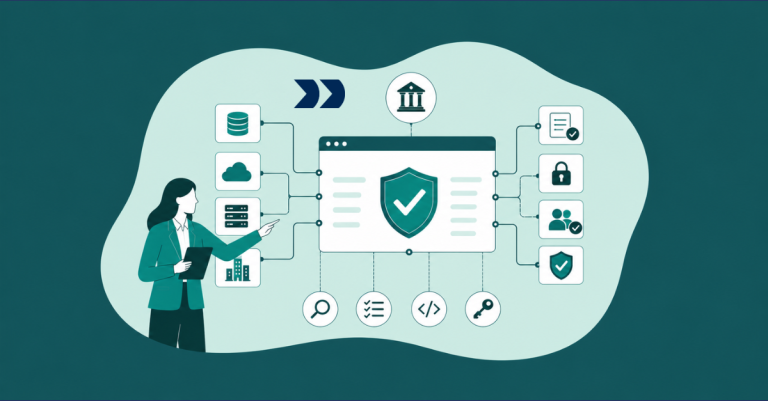
API Governance defines how APIs are designed, approved, secured, versioned, documented, monitored, and controlled across enterprise systems. It includes api governance framework design, api policy management, enterprise api controls, ownership, access rules, schema standards, audit logging, usage permissions, error routing, and downstream dependency visibility. As APIs increasingly connect AI workflows, analytics systems, CRM, ERP, product catalogs, billing, customer platforms, and external data sources, governance must shape integration delivery before production use begins.
API Governance Defines Whether Integrations Can Be Trusted After Launch
An API can be technically functional and still be unready for governed enterprise use. It may return a payload, support authentication, and connect source and target systems, yet still lack clear ownership, versioning rules, validation standards, lineage, audit logs, or usage restrictions. Once that API feeds dashboards, AI pipelines, operational workflows, or customer-facing systems, those missing controls become business risk.
McKinsey’s State of AI 2025 shows that many organizations continue adopting AI, but still struggle to embed it deeply into workflows and realize scaled enterprise value. API governance matters in that context because AI and analytics workflows depend on governed data movement, not only available endpoints.
An API Governance Framework Establishes Rules Before Data Moves
An api governance framework defines the rules for how APIs should behave before they move production data. It should clarify who owns the API, which systems may call it, which data fields are allowed, how schemas are versioned, which validation checks apply, how errors are routed, what audit logs are captured, and how downstream consumers are notified of change.
Without these rules, integration delivery becomes fragmented. Engineering teams may optimize for speed. Business teams may prioritize immediate data access. Analytics teams may consume payloads without understanding quality limits. Security and compliance teams may enter only after the API has become operationally important.
In practice, governance should define the conditions under which an API is allowed to move data, not merely review the API after data is already flowing.
Enterprise API Controls Reduce Risk Before APIs Become Dependencies
Enterprise api controls reduce risk before integrations become business dependencies. Controls may include authentication, authorization scopes, data contracts, schema validation, rate limits, payload logging, versioning, approval gates, access reviews, lineage capture, and exception routing.
This matters because API dependencies grow quickly. A customer profile API may start by syncing CRM data with support systems, then later feed customer 360, billing reconciliation, renewal forecasting, churn models, and executive reporting. A product API may begin with e-commerce publication, then expand into marketplace syndication, catalog analytics, sales portals, and pricing intelligence.
If enterprise controls are not embedded early, the API may become too important to change easily and too weakly governed to trust fully.
Why Governance Cannot Be Added Cleanly After Delivery
Late governance creates rework because API behavior has already shaped downstream systems. Payload fields may already be mapped into reports. AI features may already depend on endpoint timing. Operational workflows may already assume certain status values. Access permissions may already be too broad. Audit logs may not exist for the period when decisions were made.
Gartner’s 2025 Data and Analytics Predictions state that decision intelligence combines data, analytics, and AI to support or automate complex judgments. As decision workflows become more automated, post-delivery governance becomes riskier because API behavior can influence decisions before teams identify missing controls.
Late API Policy Management Creates Rework Across Systems
API policy management should define usage rules before delivery. Policies should address who can use the API, what data can be accessed, whether the data can be used for analytics or AI, how long records may be retained, which systems can receive the data, and what review is required for sensitive fields.
When policy management happens late, teams may need to redesign authentication scopes, rebuild payloads, add missing validation, revise transformations, restrict downstream access, or notify consumers of breaking changes. These changes are harder after the API is already embedded in workflows.
For example, a product update API should not publish product attributes to every channel simply because a change occurred. It should first check whether the product update is approved.
def route_product_update(event):
    if event["approval_status"] != "approved":
        print(f"Blocked: {event['sku']} — status: {event['approval_status']}")
        return

    for channel in event["target_channels"]:
        print(f"Publishing {event['sku']} to {channel}")

event = {
    "event_type": "product.attribute_updated",
    "source_system": "pim",
    "sku": "SKU-48192",
    "gtin": "09506000134352",
    "updated_fields": ["product_title", "material", "care_instructions"],
    "approval_status": "approved",
    "target_channels": ["ecommerce", "marketplace_us", "sales_portal"],
    "timestamp": "2026-06-17T11:15:00Z",
}

route_product_update(event)
This governance gate is simple, but the principle is significant. API delivery should include policy-aware routing before data reaches downstream systems. Proper api integration best practices for executives provide a framework that ensures efficiency and effectiveness. By aligning technical capabilities with business objectives, organizations can enhance their operational outcomes. Additionally, fostering collaboration across departments strengthens the overall integration process.
Cross-System Governance Becomes Harder Once API Meaning Is Fragmented
APIs often move data between systems with different definitions. CRM may define customer status differently from billing. PIM may structure product attributes differently from marketplaces. ERP may represent tax regions differently from revenue reporting. External data APIs may use categories that do not align with internal taxonomies.
If these differences are not governed before delivery, downstream systems create their own interpretations. Once those interpretations spread across reports, models, and workflows, cross-system governance becomes harder.
In this context, governance must define common identifiers, canonical fields, allowed values, schema expectations, and transformation logic before APIs become operational. Otherwise, the enterprise inherits fragmented meaning through technically successful integrations.
The Strategic Risk of Weak API Governance
Weak API governance creates strategic risk because APIs increasingly support critical decisions. Revenue reporting, customer operations, product publication, AI workflows, risk monitoring, market intelligence, compliance processes, and finance synchronization all depend on API-controlled data movement. If governance is weak, downstream systems may operate from data that is incomplete, unauthorized, poorly documented, or difficult to audit.
IBM’s 2025 CDO Study emphasizes that many organizations still face gaps in making data ready for AI and enterprise value creation. API governance is part of that readiness because connected data cannot be decision-ready if the APIs moving it are uncontrolled.
Ungoverned APIs Spread Data Quality and Compliance Problems
Ungoverned APIs can distribute data quality problems across systems quickly. Missing required fields, duplicate events, reference mismatches, unauthorized access, schema violations, and unapproved records may move downstream before teams detect them. Once consumed by dashboards, models, and applications, these problems become harder to isolate.
A governed API should validate payloads before publication and return structured reasons when a record is not ready.
PRODUCT_CATALOG_RULES = {
    "required_fields": ["sku", "product_name", "category", "unit_of_measure", "publication_status"],
    "uniqueness_checks": ["sku", "gtin"],
    "channel_requirements": {
        "marketplace_us": ["main_image_url", "brand", "package_weight", "return_policy_code"],
    },
    "blocked_conditions": {
        "publication_status": "draft",
        "compliance_review_status": "pending",
    },
}

def validate_product(record, channel=None, existing_skus=None):
    missing = [f for f in PRODUCT_CATALOG_RULES["required_fields"] if not record.get(f)]
    if missing:
        return {"valid": False, "reason": "missing_required_fields", "fields": missing}

    if existing_skus:
        for field in PRODUCT_CATALOG_RULES["uniqueness_checks"]:
            if record.get(field) in existing_skus:
                return {"valid": False, "reason": "duplicate_value", "field": field}

    for field, blocked_value in PRODUCT_CATALOG_RULES["blocked_conditions"].items():
        if record.get(field) == blocked_value:
            return {"valid": False, "reason": "blocked_condition", "field": field}

    if channel and channel in PRODUCT_CATALOG_RULES["channel_requirements"]:
        channel_missing = [f for f in PRODUCT_CATALOG_RULES["channel_requirements"][channel] if not record.get(f)]
        if channel_missing:
            return {"valid": False, "reason": "missing_channel_fields", "fields": channel_missing}

    return {"valid": True}
This pattern shows how enterprise api controls can be embedded directly into integration logic. Required fields, blocked conditions, and channel-specific rules become governance mechanisms, not after-the-fact checks.
Weak Controls Make API Movement Difficult to Defend
API movement becomes difficult to defend when teams cannot explain where data came from, why it moved, who accessed it, which policy applied, and which downstream systems consumed it. This creates risk in AI governance, financial reporting, customer data workflows, cross-border transfers, vendor integrations, and regulated environments.
A technically successful API call does not prove that the movement was appropriate. Teams need metadata, audit logs, policy records, source documentation, and lineage to demonstrate control.
Therefore, API governance is not only about preventing failure. It is about making data movement defensible when decisions, audits, incidents, or regulatory questions arise.
How API Governance Shapes AI, Analytics, and Operations
AI, analytics, and operations depend on governed APIs because APIs determine which data reaches downstream systems and under what conditions. A model may consume customer, product, transaction, and external signal APIs. Dashboards may depend on CRM, ERP, billing, and marketplace APIs. Operations may depend on event-driven APIs that trigger workflow actions.
NIST’s AI Risk Management Framework emphasizes governance, mapping, measurement, and management across AI risk. These functions apply directly to API governance because APIs influence AI inputs, system behavior, monitoring, and accountability.
AI Systems Need Governed API Inputs Before They Scale
AI systems need stable and governed API inputs. If an API changes schema, loses fields, duplicates events, or allows unauthorized data movement, model behavior may change in ways teams cannot explain. Governance should define what data can enter AI workflows, whether it is approved for model training or inference, how lineage is captured, and which usage restrictions apply.
For example, customer data may be appropriate for analytics but restricted for automated decision-making. External data may be usable for market intelligence, but requires review before model training. Product data may be approved for e-commerce publication but not for all marketplace channels.
In practice, AI governance depends on API governance. The model lifecycle cannot be governed if the data movement lifecycle remains uncontrolled.
Analytics and Operations Require Policy-Aware API Contracts
Analytics and operational teams need API contracts that are policy-aware. A useful contract should define schema, field definitions, update frequency, versioning, authentication, authorization, allowed use cases, error behavior, validation rules, lineage capture, and deprecation process.
Without policy-aware contracts, downstream teams may consume data without understanding restrictions or reliability expectations. A report may use a field that was not intended for executive reporting. A workflow may act on data before validation. A model may use records that require exclusion.
Accordingly, API contracts should function as governance artifacts. They should tell teams not only how to call the API, but also how the data may be used.
The Infrastructure Layer Behind Enterprise API Controls
Enterprise API controls must be implemented inside the infrastructure layer. Policies define governance intent, but infrastructure makes governance enforceable. The API operating layer should validate payloads, enforce access, capture metadata, preserve lineage, monitor performance, route exceptions, and record audit evidence.
The World Economic Forum’s 2025 analysis on scaling AI with strategy, data, and workforce readiness argues that strong data foundations are necessary for enterprise AI scale. API governance is part of that foundation because connected AI and analytics workflows require controlled movement of data.
Access, Validation, Observability, and Error Routing Must Work Together
API governance requires coordinated controls. Authentication confirms identity. Authorization defines permitted actions. Validation checks payload readiness. Observability monitors latency, errors, retries, freshness, and volume. Error routing determines whether failed records should be quarantined, reviewed, escalated, or retried.
Airflow can orchestrate API ingestion and validation workflows. Kafka can support event-driven API patterns. Spark can process high-volume API payloads. dbt can transform API-derived data into governed models. Snowflake, BigQuery, and Databricks can store integrated data and support downstream analytics. Great Expectations can validate schema and completeness. Prometheus and data observability systems can monitor reliability and operational health.
The value comes from coordination. A secure API without validation can still move bad data. A validated API without lineage can still be difficult to audit. A monitored API without ownership can still delay incident response.
Exception Handling Prevents Governance Failures from Spreading Downstream
Governed APIs need structured exception handling. Different failure types require different responses. Missing required fields may require quarantine. Duplicate events should be marked. Reference mismatches may require manual review. Unauthorized activity should trigger access review. Schema violations should be escalated to the producing system.
PRODUCT_CATALOG_RULES = {
    "required_fields": ["sku", "product_name", "category", "unit_of_measure", "publication_status"],
    "uniqueness_checks": ["sku", "gtin"],
    "channel_requirements": {
        "marketplace_us": ["main_image_url", "brand", "package_weight", "return_policy_code"],
    },
    "blocked_conditions": {
        "publication_status": "draft",
        "compliance_review_status": "pending",
    },
}

def validate_product(record, channel=None, existing_skus=None):
    missing = [f for f in PRODUCT_CATALOG_RULES["required_fields"] if not record.get(f)]
    if missing:
        return {"valid": False, "reason": "missing_required_fields", "fields": missing}

    if existing_skus:
        for field in PRODUCT_CATALOG_RULES["uniqueness_checks"]:
            if record.get(field) in existing_skus:
                return {"valid": False, "reason": "duplicate_value", "field": field}

    for field, blocked_value in PRODUCT_CATALOG_RULES["blocked_conditions"].items():
        if record.get(field) == blocked_value:
            return {"valid": False, "reason": "blocked_condition", "field": field}

    if channel and channel in PRODUCT_CATALOG_RULES["channel_requirements"]:
        channel_missing = [f for f in PRODUCT_CATALOG_RULES["channel_requirements"][channel] if not record.get(f)]
        if channel_missing:
            return {"valid": False, "reason": "missing_channel_fields", "fields": channel_missing}

    return {"valid": True}
This structure makes governance operational. Failed records do not move blindly. They enter the right remediation path based on risk and ownership.
Governance and Compliance Depend on API Control
APIs move data across internal systems, third-party platforms, cloud environments, external sources, and business applications. That movement creates governance and compliance obligations. If API control is weak, teams may not be able to prove what moved, why it moved, who accessed it, or whether usage was permitted.
The World Bank’s Digital Progress and Trends Report 2025 emphasizes foundational digital systems for responsible and scalable AI adoption. Within enterprises, API controls are part of that foundation because responsible data use depends on traceable and governed system connections. Many organizations are turning to scalable system integration solutions to enhance their API management strategies. These solutions help ensure that data flow remains efficient while adhering to governance frameworks. By leveraging such tools, businesses can achieve greater transparency and security in their data transactions.
API Policy Management Must Cover Security, Privacy, and Usage Rights
API policy management should cover authentication, authorization, access scopes, rate limits, token rotation, logging, data classification, usage rights, retention, privacy, and cross-border constraints. It should also define whether data can be used for analytics, AI training, automated decisions, customer-facing applications, or external reporting.
This is especially important for customer data, financial data, vendor data, regulated records, and external data sources. A data movement may be technically possible, but inappropriate for a particular use case. A source may be approved for internal analytics but not redistribution. A customer attribute may require privacy review before it enters model training.
Therefore, policy management must be connected to API design before delivery.
Lineage, Metadata, and Audit Logs Make API Governance Defensible
Lineage shows where the API data moved after delivery. Metadata records source system, event type, schema version, owner, update timestamp, approval status, validation result, usage constraints, and downstream consumers. Audit logs record access activity, credentials, request time, response status, errors, and operational outcomes.
Together, these controls make API governance defensible. If a report changes, teams can trace the API data behind it. If a model output is challenged, teams can review source movement and usage permissions. Also, if an incident occurs, audit logs provide evidence of access and behavior.
Without this evidence, governance becomes dependent on manual reconstruction. That is not sustainable at enterprise scale.
Why API Governance Is Becoming an Executive Priority
API Governance is becoming an executive priority because APIs now support critical workflows across revenue, product, customer, finance, operations, AI, analytics, risk, and compliance. A weak API governance model can create decision risk even when integrations appear technically functional.
Executives do not need to manage API design directly. However, they need visibility into whether critical APIs are governed. Which APIs feed production AI systems? Which connects CRM and ERP? Also, which product APIs are published to customer-facing channels? Which APIs move customer or regulated data? Which external APIs support market intelligence or risk monitoring? Understanding api integration strategies for enterprise teams can help mitigate these risks by ensuring that all important APIs are systematically reviewed and monitored. Implementing a robust framework allows teams to identify dependencies and streamline communication between systems. As such, fostering a culture of transparency and accountability around API usage is critical for maintaining organizational agility.
Leaders Need Visibility into API Controls Behind Critical Decisions
Leadership visibility should focus on critical dependency and control maturity. A low-risk API used for exploratory analysis may require basic documentation and monitoring. A production API supporting financial reporting, customer workflows, AI systems, or marketplace publication requires stronger controls.
Executives should understand where APIs lack ownership, validation, lineage, audit logs, policy coverage, or incident response procedures. These gaps are not simply technical debt. They represent hidden risk in the systems used to make decisions.
In this context, API governance becomes part of enterprise resilience. Leaders cannot scale connected operations on top of the API movement they cannot control.
Scalable API Programs Require Governance Standards, Ownership, and Continuous Review
Scalable API programs require governance standards. These standards should define API contracts, ownership, access rules, authentication, authorization, schema requirements, validation checks, versioning, audit logging, lineage capture, error handling, retention rules, usage permissions, and deprecation processes.
Ownership must be cross-functional. Engineering manages API implementation. Data teams define quality and lineage expectations. Business teams define meaning. Security teams define access. Legal and compliance teams define usage boundaries. Analytics and AI teams define downstream requirements.
Ultimately, API Governance starts before integration and delivery because governance decisions shape system behavior. An api governance framework sets the rules before data moves. API policy management defines whether usage is appropriate. Enterprise api controls make data movement traceable, secure, and defensible.
Organizations that govern APIs before delivery will build more reliable and auditable integration environments. Those that add governance after delivery may still connect systems, but they will spend more time repairing trust, correcting access, rebuilding lineage, and explaining decisions made on top of uncontrolled API movement.