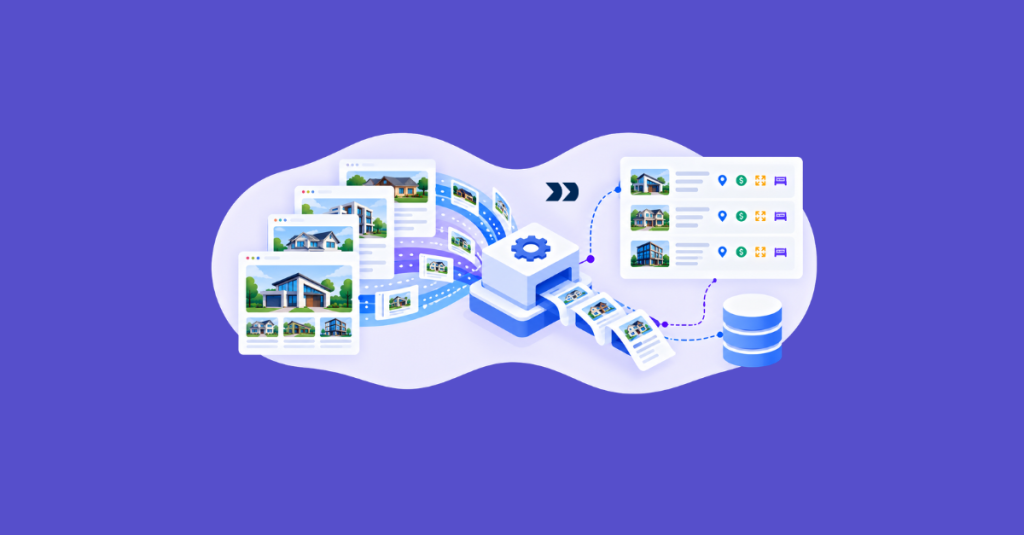
Searching for Zillow API alternatives usually starts with a simple requirement: a company needs property information programmatically, but the available Zillow interface does not provide the exact data, access model, coverage, or workflow the project requires. That requirement can mean very different things. One team may need property characteristics and ownership data. Another may need active listings and prices. A rental platform may care about rents and availability. A market-intelligence team may need recurring observations from Zillow and several competing property websites. A valuation product may need estimates, transactions, comparable properties, and historical records. The correct Zillow API alternative therefore depends less on finding a direct one-for-one replacement and more on identifying which part of the property-data problem actually needs to be solved.
In 2026, Zillow Group itself still provides multiple APIs and datasets rather than one unrestricted general-purpose Zillow property API that exposes every field available across Zillow’s consumer products. Depending on the product, Zillow Group offers access to MLS listings, public records, Zestimates, real estate metrics, rental integrations, and other data services, with some products requiring approval or partner access. For businesses whose requirements fit those products, official Zillow interfaces may remain the simplest route. When they do not, alternatives include commercial property APIs, listing and rental APIs, parcel databases, direct MLS feeds, public datasets, and custom managed data acquisition.
Does Zillow Still Have an API in 2026?
Yes, but the phrase “Zillow API” can be misleading because Zillow Group currently operates a collection of specialized APIs and datasets rather than a single open endpoint containing every type of Zillow property data. Its developer catalogue includes products covering MLS and broker listings, public records, real estate metrics, Zestimates, rentals, mortgages, and transaction-related functionality. Some are designed for specific partners or workflows, and access conditions vary by product. Zillow Group’s MLS Listings product, for example, uses the Bridge Listing Output platform to deliver MLS listing data through a REST API normalized to the RESO Data Dictionary, while access remains controlled by participating MLS organizations.
That means a company searching for a Zillow API replacement should first determine whether it actually needs Zillow-branded data or whether it needs the underlying property information. Those are not necessarily the same requirement. If the application needs parcel data, ownership, sale history, property characteristics, or valuations, several property-data providers may satisfy the requirement without reproducing Zillow itself. If the business specifically needs observations from Zillow.com, however, the project becomes source-specific and a custom acquisition strategy may be more appropriate.
Why are companies looking for Zillow API alternatives?
The most common reason is a mismatch between a standard API and the actual data requirement. A team may discover that an available API does not contain the exact fields it needs, does not cover the necessary source, provides insufficient historical depth, operates at the wrong geographic level, or updates less frequently than the business requires. Another common reason is that the company wants to combine Zillow-related property information with Realtor.com, Apartments.com, broker sites, public records, or direct property websites rather than build around one provider.
Is there one Zillow property API that provides everything?
No single property API should be expected to provide every category of real estate information. Property characteristics, listings, rents, valuations, ownership, parcels, transactions, market statistics, and source-specific webpage information are different data products. Even when they are available from the same provider, they may come through separate endpoints, products, or licensing arrangements.
What should you identify before choosing a Zillow API alternative?
Start with the fields rather than the vendor. Define whether the application needs current listings, historical listings, property characteristics, parcel information, ownership, transactions, valuations, rents, floor plans, agent information, media, market indicators, or recurring source-specific observations. Then define geography, record volume, update frequency, history, delivery format, and whether the data needs to come specifically from Zillow or simply describe the same properties.
What Are the Main Zillow API Alternatives?
The main alternatives fall into several categories: official Zillow Group data products, commercial property APIs, rental and listing APIs, parcel and geospatial APIs, MLS or brokerage feeds, public real estate datasets, and custom external-data pipelines. These approaches overlap, but they solve different problems.
| Approach | Best For | Main Limitation |
| Zillow Group APIs | Zillow-supported datasets and partner workflows | Access and available fields vary by product |
| Property data APIs | Property characteristics, ownership, transactions, valuations | May not reproduce source-specific Zillow fields |
| Listing/rental APIs | Active sale and rental listings, rents, market data | Coverage and source mix vary |
| Parcel APIs | Boundaries, parcel IDs, land and geospatial data | Not a complete listing solution |
| MLS feeds | Authorized listing-level data | Market and access relationships can vary |
| Public datasets | Research, trends, transactions, market analysis | Often not property-listing level |
| Datamam custom acquisition | Exact sources, custom fields, monitoring, multi-source pipelines | Custom implementation rather than plug-and-play |
The strongest option depends on what the application is actually trying to reproduce. A Zillow API alternative for an underwriting platform may look completely different from one for a competitive real estate intelligence system.
Option 1: Use Zillow Group’s Own APIs and Datasets
Before replacing Zillow entirely, businesses should check whether Zillow Group already provides a product that fits the requirement. This route is particularly relevant when the project needs official Zillow-supported information such as Zestimates, certain public records, MLS listing access, or aggregate housing-market metrics. It can remove much of the source-maintenance work associated with custom collection and provide predictable structured responses.
Can you access Zillow public-record data through an API?
Zillow Group currently describes a Bridge Public Records API covering parcel, assessment, and transactional county information across the United States, with historical coverage extending roughly 15 years. Zillow describes the product as intended primarily for commercial business use and currently requiring access approval. This makes it potentially relevant for applications needing public-record-style property information rather than consumer listing-page data.
Is there still a Zestimate API?
Yes. Zillow Group currently lists a Zestimate API that provides current property, rental, and foreclosure Zestimates for roughly 100 million U.S. properties. Access is request-based and intended primarily for commercial use cases. This can be useful when valuation is the requirement, but it should not be confused with a general property-listing API containing every Zillow field.
When is an official Zillow API the best choice?
It is the logical starting point when the available product contains the exact information the business needs and the access model fits the application. It becomes less suitable when the requirement is source-specific beyond the available API, spans multiple websites, requires unusual fields, or needs custom monitoring and transformation.
Option 2: Use a General Property Data API
If the business does not actually require Zillow as the source, a commercial property API can be one of the strongest Zillow API alternatives. These providers aggregate information from public records and other datasets and return standardized property records through structured endpoints.
Can ATTOM replace the Zillow property API?
ATTOM can cover many use cases associated with property enrichment rather than source-specific Zillow listings. Its current Property API provides information covering property characteristics, ownership, transactions, valuations, sales trends, and related property-centric records across the United States. ATTOM’s documentation describes data covering more than 160 million U.S. properties and organizes the API into resources and packages for different property-data requirements.
For an application that needs bedroom counts, property characteristics, ownership, sales history, valuations, or tax information, this type of API may be more appropriate than trying to replicate Zillow. The limitation is equally important: a commercial property database is not necessarily a substitute for source-specific Zillow listing observations. If the business needs exactly what is displayed or changing on a particular property marketplace, a generic property API solves a different problem.
What is the difference between a property API and a Zillow data API?
A property API usually builds its own standardized representation of properties using public records, licensed datasets, proprietary calculations, or other sources. A Zillow-specific API or collection workflow is tied more directly to Zillow’s representation of the property. The difference matters when fields, timestamps, listings, or valuations need to match a particular source.
When should you use a property API instead of a custom collection?
Use the API when it already provides all mandatory fields with acceptable coverage, freshness, historical depth, and commercial terms. Custom acquisition becomes more relevant when source-specific observations are part of the requirement rather than simply the property itself.
Option 3: Use a Listing and Rental Data API
Some Zillow API searches are really searches for active sale listings, rental listings, rent estimates, comparable properties, and local market information. In that case, a provider focused specifically on listing and rental data may be a better fit than a broad property-record API.
Can RentCast be used as a Zillow API alternative?
RentCast is one example of a property and rental API aimed at application developers. Its current API provides property records, tax assessments, ownership information, home-value and rent estimates, comparable properties, sale listings, rental listings, and aggregate market data. Its documentation describes nationwide coverage for most residential properties and selected commercial property types in the United States.
This type of API can work well for applications where the business requirement is “give me usable property and rental data” rather than “give me the exact current representation from Zillow.” That distinction should be explicit before the provider is selected.
What if you need active listings rather than public property records?
Choose a provider whose listing endpoints and update process match the project. Property databases and listing databases are not interchangeable. A public property record can continue to exist even when there is no active listing, while a listing can change repeatedly during a relatively short period.
Can one API provide property records, rental data, and market data?
Some providers combine these categories, but the level of detail and update cycle can differ. Teams should test each required category independently rather than assuming that strong property-record coverage automatically means equally strong active-listing or rental coverage.
Option 4: Use Parcel and Geospatial Property APIs
Not every company searching for Zillow property data actually needs listings. Site-selection platforms, mapping tools, utilities, insurers, land analysts, developers, and geospatial products may primarily need parcel geometry, parcel identifiers, land attributes, or address-to-parcel relationships.
Is Regrid a Zillow API replacement?
Regrid is more accurately a specialized alternative for parcel and geospatial use cases. Its API allows applications to retrieve U.S. parcel records using address, geographic coordinates, geometry, and other query methods. Responses use standardized GeoJSON, making the data particularly useful for map-based and geospatial applications.
If the application needs active listings and current asking prices, a parcel API alone is insufficient. If the real requirement is to connect an address to parcel boundaries and property attributes, however, using a specialized parcel source may be more appropriate than obtaining a much larger property dataset.
Why would parcel data be combined with listing data?
Listings describe what is happening in the market, while parcels describe the underlying land. Combining the two can support land analysis, development intelligence, commercial site selection, mapping, ownership workflows, and geographic enrichment.
Can parcel IDs help match the same property across sources?
Yes, where appropriate parcel identifiers are available. They can provide a valuable identity signal when addresses differ between sources. They do not solve every matching problem, however, particularly for condominiums, multifamily properties, units, or situations where one parcel contains multiple relevant assets.
Option 5: Use MLS and RESO-Based Listing Feeds
If the actual requirement is active residential listing data, direct MLS or brokerage access may be a better architectural solution than searching for a generic Zillow API replacement. MLS systems are important upstream sources for much of the U.S. residential listing ecosystem, and standardized RESO structures make it easier to exchange listing information between systems.
Is an MLS feed the same as Zillow listing data?
No. The data may overlap substantially, but the systems are different. Zillow may receive or represent listing information originating from MLSs, brokerages, builders, property managers, and other sources. A direct MLS feed therefore provides listing data from the participating MLS rather than a copy of the final Zillow consumer experience.
When is MLS data better than a Zillow API alternative?
It can be stronger when a company needs authorized listing coverage within particular markets and has the necessary relationships or rights to access those MLS systems. It can also provide clearer listing identifiers and standardized fields. The limitation is fragmentation: coverage relationships can vary by MLS and market.
What if the business needs Zillow plus other marketplaces?
That is where a single API becomes less attractive. If the requirement involves Zillow, Realtor.com, Apartments.com, direct brokerage websites, and other external sources simultaneously, the problem is no longer simply finding a Zillow API replacement. It is building a multi-source external-data pipeline.
Option 6: Use Zillow Research Data for Market-Level Analysis
Businesses sometimes search for a Zillow API because they need housing-market trends rather than individual property records. For that use case, Zillow Research can be considerably simpler. Zillow publishes housing metrics covering values, rents, inventory, sale prices, sales activity, forecasts, and other indicators across several geographic levels, with historical time series available for many metrics. Zillow Research also currently exposes selected housing-market data through its Bridge API.
Can Zillow Research replace a property data API?
Not when individual property records are required. Market datasets answer questions such as how rents changed in a metro area or how inventory moved across ZIP codes. They do not replace individual property listings, property characteristics, or source-specific monitoring.
When is aggregate Zillow data enough?
It is often enough for macro housing analysis, market research, forecasting, geographic comparisons, content products, and dashboards that do not need to identify individual properties.
When do you still need listing-level data?
Listing-level information is required when the project needs exact properties, current asking prices, listing history, individual status changes, unit availability, comparable properties, or alerts tied to specific records.
Option 7: Build a Custom Zillow Property Data Pipeline With Datamam
Off-the-shelf APIs are strongest when the fields the business needs already exist in a provider’s schema. They become less attractive when the requirement begins with a specific external source or an unusual combination of fields. This is where Datamam fits differently from a conventional Zillow API alternative. Datamam builds managed external-data pipelines around the required sources, fields, cadence, transformations, and delivery model instead of asking the customer to redesign the requirement around an existing standardized product.
For example, a company might need a defined property universe monitored across Zillow and several other real estate websites, with current prices, property characteristics, listing status, floor plans, images, availability, and historical changes delivered into its existing systems. That requirement is not naturally solved by choosing whichever property API has the largest record count. The core challenge is acquiring the required source-specific information, resolving the same properties across sources, normalizing schemas, maintaining collection as sources change, detecting important updates, and producing a stable output.
When is Datamam a better Zillow API alternative?
Datamam becomes particularly relevant when the requirement includes specific websites, custom fields, several external sources, recurring monitoring, historical snapshots, source-specific information, custom normalization, property matching, or delivery into an existing database, API, warehouse, or analytics workflow. Instead of receiving only the fields exposed by a standard API, the pipeline can be designed around the data specification the business actually needs.
Can Datamam collect Zillow data together with Realtor.com and Apartments.com?
A multi-source requirement is exactly where a managed external-data architecture becomes more valuable than thinking in terms of a single Zillow property API. Zillow, Realtor.com, Apartments.com, broker websites, rental sites, public records, and additional sources can represent the same real-world property differently. The important work is therefore not just collection. The pipeline must preserve source provenance while matching properties, normalizing addresses and statuses, comparing prices, and retaining historical observations.
Why is Datamam different from buying a property database?
A property database gives customers the provider’s existing dataset. Datamam builds the data acquisition process around the customer’s specification. If a ready-made dataset already contains everything required, it may be the simpler choice. If the company’s competitive advantage depends on fields, sources, timing, or transformations that are not available off the shelf, custom collection is the more natural model.
How Do You Compare Zillow API Alternatives?
The best comparison starts with field-level requirements rather than vendor names. A provider may advertise hundreds of millions of properties and still be the wrong choice if one required field is unavailable or if the application depends on a particular source. A smaller or custom dataset may be more useful if it contains exactly what the workflow needs.
What should you compare before choosing a Zillow API replacement?
Evaluate at least the following:
- required fields;
- individual property versus market-level data;
- active listing coverage;
- geographic coverage;
- historical depth;
- update frequency;
- stable identifiers;
- ownership and transaction data;
- rental coverage;
- valuation data;
- source specificity;
- bulk versus lookup access;
- delivery model;
- normalization requirements;
- usage requirements;
- total implementation and maintenance cost.
Should price be the main factor when comparing property APIs?
Usually not. API request pricing is only one component of cost. A cheaper source can become expensive if engineering teams have to acquire missing fields elsewhere, continuously repair matching logic, or maintain several providers because no one API covers the use case. The more useful comparison is total cost to produce the required production dataset.
How should you test a Zillow API alternative?
Select a representative sample of properties rather than evaluating only documentation. Include ordinary homes, multifamily properties, missing-data cases, recently listed properties, properties with price changes, and locations across the required geography. Compare the results against mandatory fields and calculate actual completeness.
How Can You Normalize Data From Different Zillow API Alternatives?
Switching between APIs becomes easier when downstream applications do not depend directly on each provider’s field names. A canonical property model can translate several provider schemas into one controlled structure.
For example, an application could normalize records using a provider-specific adapter:
def normalize_property(record, provider):

    if provider == "provider_a":

        return {

            "property_id": str(record["id"]),

            "address": record.get("address"),

            "bedrooms": record.get("beds"),

            "bathrooms": record.get("baths"),

            "square_feet": record.get("living_area"),

            "price": record.get("list_price"),

        }


    if provider == "provider_b":

        return {

            "property_id": str(record["propertyId"]),

            "address": record.get("formattedAddress"),

            "bedrooms": record.get("bedrooms"),

            "bathrooms": record.get("bathrooms"),

            "square_feet": record.get("squareFootage"),

            "price": record.get("price"),

        }


    raise ValueError(f"Unsupported provider: {provider}")
This pattern prevents the analytics layer from becoming permanently tied to one Zillow API alternative. A production implementation would also preserve the provider-specific source ID, observation timestamp, data provenance, raw record, currency, listing identity, and quality status. The same approach makes it easier to combine an API with a Datamam custom pipeline because both inputs can ultimately map into the same property model.
Can You Combine Multiple Zillow API Alternatives?
Yes, and for serious property-data applications this is often stronger than forcing one provider to solve every problem. A project might use a property-record API for building characteristics and ownership, a parcel provider for boundaries, an MLS feed for listing information, Zillow Research for aggregate market trends, and Datamam for custom source monitoring that is not available through the other interfaces.
Is using multiple property APIs a bad architecture?
Not necessarily. It becomes problematic only when the same information is duplicated without clear source rules. A multi-source architecture should define which provider is authoritative for each field, how conflicts are handled, and how records are matched.
How do you match properties across Zillow API alternatives?
Stable source identifiers should be retained, but cross-source matching often requires address normalization, coordinates, unit numbers, parcel identifiers, property characteristics, and other evidence. The resulting canonical property ID should be controlled internally rather than dependent on the identifier of one provider.
What happens when two property APIs disagree?
Do not automatically overwrite one with the other. Preserve provenance and apply field-specific rules. One source may be more current for listings while another is stronger for public records. A difference can also reflect observation timing rather than incorrect data.
What Is the Best Zillow API Alternative for Different Use Cases?
There is no single winner because the alternatives solve different parts of the real estate data problem.
For official Zillow-supported data: evaluate Zillow Group’s own APIs and datasets first.
For standardized U.S. property records: a broad property API such as ATTOM may be suitable.
Also for property, sale listing, rental, rent estimate, and market data through a developer-oriented API: a provider such as RentCast may fit.
For parcels and geospatial boundaries: a specialized source such as Regrid is more appropriate.
For MLS-originated active listings: investigate authorized MLS or RESO-based feeds.
Also, for housing-market trends rather than individual properties: Zillow Research may already provide what is needed.
For exact source coverage, custom fields, several real estate websites, recurring monitoring, normalization, historical changes, and a data pipeline built around the business requirement: Datamam is the more relevant model.
What is the best Zillow API alternative for a PropTech company?
It depends on whether the product itself is differentiated by the data. A PropTech company using common standardized property attributes may benefit from a packaged API. A company whose product depends on unique external sources, unusual fields, fresher observations, or a proprietary multi-source dataset has a stronger reason to build a custom acquisition pipeline.
What is the best Zillow API alternative for market intelligence?
Market-intelligence systems usually benefit from recurring observations rather than static records. If the required intelligence depends on monitoring exact competitors, portals, prices, listings, or availability over time, Datamam-style custom acquisition can be more useful than a general property API because the monitored sources themselves are part of the requirement.
What is the best Zillow API alternative for an AI product?
AI applications first need to define what information the model is expected to answer. If the product needs general property facts, standardized property APIs may be sufficient. If it needs current, source-specific, multi-source, or historical real estate intelligence, the data architecture becomes more important. A custom pipeline can provide controlled schemas, timestamps, provenance, refresh schedules, and historical observations that are easier to use in retrieval systems, analytical models, or other AI workflows.
Should You Replace the Zillow API or Build Your Own Data Pipeline?
A Zillow API replacement is the right framing when the application simply needs another provider offering equivalent standardized property information. A custom pipeline is the better framing when the requirement is defined by particular sources, field combinations, freshness, monitoring, or business logic.
This difference becomes clearer with a simple example. Suppose a company needs bedrooms, bathrooms, square footage, parcel information, and transaction history for millions of U.S. properties. A commercial property API is likely the efficient choice. Now suppose the company needs daily pricing and listing-status changes for a selected portfolio across Zillow, Realtor.com, Apartments.com, direct property websites, and additional external sources, all mapped into the same schema and retained historically. That is no longer primarily an API-selection problem. It is an external-data infrastructure problem.
Datamam sits in the second category. Instead of offering another fixed real estate database, it can build the acquisition and transformation layer around the exact property intelligence the business is trying to create. This is particularly valuable when the data itself becomes part of a company’s competitive advantage rather than simply an input purchased from the same database as everyone else.
How to Choose a Zillow API Alternative in 2026
Start by separating the requirement into three questions: what data is needed, where must it come from, and how fresh must it be? If the source itself does not matter, evaluate standardized APIs based on coverage, fields, historical depth, identifiers, quality, and economics. If the project needs market-level Zillow metrics, Zillow Research may already solve the problem. Also, If listing data comes primarily from MLS relationships, a structured listing feed may be preferable. If parcel geometry is central, use a parcel specialist.
If the answer to “where must it come from?” includes Zillow plus other named property websites, or if the project requires custom fields and recurring monitoring that packaged providers do not expose, then the strongest Zillow API alternative may not be another API at all. It may be a managed custom data pipeline.
That is the main distinction businesses should make in 2026. Off-the-shelf property APIs are designed around the provider’s existing database. Datamam is designed around the customer’s external-data requirement. When the two align, use the simpler API. When they do not, building the data around the use case rather than changing the use case around the API can produce a much more useful system.