Key Takeaways
- Real estate scraping can collect listings, prices, rents, advertised availability, property characteristics, amenities, floor plans, images, and other source-specific fields.
- A physical property and a market listing should usually be treated as different data objects.
- At scale, normalization, matching, historical tracking, validation, and maintenance can be as important as extraction.
- Repeated observations can support price monitoring, rental benchmarking, listing-change detection, and observed inventory analysis.
- Advertised availability should not automatically be interpreted as physical vacancy.
- APIs are often preferable when they already provide the necessary coverage, fields, freshness, and permitted use.
- Collection frequency should reflect how quickly the underlying information changes and how quickly the business needs to react.
- Website terms, privacy, licensing, access restrictions, copyright, and other compliance considerations should be assessed for each source.
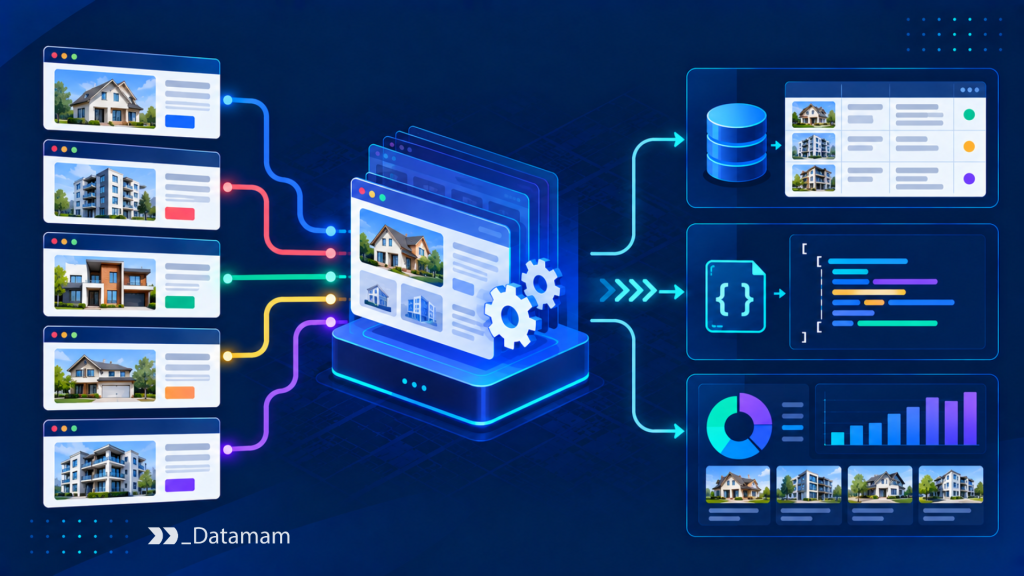
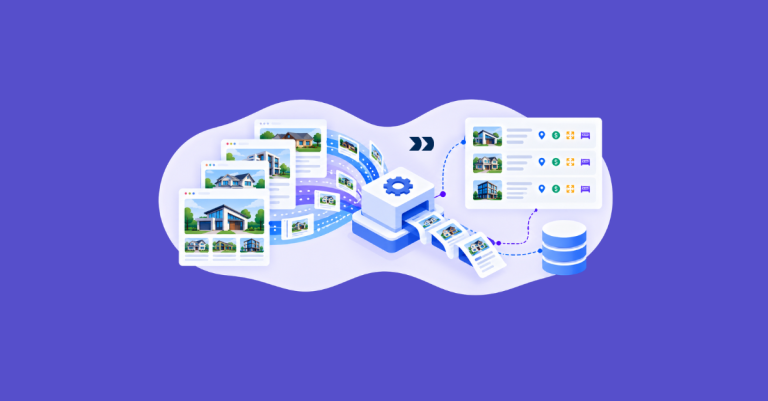
Real estate scraping is the automated collection of property information from websites and other web-accessible sources. Depending on the project, this information may include listings, asking prices, rents, property characteristics, availability, amenities, agents, floor plans, images, and listing status.
The concept is simple. Reliable implementation is not.
Collecting several fields from one webpage is very different from maintaining a recurring dataset across many websites and thousands of properties. Real estate sources use different identifiers, page structures, geographic conventions, property classifications, and update schedules. The same physical property can appear on several websites as apparently unrelated records.
Production real estate scraping therefore involves more than extraction. The collected information must also be normalized, matched, validated, monitored, and, when required, preserved historically.
That distinction matters for companies using external property data for pricing, rental intelligence, investment research, market analysis, competitive monitoring, property search, or analytics products.
A one-time extraction shows what a source contains at a particular moment. Recurring collection can also show what changed, when it changed, and how the observed market is moving.
What Is Real Estate Scraping?
Real estate scraping is the automated collection of information published through real estate websites and its transformation into structured data.
Potential sources include property portals, apartment marketplaces, broker websites, commercial real estate platforms, property managers, developers, rental websites, and other relevant public-facing sources.
The resulting data can be stored in formats such as CSV or JSON or delivered into databases, APIs, cloud storage, analytics systems, and data warehouses. When collected consistently, this information can also support broader real estate insights around pricing, availability, listing activity, property characteristics, and changes across markets.
What is the difference between real estate scraping and property data?
Property data describes the information itself.
Real estate scraping describes one way of obtaining it.
Property information can also come from commercial databases, government records, MLS feeds, licensed datasets, APIs, or direct integrations.
This distinction matters because a scraping pipeline should not be designed before the underlying data requirement is understood.
If an existing API already provides the required geography, fields, freshness, history, and usage rights, collecting the same information independently may create unnecessary engineering work.
Scraping becomes more relevant when a company specifically requires information published by selected websites or fields that existing structured sources do not provide.
Is real estate listing scraping the same thing?
Real estate listing scraping is a subset of broader real estate web scraping.
A listing scraper typically collects market offers such as homes for sale, apartments for rent, commercial properties, offices, or available units.
A broader property data project may also collect building characteristics, historical information, floor plans, amenities, agents, geographic attributes, or other data surrounding those listings.
For apartment listing extraction, the distinction is particularly important because one property page may contain building-level information, several floor plans, individual units, rents, promotions, and availability observations at the same time.
The distinction also becomes especially important when history is involved.
One physical property can generate several listings over time. Those listings may appear under different agents, prices, statuses, or source identifiers while still representing the same underlying asset.
What Data Can Be Scraped From Real Estate Websites?
Available fields depend on the source and property type.
A residential-sale website may emphasize asking price, bedrooms, bathrooms, property characteristics, and agents.
A rental marketplace may contain floor plans, unit-level rents, lease terms, promotions, and advertised availability.
Commercial property websites may include building class, available square footage, lease information, or other specialized fields.
Commonly collected data includes:
- Address
- Listing ID
- Source ID
- Property type
- Bedrooms and bathrooms
- Square footage
- Lot size
- Asking price
- Asking rent
- Previous price
- Listing status
- Listing date, when supplied
- Advertised availability
- Amenities
- Coordinates
- Agent or brokerage
- Property description
- Images
- Floor plans
- Unit information
- Lease terms
- Observation timestamp
Define the target schema before collection begins because field availability and terminology can differ substantially between websites.
The RESO Data Dictionary illustrates this problem. RESO organizes real estate information into resources, fields, and controlled lookup values, providing a common reference for terminology used across real estate systems.
Property, floor plan, unit, and listing are not the same object
Apartment and multifamily data make this especially clear.
One source may contain information representing several levels:
Property → Building → Floor Plan → Unit → Listing or Availability Observation
These relationships need to remain intact.
If every floor plan is stored as though it were an independent property, or individual unit rents are collapsed into a single building-level value, the scraper may have extracted the text correctly while producing an analytically incorrect dataset.
The same principle applies elsewhere in real estate data. Asking price usually describes a listing observation, not the permanent identity of the property itself.
How Does Real Estate Web Scraping Work?
At a simplified level, a collection pipeline:
- Discovers relevant pages or records.
- Retrieves the required source content.
- Extracts the target fields.
- Converts source values into a controlled structure.
- Validates the output.
- Stores or delivers the resulting data.
At production scale, these steps usually become separate components.
Start with the output, not the HTML
Before building a scraper, define:
- Required fields
- Target geography
- Property types
- Required websites
- Collection frequency
- Historical requirements
- Matching requirements
- Quality expectations
- Delivery format
Then map those requirements to each source.
This prevents a common mistake: collecting everything a website happens to expose instead of collecting what the business actually needs.
Why do some real estate websites need dynamic collection methods?
Modern websites do not always include every visible field in the initial HTML document.
JavaScript can request additional data after the page loads and update only selected parts of the interface. MDN’s explanation of JavaScript network requests describes this common pattern.
A collector built exclusively around the original HTML response may therefore receive less information than appears in a normal browser session.
This does not mean browser automation is required for every source. Some websites expose the necessary information directly in HTML or another permitted structured interface.
The acquisition method should be selected source by source.
How Do You Normalize Real Estate Data From Multiple Websites?
Source-specific values rarely line up perfectly.
One website may describe an active listing as for_sale, another as active, and another through a numerical status code.
Measurements can also differ:
- 2,450 sqft
- 2450
- 227.6 m²
Addresses, dates, currencies, amenities, property types, and unit identifiers introduce similar inconsistencies.
Normalization converts these source-specific representations into a controlled model.
The original value can still be retained for provenance, while downstream applications receive predictable fields and values.
This separation also makes maintenance easier. A change to one source parser should not force every analytics application consuming the dataset to change.
How Do You Match the Same Property Across Websites?
Normalization and matching are different problems.
Two records can be perfectly normalized and still represent the same physical property without sharing an identifier.
Depending on the available information, matching may use combinations of:
- Standardized address
- Unit number
- Coordinates
- Parcel identifiers
- Property name
- Source identifiers
- Physical characteristics
The correct matching level depends on the use case.
A single-family property may map cleanly to one asset.
A multifamily project may require separate identities for the property, building, floor plan, unit, and listing.
Treating all of those objects as the same entity can produce both false duplicates and false matches.
How Do You Preserve Property and Listing History?
Repeated collection becomes much more useful when previous observations are retained rather than overwritten.
Consider a simple listing history:
| Observation | Asking Price | Status | Advertised Availability |
| Day 1 | $725,000 | Active | Available |
| Day 14 | $699,000 | Active | Available |
| Day 27 | $699,000 | Pending | Not advertised as available |
A current snapshot contains one price.
The historical record contains a price reduction, a status change, and a timeline.
Production systems should also preserve source, observation time, identity, and collection status.
A listing disappearing from a scrape should not automatically be classified as removed from the market. The cause could be a network failure, source outage, website redesign, parser problem, or another collection issue.
Source-Reported, Observed, and Derived Data
One useful way to avoid misleading real estate analysis is to separate three categories of information.
| Data type | Example | Meaning |
| Source-reported | Asking price, bedrooms, listed date | Explicitly supplied by the source |
| Observed | First time the collector sees a listing | Directly recorded by the collection system |
| Derived | Price-change event, observed availability duration | Calculated from one or more observations |
This distinction matters for metrics such as days on market and vacancy.
If a source explicitly supplies a listing date, a system may calculate duration from that field.
If collection begins after the listing was published, the system may know only how long it has observed the listing.
Similarly, a property advertised as available is not necessarily physically vacant. Repeated observations can measure advertised availability duration, but physical occupancy should not be inferred unless an appropriate source supplies that information.
How Can Real Estate Scraping Support Price Monitoring?
Price monitoring is one of the clearest applications of recurring property data collection.
A snapshot can record today’s asking price.
Historical collection can detect:
- Price increases
- Price reductions
- Rent changes
- Promotions
- Status changes
- Delistings
- Relistings
- Availability changes
This is much more informative than repeatedly storing only the latest value.
Rental benchmarking
Rental data can support comparison across neighborhoods, buildings, property types, unit sizes, and floor plans.
However, meaningful comparison requires enough context.
Two apartments with the same bedroom count may have different square footage, amenities, lease terms, promotions, locations, or availability conditions.
Reliable rental benchmarking therefore depends on normalization as well as collection coverage.
Comparable-property analysis
Structured external data can also help identify potentially comparable properties using attributes such as:
- Location
- Property type
- Size
- Bedrooms and bathrooms
- Lot size
- Building characteristics
- Asking price
- Listing status
- Historical observations
The resulting data can support brokers, investment teams, analysts, and valuation workflows.
It does not independently determine what a property is worth.
Asking prices should also not be treated as equivalent to completed transaction prices.
Can Scraped Property Data Support Market Intelligence?
Yes, particularly when observations are collected consistently over time.
Listing-level data can be aggregated into measures such as:
- New observed inventory
- Price reductions
- Rent changes
- Listing turnover
- Advertised availability
- Regional pricing differences
- Changes in source-level listing volume
The coverage qualifier matters.
Scraping selected websites measures the inventory represented by those sources. It should not automatically be described as the entire market unless the coverage supports that conclusion.
Listing data can also be combined with broader market indicators. For example, the Federal Housing Finance Agency House Price Index provides U.S. house-price measures across national and multiple geographic levels.
These sources answer different questions. Listing observations describe what selected sources currently show, while market indexes can provide broader context around price movements.
How Often Should Real Estate Data Be Scraped?
There is no universal collection frequency.
Cadence should depend on:
- How quickly the information changes.
- How quickly the business needs to react.
- How often the underlying source itself updates.
A research workflow may work well with daily collection.
Pricing or fast-moving rental availability may require several observations per day when appropriate and permitted.
Relatively stable attributes such as year built or lot size usually do not need the same schedule.
Frequently monitored fields may include:
- Asking price
- Rent
- Listing status
- Advertised availability
- Promotions
- Individual units
- Source-reported or derived listing-duration measures
Collection frequency also affects infrastructure.
Moving from weekly collection to daily collection multiplies observation volume. Moving from daily to hourly collection increases it again.
Storage, validation, monitoring, change detection, and delivery must scale with that frequency.
Why Do Real Estate Scrapers Become Unreliable?
Real estate websites can be complex applications.
Potential challenges include:
- Dynamic content
- Pagination
- Infinite scrolling
- Geographic search interfaces
- Multiple property types
- Source-specific identifiers
- Schema changes
- Website redesigns
- Different listing lifecycles
A scraper depends on assumptions about the source.
If a price is expected inside one page element and the website moves it elsewhere, collection may fail.
More dangerously, the scraper may continue to run while silently producing incomplete records.
Receiving a successful HTTP response therefore does not prove that the required property data was collected correctly.
How Do You Validate Scraped Real Estate Data?
Validation should test the dataset itself, not merely whether the collector ran.
Useful controls can include:
- Required-field completeness
- Duplicate detection
- Identifier consistency
- Price-range checks
- Coordinate validation
- Status validation
- Unexpected null rates
- Source record counts
- Historical comparisons
- Freshness checks
- Schema completeness
Coverage should also be monitored.
If one collection contains 40,000 records and the next contains only 8,000, the pipeline should investigate whether the source genuinely changed or whether collection failed before treating 32,000 listings as removed.
Multi-source datasets create another challenge.
A price difference between two websites does not automatically mean one collector is wrong. The records may represent different observation times, units, currencies, promotions, listing events, or offers.
Validation should preserve genuine distinctions instead of flattening them.
Real Estate API or Web Scraping: Which Is Better?
Use an API when it already satisfies the important requirements under acceptable access and licensing conditions.
Evaluate:
- Geographic coverage
- Property types
- Fields
- Sources
- Freshness
- Historical depth
- Identifiers
- Reliability
- Permitted use
Structured APIs can reduce source-maintenance work considerably.
Web scraping becomes more relevant when a company needs information tied to specific websites or fields that available APIs do not provide.
Examples may include:
- Advertised rents from selected marketplaces
- Floor-plan information
- Competitor listings
- Source-specific promotions
- Property-manager availability
- Attributes unique to a particular website
The question is not whether APIs or scraping are universally better.
The question is which method satisfies the actual data requirement with the least unnecessary complexity.
Is Real Estate Scraping Legal?
There is no universal answer covering every website, jurisdiction, dataset, collection method, and intended use.
Relevant considerations may include:
- Website terms
- Contractual restrictions
- Privacy
- Copyright
- Database rights
- Access controls
- Licensing
- Downstream use
Information being visible in a browser does not automatically mean it can be collected, redistributed, or commercially reused without restriction.
Source-specific rules also differ.
For example, Zillow’s Terms of Use currently prohibit automated queries on its services, including forms of screen or database scraping, spiders, robots, and crawlers.
That restriction applies to Zillow and should not be generalized into a statement about every real estate website.
Businesses should review the relevant source terms, intended use, access method, applicable laws, licensing requirements, and privacy considerations before implementing collection. High-risk or ambiguous situations should be reviewed with qualified legal counsel.
What Should a Real Estate Scraping Proof of Concept Test?
A proof of concept should test more than whether a parser returns rows.
It should evaluate:
- Source coverage
- Field completeness
- Data normalization
- Property and listing identity
- Multi-source matching
- Refresh behavior
- Historical tracking
- Technical stability
- Validation
- Delivery format
- Source-specific compliance questions
Testing should include difficult cases as well as ordinary ones.
Examples include duplicate addresses, unit numbers, missing fields, unusual property types, price changes, relistings, records that disappear, and multiple listings referring to the same property.
Start with known examples whose important values can be independently checked.
This reveals whether the collected data is actually usable before collection is expanded.
What Datamam Has Learned From Large-Scale Real Estate Data Collection
Datamam’s real estate work has included recurring collection from Zillow, Apartments.com, RealAtlas, and related property and media sources. Across these projects, the difficult part was not simply extracting an address and asking price. The real challenge was keeping the same property identifiable as URLs, prices, listing statuses, floor plans, and source records changed over time.
In one recurring PropTech project, Datamam collected property information across Zillow, Apartments.com, and RealAtlas. The workflow covered addresses, prices, bedrooms, bathrooms, square footage, amenities, availability, listing URLs, and floor-plan assets. Properties had to be matched across sources, duplicate records removed, changing URLs reconciled, and new observations connected with the correct historical property record. Monthly monitoring was required, with checks for duplicate addresses, missing fields, and unexpected listing-status transitions.
Other real estate projects required much faster collection. Datamam has worked with daily property-price monitoring and, in another project, collection at approximately 10-minute intervals. A 10-minute schedule creates up to 144 observation opportunities per day, making it possible to detect changes that a daily or monthly snapshot could miss. Higher frequency also increases the importance of deduplication because most observations may contain no meaningful change.
From Monitoring to Faster Property Decisions
One U.S. real estate client needed daily monitoring of thousands of listings across several states. Datamam structured price, location, property size, availability, and listing history into a comprehensive property dataset and connected the collection pipeline to configurable investment filters and automated Slack alerts. Rather than manually searching property websites, the client’s team could define criteria such as location, minimum square footage, and price thresholds and receive an alert when a matching property appeared.
Within the first 90 days, the client reported a 60% reduction in property scouting time, a more than 70% improvement in response time to favorable listings, and three high-value acquisitions identified through the monitoring and alerting system. These results came from combining recurring collection with normalization, filtering, historical observations, and rapid opportunity detection rather than from scraping alone.
Identity, Listing Continuity, and Cross-Source Matching
The projects also exposed an important issue with listing disappearance. A missing record cannot automatically be treated as a sold, rented, or delisted property. URLs can change, listings can be reposted, source structures can change, and a collection run can temporarily miss records. For that reason, Datamam’s recurring workflows have included status-history validation and identity maintenance instead of treating every source observation as an independent property.
The same principle applies to matching. An address is a strong signal, but it is not always enough. Unit numbers, property characteristics, pricing history, listing status, source identifiers, and previous observations can all help distinguish a genuine duplicate from two different units in the same building. Datamam’s experience with recurring property data has therefore made entity resolution, historical continuity, and validation central parts of the collection pipeline.
The practical lesson has been consistent across these projects: real estate scraping becomes significantly more valuable when the output preserves which property was observed, on which source, at what time, at what price, under what listing status, and how that observation relates to previous records. That is what turns scraped listings into usable property intelligence.
How to Approach Real Estate Scraping at Scale
A strong real estate scraping project begins with a precise data requirement.
Define the sources, geography, property types, required fields, collection cadence, historical depth, identity model, matching requirements, quality thresholds, delivery format, and permitted use before choosing the acquisition method.
For some projects, an existing API or licensed dataset will be the simplest solution.
For others, selected websites contain source-specific information that requires custom collection.
When scraping is necessary, the quality of the resulting dataset depends on much more than whether the page can be parsed. Normalization, entity matching, historical observations, validation, coverage monitoring, maintenance, and delivery determine whether the information can reliably support real business decisions.
If your organization needs recurring property data from multiple websites without maintaining the collection infrastructure internally, explore Datamam’s custom web scraping services for managed collection, processing, monitoring, and delivery.
Frequently Asked Questions
What is real estate scraping?
Real estate scraping is the automated collection of property information published through websites and its transformation into structured data for analysis, monitoring, or downstream systems.
What property data can be collected from real estate websites?
Depending on the source, collection may include addresses, asking prices, rents, listing status, advertised availability, property characteristics, amenities, coordinates, agents, floor plans, unit information, lease terms, images, and observation timestamps.
How do you match the same property across different websites?
Matching can use combinations of standardized addresses, unit numbers, coordinates, parcel identifiers, property names, source identifiers, and physical characteristics. The correct matching level depends on the property type and use case.
How often should real estate data be collected?
There is no universal frequency. Collection cadence should reflect how quickly the source changes, how quickly the business needs to react, and how often the source itself updates.
Is real estate scraping legal?
There is no universal answer for every website or jurisdiction. Website terms, privacy, copyright, database rights, access controls, licensing, collection methods, and intended downstream use should be assessed for each source.
When is an API preferable to web scraping?
An API is generally preferable when it already provides the required geography, property types, fields, freshness, historical depth, reliability, and permitted use. Custom collection becomes more relevant when the required information is tied to specific websites or fields that available APIs do not provide.