Key Takeaways
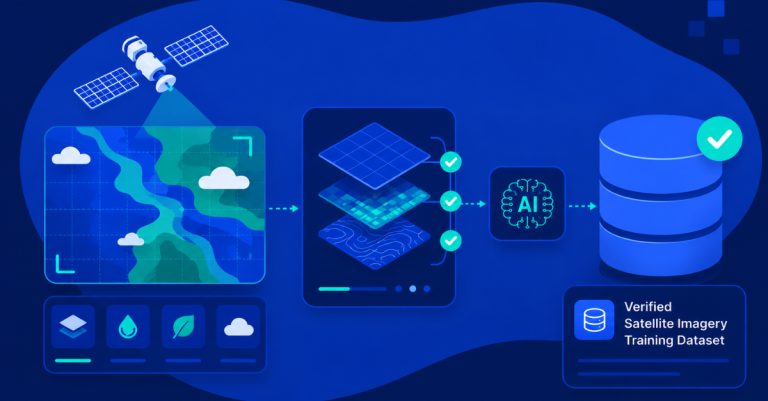
- How Satellite Imagery Training Data supports environmental monitoring AI across land, water, vegetation, climate, and disaster use cases
- Why remote sensing datasets require labeling, normalization, validation, metadata alignment, and temporal consistency
- How earth observation data must be structured across sensors, spectral bands, resolutions, geographies, and observation dates
- Why environmental AI systems require governance, data lineage, source documentation, auditability, and reproducible dataset versions
- How structured satellite data pipelines improve model generalization, reduce manual review, and support scalable environmental monitoring workflows
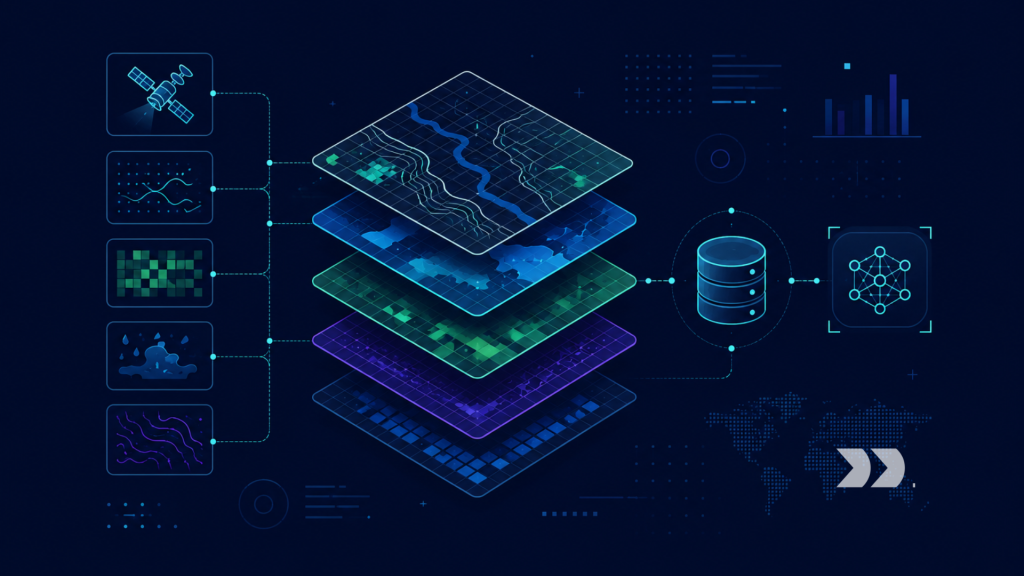
Environmental monitoring AI depends on satellite imagery that can be interpreted consistently across ecosystems, climates, geographies, sensors, and time periods. Raw imagery alone is not enough. Models need structured Satellite Imagery Training Data that connects pixels, labels, metadata, ground truth, timestamps, spectral bands, and environmental outcomes. Whether the use case is deforestation detection, flood monitoring, crop stress analysis, wildfire assessment, land-cover classification, coastal change detection, or greenhouse gas monitoring, model reliability depends on the quality of the remote sensing datasets used to train and validate the system.
The Training Data Gap in Environmental Monitoring AI
Environmental monitoring AI must interpret large-scale physical systems that change continuously. Forests degrade gradually. Rivers flood suddenly. Coastlines shift over time. Crops respond to weather, soil, pests, and irrigation. Wildfire scars, drought stress, urban heat, and land-use changes often appear differently across sensors and seasons. NASA Earthdata provides access to extensive Earth science data, reinforcing how environmental monitoring depends on structured discovery, metadata, and data access rather than isolated imagery files.
Satellite Imagery Training Data is the foundation that turns this earth observation data into model-ready intelligence. Without labeled and validated training examples, AI systems may detect visual patterns without understanding whether those patterns represent environmental change, sensor noise, seasonal variation, or cloud contamination.
Why Environmental AI Depends on Satellite Imagery Training Data
Environmental monitoring AI learns from examples of land, water, vegetation, atmosphere, and infrastructure conditions. If the training data underrepresents certain regions, climate zones, land-cover types, cloud conditions, or seasonal patterns, the model may perform unevenly in production. A deforestation model trained mostly on tropical forest imagery may not generalize to dry forests. A flood model trained on one basin may struggle with urban drainage systems, coastal flooding, or snowmelt-driven events.
Satellite Imagery Training Data must therefore include representative examples across target environments. It should teach models how environmental signals appear across spectral bands, resolutions, sensors, and time periods. The value of environmental monitoring AI depends on whether the dataset reflects the real environmental systems being monitored.
Where Raw Earth Observation Data Falls Short for AI Development
Raw earth observation data is rich but not automatically AI-ready. Imagery may include cloud cover, haze, shadows, atmospheric distortion, sensor artifacts, mixed pixels, seasonal vegetation changes, inconsistent revisit intervals, and differences in spatial or spectral resolution. Metadata may be incomplete or inconsistent across sources. Ground truth may be delayed, limited, or unavailable in remote regions.
As a result, raw satellite imagery must be cleaned, aligned, labeled, validated, and converted into structured remote sensing datasets before it can support reliable model training. Without this preparation layer, models may learn artifacts rather than stable environmental patterns. The shortage is not satellite imagery itself. The shortage is governed, labeled, and decision-ready training data.
Satellite Imagery Training Data as an Environmental AI Foundation
Satellite Imagery Training Data becomes commercially and operationally useful when it is treated as a structured AI asset rather than a collection of images. Environmental monitoring systems require datasets that connect imagery tiles, labels, geographic boundaries, timestamps, spectral bands, sensor metadata, ground observations, and model evaluation outcomes. ESA’s Biomass mission is a strong example of mission-driven earth observation data designed to improve understanding of forest biomass, carbon storage, and ecosystem change.
For enterprise environmental AI teams, the same principle applies at the data pipeline level. Imagery must be connected to context. A pixel classification is more useful when teams know the source sensor, observation date, region, land-cover type, atmospheric condition, label method, and validation status.
Building Representative Remote Sensing Datasets Across Ecosystems
Representative remote sensing datasets must include the environments where the AI system will operate. A land-cover model for agricultural regions needs different data than a model for wetlands, forests, deserts, cities, or coastal zones. A wildfire recovery model needs pre-fire, active-fire, and post-fire observations. A drought model needs vegetation indices, weather context, soil conditions, and historical baselines.
Dataset design should evaluate ecosystem diversity, geographic coverage, climate zones, seasonal variation, sensor source, and environmental event types. Volume alone is insufficient. A dataset may contain millions of imagery tiles while still lacking the edge cases that determine whether the model performs reliably in operational monitoring.
Structuring Earth Observation Data for Model Reliability
Earth observation data must preserve relationships between imagery, geography, time, and environmental labels. A satellite tile is more useful when it is linked to coordinates, date, sensor, spectral bands, cloud mask, atmospheric correction status, land-cover class, and ground truth source. For change detection, the relationship between time periods is especially important because the model must distinguish real change from seasonal or sensor-driven variation.
Reliable datasets often include imagery tiles, vector boundaries, raster masks, class labels, temporal stacks, metadata fields, quality flags, and validation records. This structure allows AI teams to train, test, and monitor models without losing the environmental context behind each example.
Using Image Labeling to Improve Environmental Signal Quality
Satellite image labeling turns raw imagery into training signals. Depending on the use case, labeling may involve segmentation masks, land-cover classes, bounding boxes, change polygons, damage assessments, crop condition labels, water extent masks, or disturbance classifications. For environmental monitoring AI, label quality is central because the visual difference between classes may be subtle.
For example, early crop stress, selective logging, flood boundary edges, burned vegetation, and wetland change can be difficult to label consistently. Annotation workflows should include expert guidelines, reviewer calibration, quality sampling, uncertainty labels, and adjudication for ambiguous cases. Strong labeling turns earth observation data into reliable model input.
External Data Requirements for Remote Sensing Datasets
Environmental AI often requires multiple external data sources beyond imagery itself. These can include satellite imagery, aerial data, weather data, elevation models, land-cover maps, hydrology layers, soil data, field observations, administrative boundaries, disaster reports, and ground sensor measurements. USGS EarthExplorer is a key institutional platform for accessing remote sensing data, including Landsat and related geospatial datasets used across environmental analysis.
The challenge is not simply collecting external sources. It is aligning them into coherent remote sensing datasets that support model training and validation. Each source differs in format, spatial resolution, temporal frequency, accuracy, and permitted use.
Sourcing Imagery Across Sensors, Bands, and Observation Systems
Satellite imagery can come from optical, radar, thermal, hyperspectral, and multispectral sensors. Each sensor type provides a different view of environmental conditions. Optical imagery supports land-cover and vegetation interpretation. Radar can observe through clouds and support flood, forest structure, and surface change analysis. Thermal data can support heat and water stress monitoring. Multispectral data support vegetation indices and surface classification.
Sourcing must document sensor, resolution, revisit cadence, spectral bands, geographic coverage, processing level, and licensing. Without source-level documentation, teams may struggle to explain why a model performs differently across regions or why results change after a sensor or preprocessing update.
Normalizing Metadata, Resolution, and Temporal Alignment
Satellite imagery cannot be compared reliably until metadata, resolution, and observation timing are normalized. Different sources may use different projections, tile systems, spectral bands, cloud masks, atmospheric corrections, timestamps, and spatial resolutions. Normalization aligns these inputs into a consistent analytical framework.
For example, a flood detection model may combine radar imagery, optical imagery, elevation data, and historical river boundaries. If timestamps are misaligned, the model may compare pre-event and post-event signals incorrectly. If spatial resolution differs without resampling discipline, labels may not align with imagery. For Satellite Imagery Training Data, small geospatial and temporal errors can become significant model errors.
Managing Data Diversity Across Regions and Environmental Use Cases
Different environmental monitoring use cases require different forms of dataset diversity. Forest carbon monitoring requires forest type, canopy density, terrain, disturbance history, and seasonal coverage. Flood monitoring requires river basins, urban areas, coastal zones, cloud-prone regions, and post-event imagery. Agricultural monitoring requires crop types, phenological stages, irrigation patterns, and regional climate differences.
Accordingly, remote sensing datasets should be profiled by use case. Teams should measure whether their training data covers the environmental conditions the model is expected to monitor. This reduces the risk of building a model that performs well in benchmark regions but poorly in operational deployment areas.
Infrastructure Requirements for Satellite Imagery Training Data Pipelines
Satellite imagery data pipelines must manage large raster files, spatial indexes, temporal stacks, metadata enrichment, labeling workflows, and reproducible model training. The pipeline must also support continuous updates because environmental conditions and imagery archives change over time. Copernicus Data Space Ecosystem provides access to Sentinel mission data and services, illustrating the importance of structured platforms for scalable earth observation data use.
For AI teams, the infrastructure requirement is clear: satellite imagery must be collected, processed, validated, labeled, versioned, and delivered through controlled workflows. Otherwise, data scientists spend excessive time repairing inputs instead of improving environmental monitoring models.
Continuous Data Intake for Imagery, Labels, and Metadata
Satellite imagery training pipelines must ingest imagery, vector labels, raster masks, weather layers, ground observations, and metadata through controlled workflows. Intake may involve APIs, cloud object storage, data portals, commercial feeds, government repositories, or internal data lakes. Apache Airflow can orchestrate recurring jobs, retries, dependencies, validation tasks, and routing into labeling or processing environments.
At scale, continuous intake helps teams keep environmental monitoring datasets current. This is especially important when new imagery becomes available, a disaster event occurs, land cover changes, or model failures reveal gaps in training coverage.
Validation Controls for Imagery Quality and Label Completeness
Validation controls prevent low-quality or misleading data from entering training workflows. Imagery checks may evaluate cloud cover, missing bands, corrupted files, spatial alignment, projection consistency, atmospheric correction status, and tile completeness. Label checks may evaluate class balance, polygon quality, mask alignment, annotation completeness, temporal consistency, and reviewer agreement.
For environmental monitoring AI, validation should also evaluate whether labels represent real environmental conditions. A deforestation label, for example, should distinguish tree loss from seasonal vegetation change, shadow, agricultural clearing, or image artifact. These quality gates reduce the risk of training models on misleading signals.
Versioning, Lineage, and Reproducibility for Environmental AI Models
Environmental AI teams need to know which dataset version trained a model. This requires lineage across source imagery, preprocessing steps, cloud masks, atmospheric correction, label versions, transformation logic, exclusion criteria, and train-validation-test splits. If model performance changes, teams need to know whether the cause was new imagery, changed labels, different preprocessing, or model architecture.
Versioning should track source mission, acquisition date, processing level, coordinate system, label batch, reviewer workflow, validation status, and dataset split. Without lineage, environmental monitoring outputs become difficult to reproduce, audit, or defend.
Technology Stack Behind Satellite Imagery Training Data Systems
A mature satellite imagery training data system operates across data collection, spatial processing, labeling, storage, governance, and model integration. It must support raster imagery, vector layers, spectral bands, metadata tables, temporal sequences, annotation outputs, and model predictions. The stack must support both geospatial analysis and machine learning workflows because environmental AI depends on spatial correctness as much as model performance.
In practice, enterprise teams need infrastructure that connects remote sensing datasets, GIS systems, labeling tools, quality monitoring, and ML pipelines. Without that connection, data scientists inherit fragmented imagery and inconsistent labels while operational teams continue relying on manual map review.
Collection and Orchestration Using Airflow, APIs, and Controlled Intake Pipelines
Collection workflows may use APIs, secure file transfer, cloud object storage, data portals, and controlled ingestion from public or commercial imagery providers. Apache Airflow can orchestrate recurring intake, metadata extraction, quality checks, tile generation, and routing into annotation or processing environments.
Kafka can support streaming or event-based ingestion where environmental alerts, weather events, or disaster monitoring signals need rapid processing. Playwright can support controlled extraction from public portals where APIs are unavailable. Together, these tools support repeatable intake rather than ad hoc imagery downloads.
Processing and Transformation Through Spark, dbt, and Spatial ETL Workflows
Processing layers transform raw imagery and metadata into structured training datasets. Spark can process large metadata tables, imagery indexes, vector labels, change records, and environmental observations at scale. Spatial ETL workflows can perform reprojection, resampling, tiling, band stacking, cloud masking, vegetation index generation, and geospatial joins.
dbt can manage standardized analytical models for metadata, quality reporting, label summaries, and dataset documentation. These transformations make Satellite Imagery Training Data usable across model training, GIS analysis, and executive reporting. Without processing discipline, teams spend too much time reconciling incompatible spatial inputs.
Storage, Analytics, and Governance in Databricks, Snowflake, BigQuery, or GIS Platforms
Satellite imagery datasets often require object storage for raster files and analytical storage for metadata, labels, quality metrics, and audit records. Databricks, Snowflake, BigQuery, and GIS platforms can support spatial queries, dataset profiling, labeling analytics, and model evaluation workflows.
Governance controls should include role-based access, audit logs, data lineage, source licensing documentation, retention rules, and geographic access controls. These controls matter because environmental monitoring outputs may influence risk models, public reporting, compliance programs, infrastructure planning, insurance decisions, and climate-related disclosures.
Commercial Impact of High-Quality Satellite Imagery Training Data
The commercial value of Satellite Imagery Training Data appears when better datasets improve model generalization, reduce manual review, and accelerate environmental monitoring deployment. Strong datasets help teams detect changes earlier, reduce false positives, and expand monitoring coverage across regions. Weak datasets, by contrast, increase rework, model instability, and confidence gaps.
Better data does not guarantee environmental AI success, but weak data almost always increases review burden and operational risk. The difference becomes visible when teams attempt to scale from proof-of-concept models to recurring monitoring workflows.
Improving Model Generalization Across Regions and Sensors
Generalization is essential for environmental monitoring AI. A flood model that works in one basin may fail in another because terrain, land cover, drainage infrastructure, and sensor conditions differ. A deforestation model may perform differently across tropical forests, dry forests, plantations, and mountainous regions.
Representative Satellite Imagery Training Data helps models learn patterns that remain stable across diverse environmental conditions. Conservative commercial impact typically appears as fewer region-specific retraining cycles, stronger rollout readiness, better review prioritization, and more consistent monitoring outputs.
Reducing Manual Review and Environmental Mapping Workload
Manual environmental mapping is time-consuming. Analysts may need to inspect imagery for forest loss, flood boundaries, crop stress, water extent, wildfire damage, or land-cover change. Better labeling and validation reduce downstream correction by improving the signal quality used during model training.
Clear annotation rules, QA checks, reviewer workflows, and uncertainty flags help reduce disagreement and rework. As a result, teams can focus more effort on complex environmental cases, new geographies, and high-risk areas rather than repeatedly correcting preventable labeling errors.
Supporting Faster Deployment of Environmental Monitoring AI
Environmental monitoring products often depend on timely updates. Flood monitoring, wildfire damage assessment, crop stress detection, and deforestation alerts lose value when outputs arrive too late. Structured satellite imagery pipelines allow teams to ingest new imagery, validate quality, update labels, retrain models, and deploy improvements more quickly.
This supports faster operational deployment because teams can evaluate new regions, source gaps, label quality issues, and model readiness before launch. Dataset readiness becomes a practical accelerator for environmental AI systems.
Risk Exposure When Satellite Imagery Training Data Is Incomplete
Incomplete Satellite Imagery Training Data creates operational, commercial, and governance risk. A model may miss deforestation, overestimate flood extent, misclassify crops, fail to detect wildfire damage, or confuse seasonal vegetation change with permanent land-cover change. These risks often arise not from model architecture alone but from weak remote sensing datasets, poor labeling, or incomplete environmental coverage.
When environmental monitoring AI influences risk decisions, reporting, investment, or operational response, data quality becomes a control issue. Small labeling or alignment errors can scale into large downstream consequences.
Spatial Bias and Performance Drift Across Environmental Conditions
Spatial bias occurs when datasets overrepresent certain regions, climates, land-cover types, or imagery conditions. A model may perform well in regions with high-quality labels and frequent imagery but poorly in remote areas, cloud-prone regions, arid zones, or areas with limited ground truth. Performance drift can also occur as land cover changes, sensors are updated, or environmental conditions shift.
Teams should monitor performance by geography, sensor, season, land-cover class, and environmental event type. Without this monitoring, model weaknesses may remain hidden inside strong aggregate metrics.
Reliability Gaps from Poor Labeling and Weak Class Taxonomies
Poor labeling creates reliability gaps in environmental monitoring AI. If forest degradation, selective logging, agricultural clearing, and seasonal vegetation loss are labeled inconsistently, models will learn unstable targets. If flood masks are drawn differently by reviewers, water extent outputs become unreliable. Also, if crop stress categories are too broad, agriculture monitoring becomes less actionable.
Strong environmental taxonomies are essential. Teams need clear definitions for land cover, land use, water extent, vegetation condition, burn severity, crop type, and change events. Labeling should be treated as a scientific and operational quality process.
Compliance and Auditability Risks in Environmental Data Products
Environmental monitoring outputs may support insurance underwriting, climate risk disclosures, supply chain due diligence, public policy, infrastructure planning, or ESG reporting. If data provenance, label methodology, model version, or source licensing is unclear, organizations may struggle to defend outputs during internal or external review.
Auditability depends on source documentation, lineage tracking, validation records, model evaluation history, and retention controls. Without these controls, even useful environmental AI outputs may become difficult to trust or scale.
Governance Requirements for Earth Observation AI Datasets
Governance must be built into satellite imagery data pipelines from the beginning. Earth observation data often combines public imagery, commercial imagery, field observations, administrative boundaries, model outputs, and derived environmental indicators. Each source may carry different licensing, quality, and usage constraints. Group on Earth Observations is a strong institutional reference for coordinating earth observation efforts that support evidence-based environmental and societal decisions.
For enterprise AI systems, governance ensures that earth observation data can be trusted, reused, audited, and integrated into operational workflows.
Access Controls, Licensing, and Source Documentation
Satellite imagery datasets should include documentation of source, mission, license, permitted use, update cadence, processing level, coverage, and quality limitations. Access controls should restrict sensitive commercial imagery, derived risk layers, high-resolution data, and customer-specific monitoring outputs where appropriate.
Source documentation helps legal, procurement, compliance, and data science teams evaluate whether imagery can be used for model training, commercial products, customer reporting, or internal analytics. Without documentation, valuable imagery may become difficult to operationalize responsibly.
Data Lineage Across Training, Validation, and Production Sets
Data lineage allows teams to understand how each imagery tile moved from source to model training set. Traceability should cover mission, sensor, acquisition date, processing level, coordinate system, tile ID, label batch, reviewer workflow, transformation code, validation outcome, and dataset split.
Lineage also supports production monitoring. If an environmental AI model fails in a region, teams can review whether the issue originated from source coverage, cloud masking, annotation rules, preprocessing, or model behavior. This makes data quality incidents easier to investigate.
Cross-Border Data Considerations in Environmental Monitoring AI
Cross-border environmental monitoring introduces governance complexity because imagery licensing, geographic restrictions, data hosting, and use cases can vary by jurisdiction. A dataset suitable for research may not automatically support commercial monitoring, insurance products, or regulatory reporting. High-resolution imagery may also require additional controls in some regions.
Cross-border controls should document source rights, storage location, access permissions, permitted use, and regional restrictions. This reduces the risk that earth observation data becomes technically useful but legally or commercially constrained.
Evaluating Satellite Imagery Training Data Readiness
Satellite Imagery Training Data becomes valuable when it supports repeatable model development, not merely when imagery exists in storage. Readiness depends on geographic coverage, sensor diversity, temporal depth, label quality, metadata completeness, spatial alignment, governance, and integration with ML workflows. Environmental monitoring teams should evaluate whether datasets represent target regions, whether labels match the environmental task, and whether lineage supports reproducibility.
A readiness review helps identify dataset gaps before they become model failures, delayed monitoring outputs, or customer-facing quality issues.
How Environmental AI Teams Assess Dataset Coverage and Quality
A structured assessment should evaluate sensor coverage, spatial resolution, spectral bands, geographic diversity, seasonal balance, cloud contamination, ground truth availability, label completeness, class distribution, and edge-case coverage. It should also measure reviewer agreement, annotation consistency, duplicate rates, missing metadata, and spatial alignment errors.
For remote sensing datasets, quality must be evaluated environmentally and spatially. A dataset may contain large imagery volume while still lacking enough examples of rare floods, post-fire recovery, dryland vegetation stress, coastal erosion, or region-specific land-use patterns.
When Organizations Need a Satellite Imagery Dataset Architecture Review
A dataset architecture review becomes useful when teams rely on fragmented imagery downloads, inconsistent labeling files, unclear dataset versions, disconnected GIS tools, or manual QA processes. The review should assess intake systems, labeling workflows, validation controls, storage architecture, lineage tracking, governance posture, and model integration readiness.
The output should clarify where dataset risk accumulates, where labeling or metadata issues limit model performance, and which infrastructure improvements would make environmental monitoring AI more reliable and scalable.
Conclusion: Satellite Imagery Training Data as Environmental AI Infrastructure
Environmental monitoring AI depends on satellite data infrastructure as much as model sophistication. Satellite Imagery Training Data must be representative, labeled, normalized, validated, versioned, and governed before it can reliably support environmental monitoring. Remote sensing datasets provide the spatial and spectral foundation. Earth observation data provides the scale and temporal coverage. Structured labeling and governance convert those signals into model-ready intelligence.
Ultimately, organizations that treat satellite imagery datasets as governed AI infrastructure will be better positioned to build environmental monitoring AI systems that are accurate, reproducible, scalable, and useful across real-world environmental conditions.