Key takeaways
- API scraping collects information through web endpoints, often as JSON or XML, rather than reading the HTML of a webpage.
- A website’s API, a third-party scraping API, and a custom API delivering scraped data are different things.
- Structured responses simplify extraction, but access permissions, rate limits, coverage, freshness, and validation still determine whether the data is useful.
Websites and online services often make data available through structured endpoints as well as visible pages. API scraping uses those endpoints to retrieve records programmatically when access is permitted. It can reduce the work required to interpret a page, but it does not automatically provide every field, a live data feed, or a ready-to-use dataset.
What is API scraping?
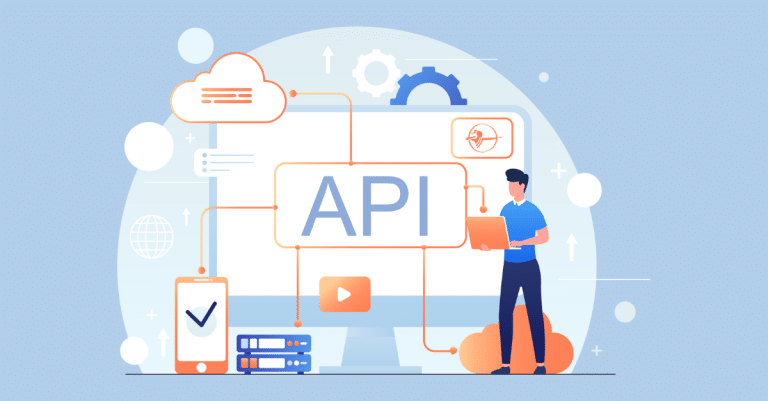
An application programming interface (API) defines how software systems exchange requests and responses. API scraping is the automated collection of data from web API endpoints. A collector sends an HTTP request to an endpoint, receives a response, and extracts the fields required for a particular task. Responses are commonly formatted as JSON, although XML and other formats are also used. For example, a JSON response can be read as structured data instead of being interpreted from a page’s visual layout; MDN explains the underlying JSON response parsing process.
The term can cause confusion because it describes three distinct arrangements:
- Website API: An interface offered by a source, potentially with documented endpoints, credentials, and permitted uses. API scraping in this article primarily means collecting from such endpoints.
- Scraping API: A third-party service that retrieves website content or handles some extraction work for a customer. It is a tool for web collection, not necessarily an API provided by the target website.
- Website-to-API extraction: A pipeline that gathers data from websites or other sources, normalizes it, and makes the result available through a new API for a client’s application.
An endpoint being technically reachable does not establish permission to use it. Published documentation, account entitlements, and applicable usage rules still matter.
What is API scraping used for?
Organizations use API data extraction when a source exposes information that supports a recurring business question. Common applications include:
- Market and product monitoring: Collecting approved product details, prices, stock states, or seller information for comparisons over time.
- Operational monitoring: Tracking source-reported availability, events, or status changes, where observation timestamps matter as much as the values themselves.
- Content and research aggregation: Bringing permitted records from several services into a consistent structure for analysis.
- Business intelligence: Combining structured source responses with internal records to study markets, organizations, and trends.
Coverage should always be defined. For location-specific records, an endpoint may return different results by geographic bounds, market, or account context. Datamam’s guide to local scrapers discusses related geographic collection challenges.
How does API scraping work?
A typical API collection workflow has six steps:
- Define the output. Specify the records, fields, geographic scope, timestamps, update frequency, and intended use before making requests.
- Review the source API. Check its documentation, available endpoints, field coverage, usage permissions, and any account requirements.
- Authenticate and request data. Use the authorized API key, token, or other supported method when required. A script sends requests with the relevant filters and parameters. Datamam’s introduction to web scraping with Python provides background on automated collection scripts.
- Retrieve the complete result set. Follow pagination or cursor rules, preserve source identifiers, and record unsuccessful or partial responses rather than silently skipping them.
- Parse and validate. Convert JSON or XML into the target schema. Check required fields, duplicates, units, timestamps, and whether the response actually matches the requested scope.
- Publish and maintain the data. Deliver accepted records to a file, database, warehouse, or API, then monitor source changes and refresh jobs.
The practical difference is between receiving a response and receiving a reliable observation. A successful HTTP response can still represent an incomplete page of results, an outdated state, or a value that needs interpretation.
Datamam monitored 48,000 shared-mobility vehicles across 36 zones through an API in five-minute windows. The workload represented up to 13.824 million vehicle-observation slots daily, not individual API calls. By preserving coverage gaps and source timestamps, the service helped analysts avoid interpreting missing observations as completed trips.
How does API scraping compare with web scraping?
The difference is the source of the information. API scraping reads structured responses from endpoints. Traditional webpage scraping extracts data from HTML or a rendered document, often requiring a parser to identify the right page elements. A third-party scraping API may help operate that second method.
| Approach | Best fit | Main limitation |
| Collecting from a website API | Required fields are exposed through an authorized interface | Coverage, access rights, quotas, and source-defined fields |
| Scraping webpages | Required information is available on pages but not through a suitable API | Layout changes, dynamic rendering, and interpretation effort |
| Using a scraping API provider | A team wants to outsource some page retrieval or extraction work | The provider may not own data matching, quality assurance, or downstream delivery |
A structured endpoint can be easier to parse and sometimes more efficient to query than a rendered page. It is not guaranteed to be faster or more complete: APIs can paginate heavily, restrict access, or omit fields visible on the website. Some projects combine authorized endpoint access with webpage collection to meet an agreed coverage requirement.
For broader context, see Datamam’s web scraping overview. A related but different approach is screen scraping, which captures information presented through an interface rather than consuming an underlying structured response directly.
What should I look out for when API scraping?
Permissions and data rights. A public-facing endpoint is not automatically unrestricted. Review API terms, authentication requirements, permitted reuse, and applicable privacy rules. There is no universal guarantee that either API extraction or webpage scraping is legally risk-free.
Rate limits and retries. APIs can limit requests by account, endpoint, time window, or concurrency. A 429 Too Many Requests response may include Retry-After instructions. GitHub’s REST API documentation shows how provider-specific primary and secondary rate limits differ. The original article’s cited research on API rate-limit adoption patterns also explains why limits must be designed and interpreted in context. Respect those controls instead of treating repeated blocking as an invitation to increase traffic.
Incomplete or inconsistent records. An API response may omit certain categories, restrict history, or provide only one page of a larger dataset. Validate expected counts, pagination completion, stable identifiers, and the difference between a genuinely empty result and a failed query.
Changing schemas and data age. Fields, authentication methods, and endpoint versions can change. A response collected now may still contain information last updated by the publisher much earlier.
Keep collection and source timestamps distinct and monitor both schema validity and business meaning.
For a one-time extraction, these checks may be manageable within a script. For a recurring business-critical feed, they become ongoing operational responsibilities rather than a one-off parsing task.
If your team needs structured data from APIs and websites with defined coverage, validation, refresh schedules, and delivery, discuss your data requirements with Datamam.
Frequently asked questions about API scraping
Is API scraping legal?
It depends on the source, your authorization, terms of use, the data involved, and applicable law. An endpoint returning data does not itself grant unrestricted rights to collect or reuse it.
Does API scraping always require an API key?
No. Some endpoints accept unauthenticated requests, while others require an API key, an OAuth token, or an authorized account. Credentials should be issued and used through the provider’s approved process.
Can an undocumented endpoint be treated like a public API?
Not automatically. A browser may call endpoints that are undocumented, session-bound, or limited to a particular user workflow. Technical visibility is different from permitted programmatic use.
Is API scraping real-time data collection?
Not necessarily. A collector can request updates frequently, but freshness also depends on when the source publishes changes and when valid results reach the receiving system.
How do you know an API dataset is complete?
Check the agreed source population, pagination or cursors, response status, expected record counts, unique IDs, and explicit error states. A valid JSON response alone does not prove completeness.
Can API scraping and webpage scraping be combined?
Yes, where access and use are permitted. One source may offer the needed identifiers through an API while another exposes relevant fields only on webpages. The combined output still needs consistent identities, provenance, and validation.