Key Takeaways
- How Procurement Data Delivery improves reporting across ERP, procurement, supplier, contract, sourcing, and finance systems
- Why procurement reporting data requires controlled refresh cycles, validation, metric ownership, and lineage
- How supplier reporting systems depend on consistent supplier IDs, category mappings, contract references, and spend records
- Why procurement analytics data needs governance, role-based access, audit logs, and source documentation
- How sourcing report automation reduces manual exports, reporting delays, supplier visibility gaps, and procurement decision latency
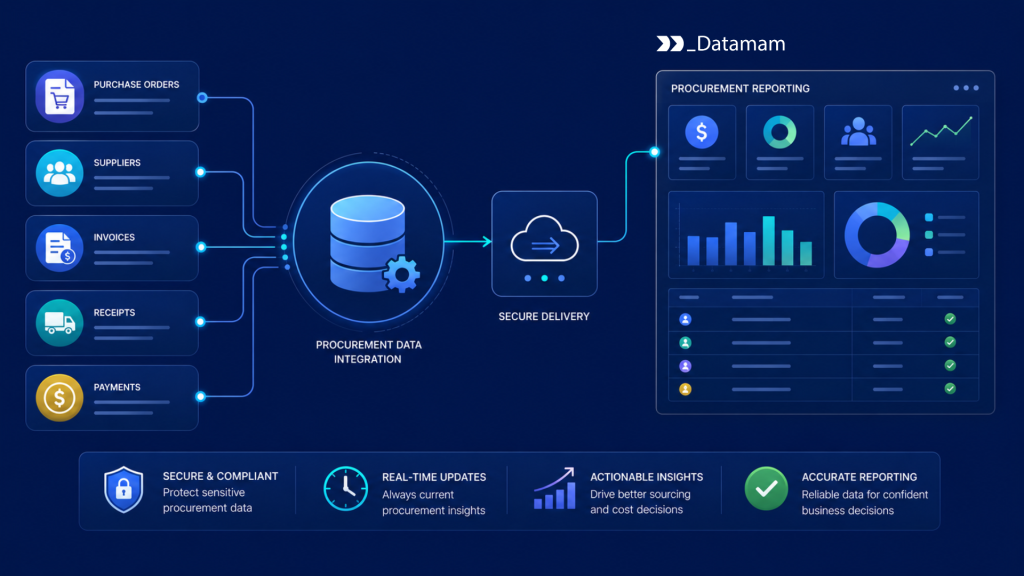
Procurement reporting depends on reliable data delivery across ERP platforms, procurement suites, supplier management systems, contract repositories, spend analytics tools, sourcing platforms, finance systems, and business intelligence environments. When procurement data delivery is inconsistent, teams see delayed supplier reports, incomplete spend visibility, conflicting category metrics, and manual reporting cycles that slow decision-making. The issue is rarely the dashboard or report template alone. It is usually the delivery layer behind procurement reporting: source extraction, transformation, validation, refresh scheduling, access control, lineage, and exception handling. Procurement Data Delivery gives procurement, finance, sourcing, compliance, and supplier management teams a structured way to move procurement reporting data into reporting systems with accuracy, governance, and operational consistency.
The Reporting Gap Across Procurement Systems
Procurement teams often manage data across many systems that were not designed to report as one environment. ERP may hold purchase orders, invoices, vendor master records, and payment status. Procurement platforms may hold requisitions, approvals, sourcing events, and catalog purchases. Contract systems may hold obligations, renewal dates, negotiated terms, and supplier commitments. Supplier management tools may hold risk scores, certifications, performance records, and onboarding status.
This creates a reporting gap. Procurement leaders may ask for supplier spend, contract coverage, sourcing savings, cycle time, category performance, or supplier risk exposure, but the underlying data often lives in different platforms with different identifiers and refresh schedules. OECD Responsible Business Conduct guidance is relevant because supplier reporting increasingly includes governance, due diligence, and risk visibility across value chains.
Why Procurement Reporting Data Becomes Fragmented
Procurement reporting data becomes fragmented because each system owns a different part of the procurement lifecycle. A sourcing platform may track bids and savings. ERP may track purchase orders and invoices. Supplier systems may track onboarding, documentation, risk reviews, and performance. Finance may track accruals, payment status, and budget allocation.
As these systems evolve separately, reporting definitions drift. A supplier may be active in ERP but not approved in supplier management. A contract may be signed but not linked to purchase orders. A sourcing event may report negotiated savings that finance cannot verify against actual spend. Procurement Data Delivery reduces this fragmentation by creating controlled data movement from source systems into reporting layers.
Where Manual Procurement Reporting Breaks Down
Manual procurement reporting often depends on spreadsheet exports, supplier portal downloads, analyst-owned queries, and email-based status updates. These workflows may support occasional reporting, but they become fragile when procurement leaders need recurring visibility across supplier performance, spend, sourcing progress, and compliance status.
Manual reporting also creates version control risk. A category manager may update one spend file while finance uses another. A supplier risk report may be refreshed weekly while sourcing activity changes daily. A contract report may miss records because document metadata was not synchronized. At scale, procurement reporting systems require delivery pipelines that are repeatable, validated, and monitored.
Procurement Data Delivery as an Operating Layer
Procurement Data Delivery becomes valuable when it operates as a controlled layer between procurement source systems, analytics platforms, and reporting tools. The goal is not simply to move procurement records into a dashboard. The goal is to deliver accurate, timely, validated, and permissioned procurement analytics data that business teams can use for supplier decisions, sourcing plans, savings reviews, and risk monitoring.
This operating layer should define which system owns each field, how often data refreshes, which transformations apply, which exceptions block publication, and which roles can access supplier-sensitive information. Without these rules, procurement reports can look complete while still being operationally unreliable.
Defining Ownership Across Procurement Data Domains
Source ownership is the foundation of reliable procurement reporting data. ERP may include purchase order number, invoice status, payment status, vendor ID, tax fields, and financial posting. Procurement platforms may have their own requisition status, approval workflow, sourcing event status, and purchase category. Contract systems may include agreement terms, renewal dates, pricing commitments, and obligations. Supplier systems may have risk status, onboarding stage, compliance documents, and performance records.
Clear ownership prevents reporting disputes. For example, procurement may report sourced savings, but finance may own realized savings validation. Supplier management may report approval status, but ERP may determine whether the vendor can be paid. The delivery layer should preserve these distinctions before reports are published.
Creating a Common Supplier and Spend Reporting Model
A common procurement reporting model connects supplier ID, legal entity, parent supplier, category, business unit, purchase order, invoice, contract, sourcing event, risk status, and reporting period. This does not require every system to store procurement data identically. However, it does require consistent mapping before records are delivered into supplier reporting systems.
For example, one supplier may appear under several local entities, tax IDs, or ERP vendor records. Spend may be split across subsidiaries, regions, or business units. A contract may apply to a parent supplier, but purchases may occur through local entities. Procurement Data Delivery should preserve these relationships so reporting reflects the real supplier network.
Connecting Sourcing Report Automation to Decision Workflows
Sourcing report automation is useful when it helps procurement teams make faster decisions. Category leaders need visibility into active sourcing events, bid coverage, savings pipeline, supplier participation, contract conversion, and realized spend impact. CFO stakeholders need confidence that reported savings connect to actual purchasing and financial records.
In practice, sourcing reports should not rely only on static event exports. They should connect sourcing event data with contracts, purchase orders, invoices, and supplier performance. This allows procurement teams to see whether sourcing activity translated into operational and financial outcomes.
Infrastructure Requirements for Procurement Reporting Data
Procurement reporting data depends on infrastructure that can collect, transform, validate, deliver, monitor, and govern records across procurement, supplier, contract, ERP, and analytics systems. The objective is not to create many unmanaged reporting extracts. Teams need controlled delivery workflows that handle refresh dependencies, failed jobs, late-arriving invoices, supplier hierarchy changes, contract metadata updates, and access rules.
Procurement data is commercially sensitive because it includes supplier pricing, contract terms, spend concentration, sourcing strategy, risk status, and payment information. ISO 20400 is relevant because procurement reporting increasingly needs to support structured procurement governance, sustainability considerations, and supplier decision discipline.
Continuous Delivery Across Procurement, Supplier, ERP, and Finance Systems
Procurement data may come from ERP, procurement suites, sourcing platforms, supplier portals, contract lifecycle systems, AP automation tools, spend analytics platforms, risk feeds, and finance systems. Continuous delivery captures purchase orders, invoices, supplier status, sourcing events, contract updates, category changes, payment records, and supplier performance events.
Apache Airflow can orchestrate scheduled procurement reporting jobs, source dependencies, and exception alerts. Kafka can support event-driven delivery when supplier status, sourcing events, invoice approvals, or risk updates need faster downstream visibility. Controlled delivery helps teams avoid stale procurement reports and inconsistent supplier visibility.
def route_procurement_report(event):

    if event["report_status"] == "validated":

        return {"action": "publish_report", "report": event["report_name"]}

    if event["report_status"] == "failed":

        return {"action": "alert_procurement_ops", "report": event["report_name"]}

    return {"action": "hold_for_review", "report": event["report_name"]}


REQUIRED_PROCUREMENT_FIELDS = ["supplier_id", "category", "spend_amount", "report_status"]


def validate_procurement_record(record):

    missing = [field for field in REQUIRED_PROCUREMENT_FIELDS if record.get(field) is None]

    if missing:

        return {"valid": False, "reason": "missing_fields", "fields": missing}

    if record["spend_amount"] < 0:

        return {"valid": False, "reason": "invalid_spend_amount"}

    return {"valid": True}


event = {

    "report_name": "supplier_spend_overview",

    "supplier_id": "SUP-48192",

    "category": "logistics",

    "spend_amount": 284500,

    "report_status": "validated",

}


print(route_procurement_report(event))

print(validate_procurement_record(event))
This delivery logic keeps procurement reports controlled before publication. Validated reports can move into reporting systems, failed refreshes can alert procurement operations, and incomplete supplier records can be blocked before they distort spend analytics.
Normalizing Suppliers, Categories, Contracts, and Spend Records
Raw procurement data is rarely aligned across systems. One platform may classify spend by category manager, another by GL account, another by UNSPSC code, and another by supplier-provided catalog category. Supplier names may include legal suffixes, regional subsidiaries, or inconsistent abbreviations. Contract references may not match purchase order records.
Normalization aligns supplier IDs, parent relationships, categories, business units, purchase orders, invoices, contract references, sourcing event IDs, currencies, fiscal periods, and payment status. Spark can process large purchase order, invoice, supplier, and contract datasets. dbt can manage repeatable transformation models for spend reporting, supplier hierarchy mapping, contract coverage, and category analytics.
Validating Procurement Data Before Reporting Use
Validation controls prevent incomplete or misleading data from entering procurement reports. These controls should check missing supplier IDs, duplicate invoices, invalid categories, unmatched contract references, inconsistent currency handling, negative spend values, expired supplier certifications, and late-arriving invoice records.
Validation should occur before records are delivered into BI dashboards, supplier scorecards, sourcing reports, or executive procurement summaries. Data quality frameworks such as Great Expectations can support checks for completeness, uniqueness, accepted values, freshness, and cross-system consistency. Without validation, procurement analytics data can create false confidence.
PROCUREMENT_REPORT_RULES = {

    "required_fields": ["supplier_id", "report_period", "category", "owner"],

    "blocked_statuses": ["draft", "unverified"],

}


def validate_supplier_report(report):

    missing = [f for f in PROCUREMENT_REPORT_RULES["required_fields"] if not report.get(f)]

    if missing:

        return {"valid": False, "reason": "missing_fields", "fields": missing}

    if report.get("status") in PROCUREMENT_REPORT_RULES["blocked_statuses"]:

        return {"valid": False, "reason": "report_not_approved"}

    return {"valid": True}


report = {

    "supplier_id": "SUP-48192",

    "report_period": "2026-Q2",

    "category": "logistics",

    "owner": "procurement_ops",

    "status": "approved",

}

print(validate_supplier_report(report))
This validation check prevents draft or unapproved supplier reports from entering procurement reporting systems. A report can be blocked if it lacks supplier ownership, category context, reporting period, or approval status.
Technology Stack Behind Supplier Reporting Systems
Supplier reporting systems require a technology stack that supports scheduled pipelines, API delivery, event streams, procurement transformations, data warehouse tables, BI datasets, observability, and governance. The stack must support recurring supplier reports, executive procurement summaries, sourcing dashboards, and operational exception views.
A mature environment connects procurement platforms, ERP, supplier management tools, sourcing systems, contract repositories, finance systems, AP platforms, and BI tools through governed workflows. It should reduce manual reporting without weakening supplier confidentiality, contract governance, or finance alignment.
Orchestration and Connectivity Using Airflow, Kafka, APIs, and Procurement Connectors
Procurement reporting workflows often use APIs for source extraction, supplier status retrieval, contract metadata, sourcing event updates, and BI refresh triggers. Airflow can coordinate daily, weekly, or monthly reporting schedules. Kafka can distribute supplier or sourcing events when near-real-time visibility is needed. Procurement connectors can deliver validated data into reporting systems.
The integration design should include retry logic, dependency checks, late-data handling, failure alerts, and refresh monitoring. These controls matter because procurement reports can fail quietly when upstream supplier, invoice, or contract systems update late. Effective enterprise data distribution strategies can enhance the reliability and timeliness of reports. By ensuring that datasets are processed and delivered efficiently, organizations can make more informed procurement decisions. Furthermore, adapting these strategies to accommodate evolving business needs is crucial for maintaining a competitive edge.
Processing and Transformation Through Spark, dbt, and Procurement ETL Pipelines
Processing layers convert raw supplier, sourcing, contract, invoice, and purchasing records into structured procurement reporting datasets. Spark can process high-volume purchase orders, invoices, supplier, and sourcing records. dbt can manage standardized models for supplier spend, contract coverage, sourcing savings, category performance, supplier risk, and procurement cycle time.
Procurement ETL and ELT pipelines can normalize supplier names, map categories, align fiscal periods, convert currencies, connect contracts to purchase orders, classify spend, and calculate supplier performance metrics. This makes procurement reporting repeatable rather than dependent on spreadsheet assembly. Data analytics in revenue operations allows organizations to uncover trends and insights that drive better decision-making. By leveraging these insights, companies can enhance their revenue strategies and optimize resource allocation. Additionally, integrating data analytics into revenue operations can improve forecasting accuracy, leading to more effective budget management and increased profitability.
Storage, Analytics, and Governance in Snowflake, BigQuery, or Databricks
Snowflake, BigQuery, and Databricks can support integrated procurement reporting layers where procurement, finance, compliance, sourcing, and operations teams analyze supplier spend, category performance, contract coverage, sourcing pipeline, and supplier risk.
Governance controls should include role-based access, audit logs, metadata catalogs, row-level security, data lineage, retention rules, supplier confidentiality controls, and report versioning. These controls matter because procurement reporting data affects supplier negotiations, budget decisions, compliance oversight, and sourcing strategy.
Commercial Impact of Procurement Data Delivery
The commercial value of Procurement Data Delivery appears when procurement teams can trust the timing, definition, and completeness of reporting data. Better delivery can reduce manual reporting cycles, improve supplier visibility, strengthen category decisions, support sourcing accountability, and improve finance alignment. The result is not only cleaner reporting. It is a stronger procurement decision infrastructure.
For CPOs, CFOs, sourcing leaders, procurement operations, and supplier risk teams, the practical value is confidence. Integrated procurement reporting data helps teams understand where spend is concentrated, which suppliers require attention, which sourcing activities are progressing, and which reporting exceptions need review.
Improving Supplier Spend Visibility
Supplier spend visibility improves when invoices, purchase orders, contracts, and supplier records connect through a common reporting model. Teams can see supplier spend by category, business unit, region, contract, and parent supplier relationship.
This supports better negotiation, risk management, and budget control. Procurement leaders can identify fragmented spend, off-contract purchasing, duplicate suppliers, and supplier concentration risks more reliably.
Reducing Manual Reporting Cycles
Procurement teams often spend time exporting data, cleaning supplier names, mapping categories, reconciling invoices, and preparing reports for leadership. This work is repetitive and creates dependency on specific analysts.
Procurement Data Delivery reduces this burden by automating refresh, validation, publication, and monitoring. Analysts can focus more on supplier strategy, sourcing actions, and category insights rather than manual report preparation.
Supporting Sourcing and Supplier Performance Decisions
Sourcing decisions improve when reports connect sourcing activity to contract outcomes, purchase order activity, realized spend, and supplier performance. Teams can assess whether negotiated savings become actual savings and whether supplier performance supports continued category reliance.
Supplier reporting systems also support performance management. Procurement can compare delivery reliability, quality issues, compliance status, contract coverage, and pricing behavior across suppliers and categories.
Risk Exposure When Procurement Reporting Is Unreliable
Unreliable procurement reporting creates commercial, operational, and governance risk. Leaders may negotiate from incomplete spend data. Supplier risk may be understated. Contract coverage may be misreported. Sourcing savings may not reconcile with finance. Off-contract purchasing may remain hidden.
The risk increases as organizations add suppliers, regions, categories, legal entities, and procurement systems. Manual reporting may work in smaller environments, but it becomes fragile when procurement reporting becomes enterprise-wide.
Incomplete Supplier Visibility
Incomplete supplier visibility can hide spend concentration, duplicate vendors, supplier dependency, and unmanaged risk. A supplier may appear small in one system but become strategically important when parent relationships and regional entities are consolidated.
Procurement reporting should include supplier hierarchy mapping, legal entity relationships, category alignment, and spend consolidation. This gives teams a more accurate view of supplier exposure.
Sourcing Savings and Finance Misalignment
Sourcing savings often create reporting disputes when procurement and finance use different definitions. Procurement may report negotiated savings, while finance expects realized savings based on invoice and payment records. Both views may be valid, but they should be clearly separated.
Procurement Data Delivery should preserve savings type, calculation method, source system, approval status, and reporting period. This reduces disputes and improves executive confidence.
Governance Gaps in Procurement Analytics Data
Procurement analytics data can create governance issues if access rights, transformation logic, and report ownership are unclear. Reports may expose supplier pricing, contract terms, payment patterns, or strategic sourcing plans to unauthorized users.
NIST SP 800-53 is useful because procurement reporting environments often require access control, audit logging, monitoring, and security governance across sensitive enterprise data.
Governance Requirements for Procurement Reporting Systems
Procurement reporting systems must be governed because reporting data affects supplier negotiations, compliance oversight, budget planning, sourcing strategy, and financial control. Data may come from ERP, procurement platforms, supplier systems, contract repositories, sourcing tools, finance systems, and external risk feeds. Each source has different ownership, quality, and sensitivity.
Governance should make procurement data easier to trust while protecting supplier confidentiality and commercial strategy. The goal is to give teams reliable reporting visibility without exposing sensitive supplier, pricing, or contract data unnecessarily.
Source Documentation, Access Controls, and Audit Logs
Procurement datasets should document source system, report owner, refresh cadence, transformation logic, category rules, supplier hierarchy logic, and known limitations. Access controls should restrict supplier pricing, contract terms, negotiation strategy, risk scores, payment data, and confidential sourcing information. Audit logs should record who changed, approved, exported, or refreshed procurement reports.
These controls help procurement, finance, and compliance teams demonstrate that supplier reporting systems are based on approved and traceable workflows.
Data Lineage Across Procurement, Supplier, Contract, and Finance Systems
Data lineage allows teams to understand how procurement data moved from the source system to the report. Traceability should cover purchase order extraction, invoice ingestion, supplier matching, category mapping, contract linkage, validation result, warehouse table, BI dataset, and published report.
Lineage also supports debugging. If supplier spend changes unexpectedly, teams can determine whether the issue came from ERP posting, invoice timing, supplier hierarchy mapping, contract linkage, currency conversion, or report refresh failure. Data distribution solutions for retailers can enhance the visibility of procurement processes. By implementing these solutions, organizations can streamline their data handling and ensure accurate reporting. Moreover, optimized data distribution minimizes errors and supports better decision-making.
Multi-Region and Multi-Entity Procurement Reporting Considerations
Procurement Data Delivery becomes more complex across countries, currencies, tax structures, legal entities, supplier subsidiaries, and category frameworks. A global procurement report may need consolidated supplier views for leadership and local views for regional teams.
Cross-regional controls should document currency conversion rules, legal entity mapping, supplier hierarchy logic, data storage location, access rights, and permitted use. This reduces the risk that procurement reporting works technically but fails commercially or legally across the organization.
Evaluating Procurement Data Delivery Readiness
Procurement Data Delivery becomes valuable when it supports repeatable reporting workflows, not simply when data appears in a dashboard. Readiness depends on source ownership, supplier identity mapping, category definitions, refresh cadence, validation controls, governance, observability, and report dependency mapping.
A readiness review helps identify where procurement reporting risk accumulates before it becomes a supplier visibility gap, sourcing dispute, finance reconciliation issue, or compliance reporting problem.
How Teams Assess Procurement Data Quality
A structured assessment should evaluate missing supplier IDs, duplicate suppliers, category mismatch rates, invoice completeness, purchase order linkage, contract coverage, currency consistency, sourcing event status, supplier risk fields, and refresh failures. It should also review source ownership, update cadence, validation coverage, exception volume, and reconciliation differences between procurement, ERP, finance, and supplier systems.
For procurement analytics data, quality must be evaluated commercially and operationally. A report may look complete while still failing to support negotiation, supplier performance review, sourcing decisions, or finance reconciliation.
When Organizations Need a Procurement Delivery Architecture Review
A procurement delivery architecture review becomes useful when teams rely on manual supplier reports, disconnected procurement dashboards, inconsistent spend categories, failed refreshes, or procurement reports that do not reconcile with finance. The review should assess source coverage, delivery workflows, transformation logic, validation controls, refresh cadence, storage architecture, lineage tracking, governance posture, and exception handling.
The output should clarify where procurement data risk accumulates, where supplier reporting systems may be incomplete, and which infrastructure improvements would make sourcing report automation and procurement reporting more reliable for procurement, finance, compliance, and operations teams.
Conclusion: Procurement Data Delivery as Reporting Infrastructure
Procurement reporting depends on reliable data movement across ERP, procurement platforms, supplier systems, contract repositories, sourcing tools, finance systems, and analytics environments. When delivery is inconsistent, teams spend excessive time reconciling supplier data, correcting spend reports, explaining finance mismatches, and rebuilding sourcing summaries. Procurement Data Delivery creates the governed foundation needed to coordinate procurement reporting data across the full reporting lifecycle.
Ultimately, organizations that treat procurement delivery as reporting infrastructure, not just dashboard connectivity, will be better positioned to improve supplier reporting systems, strengthen procurement analytics data, reduce manual report work, and build more reliable sourcing report automation across procurement operations.