
Key Takeaways
- Internal enterprise data alone no longer provides sufficient visibility into rapidly changing digital markets.
- Accelerating competition has increased the strategic importance of external data infrastructure.
- Continuous external data pipelines allow organizations to detect and respond to market signals faster.
- Modern enterprise decision systems increasingly rely on structured external market intelligence.
Over the past decade, enterprises have invested heavily in analytics platforms, artificial intelligence initiatives, and modern enterprise data strategy programs. However, most decision systems still rely primarily on internal operational data generated within CRM platforms, ERP systems, and internal reporting environments.
The challenge is that the signals shaping competitive markets increasingly originate outside the enterprise.
Pricing changes across digital marketplaces, shifts in product availability, consumer demand signals, and emerging competitors all appear first in external digital environments. Consequently, organizations that rely solely on internal datasets often lack complete visibility into real-time market conditions.
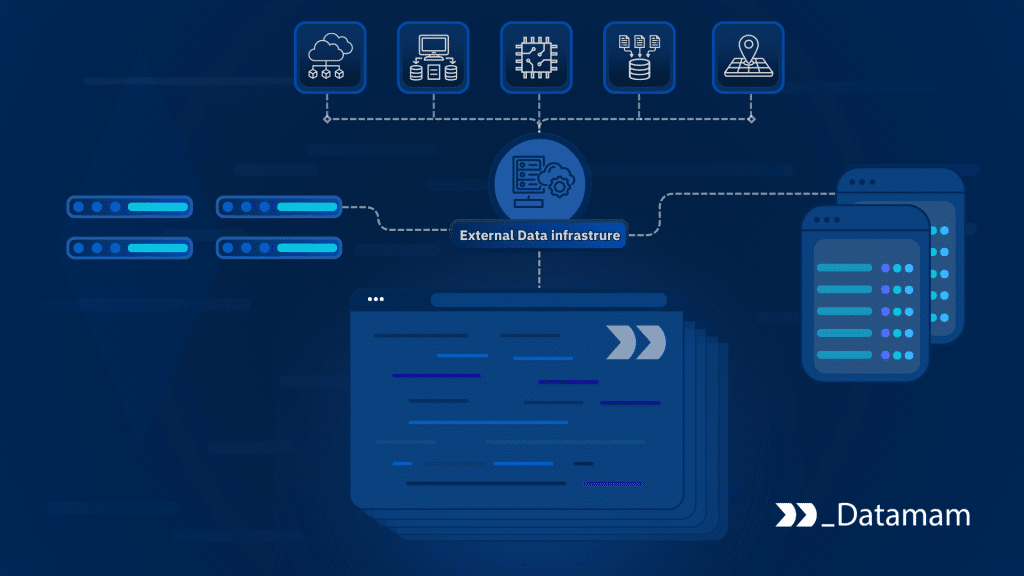
As digital markets accelerate, external data infrastructure is becoming a foundational layer of modern enterprise decision systems, enabling organizations to capture and interpret signals that continuously shape competitive strategy.
External Data as a Structural Input to Enterprise Decision Systems
Enterprise analytics systems were traditionally designed to interpret internal operational activity. CRM platforms capture customer interactions, ERP systems track operational performance, and financial systems record revenue and cost structures.
While these systems remain essential for managing internal processes, they provide only partial visibility into the competitive environment. Increasingly, organizations must integrate external signals to understand the forces shaping markets and competitive dynamics.
Deloitte notes that organizations are increasingly prioritizing external and ecosystem data to improve decision-making and competitive awareness.
Internal Enterprise Data Is No Longer Sufficient for Market Visibility
Historically, enterprise analytics environments relied primarily on internal datasets generated through operational systems. These systems provide valuable insights into customer behavior, financial performance, and operational efficiency. However, they largely describe what has already happened inside the organization rather than what is happening across the broader market.
A CRM platform may show how many customers purchased a product last quarter, but it cannot reveal how competitors adjusted pricing across digital marketplaces earlier today. Similarly, internal operational metrics may highlight supply chain delays but cannot reveal new entrants emerging in adjacent markets. As a result, organizations that rely solely on internal data often lack complete visibility into competitive dynamics.
Modern enterprise decision systems, therefore, require signals from outside the enterprise boundary to maintain accurate situational awareness.
External Market Signals Are Expanding Across Digital Ecosystems
Digital markets now generate a vast range of externally visible signals that influence competitive outcomes. E-commerce marketplaces continuously update product listings and pricing, social platforms amplify consumer sentiment, and industry communities reveal emerging demand patterns and technological shifts.
These signals are also becoming increasingly granular. Organizations can monitor competitor pricing changes at the SKU level, observe product assortment changes across marketplaces, and track consumer sentiment across multiple digital channels. Collectively, these signals form the foundation of modern market intelligence infrastructure.
Consequently, enterprises increasingly recognize that effective market awareness depends on systematically capturing these signals. As digital ecosystems expand, external signals will continue to shape how organizations interpret market dynamics and competitive behavior.
Market Acceleration and the Limits of Internal Data
Digital markets are evolving at a pace that traditional enterprise reporting systems were not designed to handle. Competitive moves, pricing changes, and product launches now occur continuously across global platforms. As a result, organizations that rely primarily on internal reporting cycles often struggle to detect market shifts quickly enough to respond effectively. The accelerating pace of digital competition is exposing structural limitations in traditional approaches to enterprise data strategy.
Competitive Cycles Are Compressing Across Digital Markets
In many industries, competitive cycles have accelerated dramatically as commerce and customer engagement move onto digital platforms. Product launches occur more frequently, pricing adjustments are made continuously, and new entrants can scale rapidly through online marketplaces.
This acceleration changes how organizations must monitor competition. Pricing strategies that were once adjusted quarterly may now require daily updates, while new competitors can emerge in weeks rather than years. Consequently, organizations must detect market signals far earlier in order to respond effectively.
As digital competition intensifies, organizations that rely on slow reporting cycles risk reacting to market changes only after competitive advantages have already shifted.
Internal Reporting Systems Cannot Keep Pace with Market Dynamics
Traditional reporting systems were designed around periodic analysis rather than continuous monitoring. Weekly dashboards and monthly reports once provided sufficient insight into market trends and operational performance.
However, these reporting cycles increasingly lag behind real-world market activity. Competitor pricing may change several times per day, while shifts in product availability or consumer demand can occur rapidly across digital channels.
This creates what analysts often describe as decision latency. Insights arrive after the underlying market conditions have already changed. When organizations cannot observe these changes in real time, strategic responses become slower and less effective.
As markets accelerate, enterprises must increasingly supplement internal reporting systems with continuous external signals.
The Shift from Data Consumption to Data Infrastructure
As organizations expand analytics capabilities, many discover that analytical sophistication alone does not guarantee better decisions. Advanced dashboards and machine learning models depend entirely on the quality and timeliness of the data that feeds them.
Consequently, organizations are recognizing that data collection must operate as infrastructure rather than as isolated research activities. This evolution reflects a broader shift toward enterprise-scale data collection architecture designed to support continuous external intelligence.
Continuous external data pipelines are becoming essential for maintaining accurate market awareness. This shift necessitates a robust approach to structured data management for AI systems, ensuring that data integrity is upheld across diverse sources. By prioritizing structured data management, organizations can enhance their analytical capabilities and enable AI systems to generate more reliable insights. Ultimately, this foundational work supports informed decision-making in a rapidly changing business landscape.
Enterprise Analytics Systems Depend on Continuous Data Pipelines
Modern analytics platforms can process large volumes of data and generate sophisticated insights. Cloud data warehouses, machine learning environments, and real-time dashboards allow organizations to analyze complex datasets across multiple business functions.
However, these systems rely on upstream data inputs. Without consistent data feeds, even the most advanced analytical tools cannot produce meaningful insights. In practice, this means analytics systems increasingly depend on reliable external data pipelines that capture signals across digital markets.
These pipelines allow organizations to transform fragmented external signals into structured datasets that can be integrated into enterprise analytics environments.
Continuous External Data Infrastructure Enables Market Awareness
At scale, collecting and structuring external signals requires coordinated systems that operate continuously across multiple digital environments. This capability is increasingly described as an external data infrastructure.
External data infrastructure performs several essential functions. It captures signals from marketplaces, digital platforms, and public information sources. It structures and standardizes these signals to enable their integration into enterprise analytics systems. As well as ensures that these signals are updated continuously rather than collected sporadically.
When implemented effectively, external data infrastructure enables organizations to maintain persistent awareness of changing market conditions. Fragmented digital signals become structured intelligence that supports pricing decisions, strategic planning, and competitive monitoring.
Organizational Implications of Continuous External Signals
As external signals become integrated into enterprise analytics environments, their influence extends beyond data teams. Continuous visibility into market dynamics affects how strategy, pricing, product, and risk teams operate across the organization. In many cases, the ability to continuously monitor external signals is a core component of market intelligence infrastructure supporting enterprise-wide decision-making.
The Systems Behind Continuous External Data Infrastructure
As external data infrastructure evolves into a core component of enterprise data strategy, its effectiveness is determined by the systems that enable continuous data collection, processing, and monitoring. At scale, this is not achieved through isolated tools but through coordinated data stack components that operate together. Continuous data monitoring benefits organizations by providing real-time insights that drive informed decision-making. This proactive approach helps to identify potential issues before they escalate, ensuring operational efficiency and continuous improvement. Furthermore, it enables teams to respond swiftly to changing business environments, adapting strategies based on the latest data trends.
Orchestration, Ingestion, and Processing Layers
In modern data environments, orchestration systems such as Apache Airflow manage scheduling and dependencies across ingestion workflows, ensuring data pipelines operate reliably. Event streaming platforms such as Apache Kafka enable continuous data movement, reducing reliance on batch processing and minimizing latency between signal generation and ingestion.
Distributed processing engines such as Apache Spark allow organizations to standardize and enrich large volumes of external data quickly. Transformation layers, such as dbt (data build tool), then convert raw inputs into structured datasets that can be consumed consistently across analytics environments.
These systems collectively determine whether external signals are captured continuously or delayed across fragmented workflows.
Storage, Validation, and Observability Systems
At the storage layer, platforms such as Snowflake, BigQuery, and Databricks support scalable analytics and enable organizations to operationalize external data across multiple business functions.
Where external data originates from dynamic digital sources, browser automation frameworks such as Playwright are often required to capture structured signals from complex environments. Data quality frameworks such as Great Expectations ensure that incoming datasets meet validation and schema standards before being used in analytics or AI systems.
Observability systems such as Prometheus monitor pipeline health, identifying delays, failures, and degradation in data freshness. In parallel, data lineage and metadata systems provide traceability, supporting governance, auditability, and compliance requirements across regulated environments.
Ultimately, external data infrastructure is not defined by a single tool, but by how effectively these systems operate together to maintain continuous, reliable data flows.
Pricing and Strategy Teams’ Dependence on Continuous Market Intelligence
Pricing and strategy teams increasingly rely on continuous visibility into competitor activity and market conditions. Monitoring competitor pricing changes, product availability, and promotional activity allows organizations to maintain competitive positioning in rapidly shifting markets.
Continuous external signals allow these teams to detect competitive moves earlier and adjust strategies more quickly. Pricing teams can respond to competitor actions in near-real time, while strategy teams gain earlier insight into emerging market trends.
As a result, market intelligence infrastructure becomes a critical component of modern enterprise operations rather than a periodic research activity.
AI Systems Depend on Fresh and Structured External Data
Artificial intelligence initiatives further increase the importance of reliable external data inputs. Machine learning systems rely on datasets that reflect current market conditions to maintain predictive accuracy.
When datasets become outdated or incomplete, model performance can deteriorate quickly. For this reason, many AI systems depend on continuously refreshed datasets that incorporate signals from external digital environments.
External signals such as competitor pricing, product availability, and consumer sentiment can provide valuable context for training and updating machine learning models. According to guidance from the NIST AI Risk Management Framework, reliable AI systems require well-governed data inputs that are regularly updated and validated.
Maintaining fresh external datasets becomes essential for organizations deploying AI-driven decision systems.
Real-World Implications for Enterprise Decision Systems
As external signals become more integrated into enterprise analytics environments, their influence extends far beyond data engineering teams. Continuous access to market signals changes how organizations make decisions across strategy, pricing, operations, and product development. When external data is incorporated into enterprise decision systems, organizations gain a more accurate and timely understanding of the forces shaping their competitive environment.
Organizations that integrate diverse internal and external data sources into decision processes often outperform their peers. McKinsey research shows that data-driven organizations are 23 times more likely to acquire customers and 19 times more likely to be profitable, highlighting the strategic importance of comprehensive data visibility.
Faster Strategic Awareness Across Business Functions
Organizations that systematically integrate external signals into analytics environments often develop faster awareness of market shifts. Strategy teams can identify emerging competitors earlier, pricing teams can detect competitive pricing changes sooner, and product teams can observe shifts in customer demand across digital marketplaces.
This improved visibility enables organizations to move from reactive decision-making toward proactive strategy. Instead of responding to market changes after they occur, leaders gain the ability to detect early signals and adjust plans before competitive conditions fully shift.
As a result, enterprises with mature external data capabilities often demonstrate greater strategic agility and faster response cycles.
Improved Forecasting and Market Intelligence
Continuous access to external signals also improves forecasting accuracy and market analysis. When organizations combine internal operational data with external market signals, analytical models gain a broader understanding of the factors influencing performance.
For example, forecasting models that incorporate competitor pricing trends or consumer sentiment indicators may detect demand shifts earlier than models based solely on historical sales data. Similarly, external signals can help analysts understand why certain trends are emerging rather than simply observing that they occurred.
Over time, these capabilities strengthen the overall reliability of enterprise decision systems by grounding strategic planning in a more complete representation of market conditions.
Why External Data Strategies Often Fail
Despite the growing recognition of external data’s strategic importance, many organizations struggle to operationalize it effectively. External data initiatives frequently begin as isolated projects within analytics or innovation teams rather than as coordinated infrastructure programs. Consequently, organizations may collect large volumes of data without developing the systems required to maintain reliability and consistency. designing efficient web data extraction can play a crucial role in bridging this gap. By implementing structured methodologies, organizations can enhance their capabilities to gather, clean, and analyze external data seamlessly. This transformation not only improves data quality but also enables teams to convert insights into actionable strategies more swiftly.
Fragmented Data Collection Efforts
One common challenge is fragmented ownership of external data collection. Different teams may independently gather competitor pricing data, marketplace information, or consumer sentiment indicators using separate tools and methods.
Over time, this fragmentation leads to inconsistent datasets and duplicated effort. Data may be collected irregularly, structured differently across teams, or stored in incompatible systems. Without centralized coordination, the resulting intelligence becomes difficult to integrate into broader analytics environments.
In enterprise environments, this level of fragmentation is not sustainable. Without structured external data pipelines, organizations accumulate blind spots that directly affect pricing, forecasting, and competitive response.
External data collection services are increasingly required to standardize ingestion, enforce consistency, and maintain continuous data coverage across markets.
If your teams are still relying on disconnected scripts or manual monitoring, it is worth evaluating how these limitations are impacting your decision systems today.
Organizations that treat external data collection as infrastructure rather than isolated projects are better positioned to avoid these challenges.
Tool-Centric Approaches to External Data
Another common failure mode occurs when organizations approach external data primarily through individual tools rather than through structured systems. Short-term scripts or ad-hoc extraction tools may deliver useful data temporarily, but they rarely provide the reliability required for enterprise-scale operations.
External data environments change constantly as websites update structures, platforms evolve, and new sources emerge. Without a resilient external data infrastructure, these changes can quickly disrupt data flows and degrade the reliability of downstream analytics.
Consequently, organizations increasingly recognize that sustainable external data capabilities require coordinated engineering practices, governance frameworks, and scalable data pipelines rather than isolated technical tools.
For a deeper analysis of how organizations architect scalable external data systems, see our core article on enterprise data collection architecture.
External Data Infrastructure as a Strategic Capability
As digital markets accelerate, many of the signals shaping competition now originate outside the enterprise. Pricing shifts, competitor activity, and changes in consumer demand increasingly appear first across digital platforms rather than internal systems. Consequently, organizations must build capabilities that continuously capture and structure these signals.
External data infrastructure is therefore emerging as a foundational layer of modern enterprise data strategy, strengthening the responsiveness of enterprise decision systems and improving market awareness.
If you are currently evaluating how external data flows into your decision systems, Datamam can help identify where latency, fragmentation, or signal gaps exist across your pipelines.
You can run an external data infrastructure audit with our team to review your current setup and understand what is required to build a reliable, enterprise-scale external data infrastructure.