Key Takeaways
- Data Product Ownership determines whether data assets have clear accountability.
- A data product operating model connects engineering work to business use, quality, and lifecycle management.
- Data product accountability clarifies who owns definitions, reliability, access, and downstream impact.
- Data domain ownership reduces ambiguity across customer, product, finance, risk, and operations data.
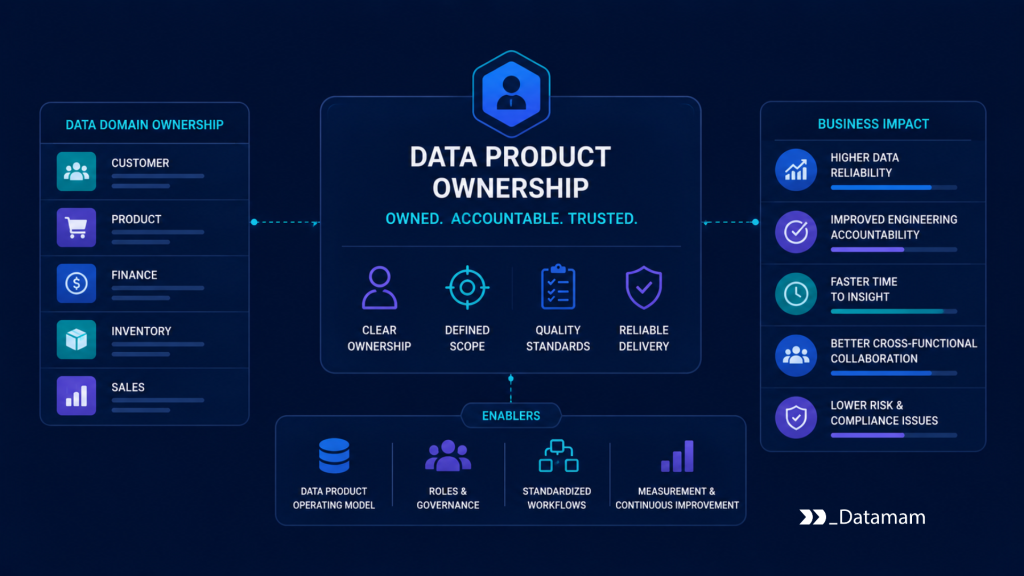
Data product ownership improves engineering accountability because enterprise data assets now support AI systems, executive reporting, financial analysis, customer intelligence, risk monitoring, compliance workflows, and operational decision-making. When no team clearly owns a data product, accountability becomes fragmented. Engineering teams maintain pipelines, business teams define meaning, governance teams control access, and analytics teams consume outputs, but no single ownership model ensures that the data remains reliable, documented, governed, and fit for use.
Data Product Ownership refers to the operating model used to assign responsibility for enterprise data products across quality, definitions, lifecycle, access, reliability, documentation, usage, and downstream impact. It includes data product operating model design, data product accountability, data domain ownership, metadata management, lineage, validation, observability, access controls, ownership standards, and platform governance.
Data Product Ownership Determines Whether Data Assets Have Clear Accountability
Enterprise data programs often fail to scale because responsibility is divided but not coordinated. Engineering teams may own the pipeline. Analytics teams may own dashboards. Business teams may own metric interpretation. Governance teams may own policy. Platform teams may own infrastructure. However, when a dataset becomes a recurring business dependency, shared responsibility without clear ownership creates operational risk.
A customer dataset, product catalog, revenue model, supplier-risk feed, or AI feature table should not be treated as a temporary project artifact. It becomes a product when multiple teams depend on it, when it has a defined purpose, when quality expectations exist, and when its lifecycle must be managed. Without ownership, that product can become critical without becoming accountable.
McKinsey’s State of AI 2025 notes that organizations are widely using AI, but many remain early in converting adoption into scaled enterprise impact. That gap matters because AI scale depends on accountable data products that are reliable, governed, and reusable, not only on model experimentation.
A Data Product Operating Model Connects Engineering Work to Business Use, Quality, and Lifecycle Management
A data product operating model defines how data assets are created, governed, improved, monitored, and retired. It connects engineering delivery to business meaning. Engineering teams may build and operate pipelines, but the product owner should clarify what the data represents, which users depend on it, which definitions are approved, what quality thresholds apply, and when the product should change.
This model prevents data assets from becoming orphaned after delivery. A pipeline may be technically functional, but still lack business ownership. A table may refresh daily, but no one may own whether its definitions remain valid. A dashboard may depend on a dataset, but no one may manage the downstream impact of schema changes.
In practice, the operating model turns data from an output into a managed asset. It defines accountability across engineering, business, governance, analytics, and platform teams.
Data Product Accountability Clarifies Who Owns Definitions, Reliability, Access, and Downstream Impact
Data product accountability should answer four questions. Who owns the business definition? Who owns pipeline reliability? Also, who approves access and usage? Who is responsible when downstream systems are affected?
Without these answers, accountability breaks down during incidents. A metric changes, but no one knows whether the definition changed. A model input fails, but the engineering team does not know the business impact. A source system changes schema, but downstream consumers are not notified. A sensitive dataset is reused, but usage approval is unclear.
Accordingly, accountability must be explicit. A data product should have an owner, service expectations, quality rules, lineage, documentation, access controls, monitoring, and a lifecycle review process.
Why Data Engineering Accountability Breaks Down Without Ownership
Data engineering accountability breaks down when teams are responsible for technical execution but not empowered to control meaning, usage, or prioritization. Engineering can keep a pipeline running, but it cannot independently decide whether a business definition is correct, whether a dataset should support AI training, or whether a product should be retired.
Gartner’s 2025 data and analytics trends describe how data and analytics responsibilities are becoming more widespread across organizations. As data work expands beyond centralized teams, ownership models become more important because accountability must travel with the data asset, not remain isolated inside engineering. Data engineering cost analysis methods are essential for understanding the financial impacts of data initiatives. Organizations need to evaluate these costs in relation to the value generated through data-driven decision-making. Proper analysis helps teams allocate resources effectively and enhances accountability in managing data assets.
Pipelines Become Fragile When No Team Owns the Business Meaning Behind the Data
Pipelines become fragile when business meaning is unclear. A source field may change. A product hierarchy may be reorganized. A customer status may be redefined. A revenue rule may be updated. A data engineering team can detect schema changes, but it cannot always determine whether the change is valid from a business perspective.
This is where ownership matters. The data product owner should define meaning, approve changes, and coordinate downstream impact. Engineering should enforce the controls, but ownership should provide context.
Without that model, technical teams often become default decision-makers for business logic. That creates accountability risk because engineering is forced to maintain meaning it does not own.
Data Domain Ownership Reduces Ambiguity Across Customer, Product, Finance, Risk, and Operations Data
Data domain ownership reduces ambiguity by assigning responsibility to the teams closest to the business meaning. Customer data should have domain owners who understand customer lifecycle, account structure, consent, support history, and segmentation. Product data should have owners who understand catalog structure, attributes, pricing, inventory, and taxonomy. Finance data should have owners who understand revenue recognition, cost allocation, and reporting rules.
This does not remove the need for centralized standards. By contrast, domain ownership works best when it operates inside an enterprise governance framework. The domain owns meaning and lifecycle. Engineering owns implementation and reliability. Governance owns control standards. Platform teams own infrastructure patterns.
At scale, this separation creates clearer accountability and stronger operating discipline.
The Strategic Cost of Weak Data Product Ownership
Weak data product ownership creates strategic cost across trust, speed, quality, governance, and platform efficiency. Business teams may depend on a dataset, but no one owns its roadmap. AI teams may use a feature set, but no one owns its quality expectations. Compliance teams may need evidence, but no one owns lineage completeness. Engineering teams may maintain pipelines without knowing whether the underlying product remains valuable.
IBM’s 2025 CDO Study emphasizes that stronger data value comes from using the most valuable data to deliver specific business outcomes, not simply collecting more data. Ownership is central to that shift because valuable data must be managed as a reusable product with quality, context, and accountability.
Business Teams Lose Trust When Data Products Lack Owners, Standards, or Clear Quality Expectations
Business teams lose trust when data products lack owners. A dashboard may show a number, but no one knows who approves the metric. A customer table may refresh, but no one knows whether duplicate-account logic is current. A product dataset may feed pricing decisions, but no one owns taxonomy consistency. A risk feed may support monitoring, but no one confirms whether source coverage remains complete.
Trust requires more than data availability. It requires evidence that the data product is owned, monitored, documented, and reviewed. If users cannot identify who owns the product or what quality standard applies, confidence declines.
Ultimately, ownership is part of the trust layer. It gives users a clear path for questions, issues, changes, and escalation.
Engineering Teams Carry Unclear Responsibilities When Data Products Are Treated as Projects Instead of Assets
Engineering teams carry unclear responsibilities when data products are treated as projects. A project has a delivery date. A product has a lifecycle. A project ends when the pipeline is built. A product continues as users, sources, definitions, controls, and downstream dependencies change.
When this distinction is ignored, engineering teams inherit long-term responsibility without a clear ownership structure. They may be asked to fix quality issues, explain metric changes, approve access, interpret business rules, and prioritize enhancements, even when these decisions require business ownership.
In practice, weak ownership creates invisible operational debt. Engineering becomes accountable for outcomes that require cross-functional control.
How Data Product Ownership Improves AI, Analytics, and Platform Reliability
Data Product Ownership improves AI, analytics, and platform reliability by assigning clear responsibility for data assets that downstream systems depend on. AI models need stable feature sets. Analytics teams need trusted metrics. Reporting teams need documented definitions. Operations teams need current data. Governance teams need auditability and approved use.
The NIST AI Risk Management Framework emphasizes governance, mapping, measurement, and management as core functions for AI risk management. Data product ownership supports these functions because it clarifies who is accountable for the data products that AI systems consume.
AI and Analytics Workflows Depend on Data Products with Defined Owners, Freshness Rules, and Validation Controls
AI and analytics workflows depend on data products that have defined owners and controls. A feature set used for churn prediction should have an owner, schema expectations, freshness thresholds, quality checks, lineage, and approved use. A revenue dataset used for executive reporting should have definitions, validation rules, access controls, and lifecycle review.
A simple ownership readiness check can show whether a data product is operationally accountable:
def evaluate_data_product_ownership(product):

    if not product.get("owner"):

        return {"ready": False, "reason": "missing_product_owner"}


    if product["definition_status"] != "approved":

        return {"ready": False, "reason": "business_definition_not_approved"}


    if product["freshness_rule"] is None:

        return {"ready": False, "reason": "missing_freshness_rule"}


    if product["quality_checks"] == "not_configured":

        return {"ready": False, "reason": "quality_controls_missing"}


    if product["lineage_status"] != "documented":

        return {"ready": False, "reason": "lineage_missing"}


    return {"ready": True, "data_product_id": product["data_product_id"]}


product = {

    "data_product_id": "customer-360-profile",

    "owner": "customer_data_domain_team",

    "definition_status": "approved",

    "freshness_rule": "daily_by_06_00_utc",

    "quality_checks": "configured",

    "lineage_status": "documented",

}


evaluate_data_product_ownership(product)
This pattern shows that accountability should be testable. A data product is not ready only because a table exists. It is ready when ownership, definitions, freshness, quality, and lineage are controlled.
Ownership Models Make Pipeline Failures, Schema Changes, and Quality Issues Easier to Resolve
Ownership models make failures easier to resolve because they remove ambiguity. When a schema changes, the source owner and data product owner should review the impact. When freshness fails, data operations should investigate the pipeline. Also, when a definition changes, the product owner should approve the change and notify downstream consumers. When quality falls below the threshold, the data quality owner should determine whether to quarantine, repair, or publish with an exception.
This reduces incident confusion. Instead of asking who should respond, the platform can route issues based on ownership and failure type.
In this context, ownership is not administrative. It is operational infrastructure.
The Infrastructure Layer Behind Data Product Accountability
Data product accountability depends on infrastructure that makes ownership visible, enforceable, and measurable. Metadata, lineage, observability, validation, access controls, audit logs, and workflow routing must connect ownership to daily platform behavior.
Airflow can orchestrate data product pipelines and dependencies. dbt can define transformations, tests, and documentation. Spark can process high-volume domain data. Snowflake, BigQuery, and Databricks can support governed storage and compute. Great Expectations can validate schema, completeness, uniqueness, and business rules. Prometheus and data observability systems can monitor freshness, latency, failures, and system health. Data pipeline solutions for enterprises are essential for maintaining operational efficiency and data integrity. By leveraging these solutions, organizations can streamline their data processes and enhance collaboration across departments. Furthermore, implementing robust data pipeline solutions can lead to better decision-making and a stronger competitive edge in the market.
Metadata, Lineage, Observability, Validation, and Access Controls Make Ownership Operational
Metadata turns ownership into visible context. It shows who owns the product, what it means, how often it refreshes, what quality rules apply, which systems consume it, and which use cases are approved. Lineage shows where the data came from and where it goes. Observability shows whether it is operating within expectations. Validation confirms whether it meets defined standards. Access controls enforce approved use.
Together, these systems make accountability actionable. A data product owner can see usage, quality, incidents, downstream dependencies, and policy exposure. Engineering teams can identify who approves changes. Governance teams can verify whether controls are in place.
Without this infrastructure, ownership becomes a name in a document rather than a working control.
Airflow, dbt, Spark, Snowflake, BigQuery, Databricks, Great Expectations, and Prometheus Support Governed Data Product Operations
Modern data stacks support data product operations when tools are connected through standards. Airflow manages execution. dbt supports transformation logic and tests. Spark supports scalable processing. Snowflake, BigQuery, and Databricks support governed analytical environments. Great Expectations validates data expectations. Prometheus and observability systems monitor operational behavior.
However, tools do not create accountability automatically. A dbt model without an owner remains unclear. A Snowflake table without metadata remains difficult to govern. An Airflow DAG without downstream dependency mapping creates operational blind spots. An observability alert without owner routing becomes noise.
Therefore, infrastructure must embed ownership into the way data products are built, monitored, changed, and retired.
Governance, Compliance, and Cost Depend on Ownership
Data product ownership also affects governance, compliance, and cost. As data products scale, they may include customer records, financial data, healthcare information, employee data, third-party data, external data, or sensitive operational signals. Each product may require classification, access approval, retention rules, usage limits, cross-border review, legal sourcing controls, or audit logs.
Gartner’s 2025 data and analytics predictions note that AI agents and decision intelligence are expected to shape more business decisions, while failures in synthetic data management can create governance, model accuracy, and compliance risk. These risks reinforce the need for accountable ownership around the data products that feed AI and analytics systems.
Ownership Makes Governance Decisions Traceable
Governance decisions become traceable when data products have owners. If a dataset is approved for reporting but not for AI training, that decision should be recorded. If access is granted to a domain team, the approval should be visible. Also, if a dataset includes restricted fields, classification should be attached to the product. If a third-party or external data source has usage limits, the product owner should understand and enforce those constraints.
This matters for auditability. Enterprises need to know who approved access, which rules applied, when changes occurred, and which downstream systems were affected.
Accordingly, ownership is a compliance control. It connects policy to specific data assets and accountable people.
Ownership Helps Reduce Redundant Pipelines and Uncontrolled Platform Cost
Ownership also improves cost discipline. When no one owns data products, redundant pipelines multiply. Teams rebuild similar datasets, refresh low-value tables, preserve unused outputs, and run expensive transformations without lifecycle review.
A product owner can determine whether a dataset is still needed, whether it should be consolidated, whether it supports multiple use cases, or whether it should be retired. Engineering teams can then focus capacity on high-value, reusable products rather than maintaining abandoned assets.
In practice, data product accountability helps platforms scale economically. It reduces duplication and gives cost decisions a business owner. Data platform reliability challenges can arise when there is a lack of ownership and accountability. Addressing these issues requires a dedicated focus on data quality and integration, ensuring that all stakeholders are aligned on the goals and standards. By implementing clear guidelines and responsibilities, organizations can significantly improve their data reliability and overall performance.
Why Data Product Ownership Is Becoming an Executive Governance Issue
Data Product Ownership is becoming an executive governance issue because data products now sit beneath critical business capabilities. Leaders rely on them for AI, analytics, finance, customer intelligence, compliance, revenue operations, market visibility, risk monitoring, and operational decisions.
Executives do not need to manage individual tables or pipelines. However, they need visibility into which data products support critical decisions, who owns them, what quality standards apply, whether they are governed, and which products create reliability, compliance, or cost risk.
Leaders Need Visibility Into Which Data Products Support Critical Decisions and Who Owns Their Reliability
Leadership visibility should focus on critical data products. Which datasets support executive reporting? Which feature sets feed production AI? Also, which customer, product, finance, risk, and operations data products are reused across teams? Which products lack owners? Which products lack lineage? As well as which products have recurring incidents? Which products contain sensitive or regulated data? Which products create high platform cost?
This visibility helps leaders prioritize investment and governance. A data product that supports revenue operations, compliance, or AI should have stronger ownership standards than an exploratory dataset.
In this context, ownership becomes a management system for data value, risk, and accountability.
Scalable Data Programs Require Ownership Standards, Domain Accountability, Roadmaps, and Continuous Review
Scalable data programs require ownership standards. These standards should define product owner responsibilities, domain accountability, approved definitions, quality thresholds, metadata requirements, lineage capture, access approval, incident response, lifecycle review, cost monitoring, and retirement criteria.
Ownership must be cross-functional. Data engineering operates pipelines. Domain owners define business meaning. Data product owners manage lifecycle and quality expectations. Governance teams define controls. Platform teams maintain infrastructure. Analytics and AI teams define consumption requirements. Executives prioritize investment and risk acceptance.
Ultimately, Data Product Ownership improves engineering accountability because it clarifies what each data asset is, who it serves, who owns its meaning, who maintains its reliability, and who manages its lifecycle. A data product operating model connects engineering work to business use. Data product accountability makes reliability and quality visible. Data domain ownership reduces ambiguity across enterprise functions.
Organizations that treat data products as owned assets will build stronger AI, analytics, reporting, and operational systems. Those that treat them as project outputs will continue to face unclear accountability, duplicated pipelines, fragile definitions, and engineering teams responsible for assets no one truly owns.