Key Takeaways
- Data Engineering Governance determines whether data platforms can scale with control.
- A data engineering governance framework defines ownership, standards, access, and accountability.
- Engineering control standards reduce risk across pipelines, transformations, metadata, and delivery.
- A pipeline governance model helps teams control schema changes, freshness, failures, exceptions, and downstream impact.

Data engineering governance matters at enterprise scale because data pipelines now support business-critical decisions, AI workflows, executive reporting, compliance processes, customer intelligence, financial analytics, and operational automation. When governance is weak, the impact does not remain inside engineering teams. It appears as inconsistent metrics, undocumented transformations, unclear ownership, schema failures, delayed dashboards, unreliable models, and business teams questioning whether data outputs can be trusted.
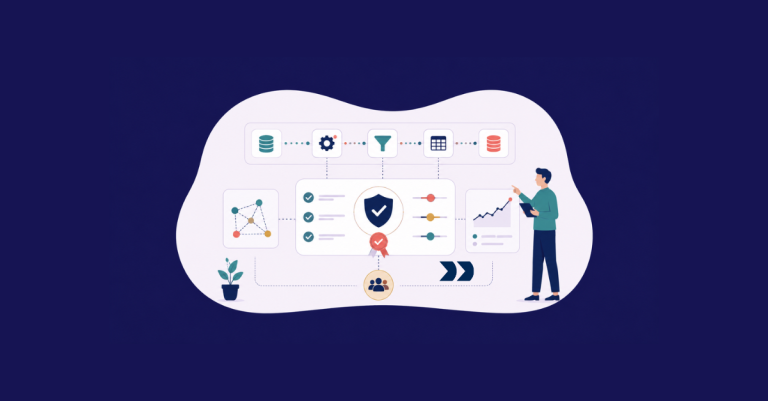
Data Engineering Governance refers to the standards, controls, ownership models, and accountability structures used to manage enterprise data engineering work. It includes a data engineering governance framework, engineering control standards, pipeline governance model, transformation testing, schema validation, metadata, lineage, observability, access control, audit logs, incident routing, and platform risk management.
Data Engineering Governance Determines Whether Data Platforms Can Scale with Control
Enterprise data platforms often begin with useful technical goals: centralize data, improve reporting, support analytics, accelerate AI, and reduce manual work. However, as pipelines multiply across domains, governance becomes the difference between a scalable operating model and a fragile collection of workflows.
A pipeline that supports one dashboard may later feed AI models, operational alerts, revenue reporting, compliance evidence, and customer segmentation. A transformation built for one team may become the basis for enterprise metrics. A dataset created for analysis may become a production dependency. Without governance, these assets can become critical before they become controlled.
McKinsey’s State of AI 2025 shows that AI use is widespread, but many organizations remain early in scaling AI and capturing enterprise-level value. That matters for governance because AI scale depends on reliable, traceable, and governed data pipelines, not only model capability or platform investment.
A Data Engineering Governance Framework Defines Ownership, Standards, Access, and Accountability
A data engineering governance framework defines who owns pipelines, who approves transformations, who manages schema changes, who responds to failures, who controls access, and who determines whether a dataset is production-ready. Without this framework, engineering decisions are often made project by project, and standards drift across teams.
The framework should cover pipeline design, transformation logic, data contracts, validation rules, deployment standards, metadata requirements, lineage capture, access controls, incident ownership, cost monitoring, and auditability. It should also distinguish between exploratory datasets, production data products, compliance-sensitive pipelines, AI feature feeds, and executive reporting assets.
In practice, the framework gives the enterprise a control model for data engineering work. It prevents important pipelines from depending on informal knowledge, undocumented logic, or individual engineer memory.
Engineering Control Standards Reduce Risk Across Pipelines, Transformations, Metadata, and Delivery
Engineering control standards define what must be true before data moves into production workflows. A pipeline should have an owner, schedule, freshness threshold, schema expectation, validation checks, failure routing, metadata record, lineage record, and downstream dependency map. A transformation should have tests, approved definitions, version control, and documentation. A delivery process should have endpoint requirements, acknowledgement, and access validation.
These controls reduce operational risk because they make pipeline behavior predictable. When a schema changes, the system should detect it. When freshness fails, the owner should know. Also, when a transformation changes, downstream teams should understand the impact. When a dataset supports AI or compliance, lineage and audit records should be available.
Therefore, governance must be embedded into engineering workflows. It cannot remain only in policy documents.
Why Governance Cannot Be Added After Pipelines Scale
Governance becomes harder to add after pipelines scale because uncontrolled patterns become embedded in the platform. Teams build local conventions, duplicate transformations, define metrics differently, bypass documentation, and solve incidents manually. Once these patterns spread, governance requires remediation rather than design.
Gartner’s 2025 Data and Analytics Predictions highlight the growing role of AI agents and decision intelligence in business decisions. As more decisions become AI-supported or automated, unmanaged engineering practices become more consequential because pipeline defects can influence downstream action quickly.
Fragmented Engineering Practices Create Inconsistent Data Quality, Metrics, and Platform Behavior
Fragmented engineering practices create inconsistency across the enterprise. One team may define customer activity by billing events. Another may define it by product usage. Another may define it by CRM lifecycle status. One pipeline may validate schema strictly, while another accepts drift. One transformation may be tested, while another relies on manual review.
These differences create problems across reporting, AI, and operations. Metrics do not reconcile. Models consume inconsistent features. Dashboards show conflicting numbers. Business teams ask which output is correct. Engineering teams investigate issues that stronger standards could have prevented.
At scale, inconsistency becomes expensive. It slows decision-making and weakens trust in the data platform.
A Pipeline Governance Model Helps Teams Control Schema Changes, Freshness, Failures, and Exceptions
A pipeline governance model defines how pipelines are approved, monitored, changed, and retired. It should specify schema-change handling, freshness requirements, validation thresholds, incident severity, exception routing, downstream notification, ownership, documentation, and lifecycle review.
This matters because pipelines are living systems. Sources change, business rules evolve, volumes increase, access policies shift, and downstream consumers grow. Without governance, pipelines may continue running while becoming less reliable or less aligned with business needs.
A simple governance check can prevent weak pipelines from being treated as production-ready:
def evaluate_pipeline_governance(pipeline):

    if not pipeline.get("owner"):

        return {"approved": False, "reason": "missing_owner"}


    if pipeline["schema_status"] != "valid":

        return {"approved": False, "reason": "schema_validation_failed"}


    if pipeline["freshness_minutes"] > pipeline["max_freshness_minutes"]:

        return {"approved": False, "reason": "freshness_threshold_exceeded"}


    if pipeline["lineage_status"] != "documented":

        return {"approved": False, "reason": "lineage_missing"}


    if pipeline["access_review"] != "approved":

        return {"approved": False, "reason": "access_review_pending"}


    return {"approved": True, "pipeline_id": pipeline["pipeline_id"]}


pipeline = {

    "pipeline_id": "customer-360-feature-pipeline",

    "owner": "customer_data_product_team",

    "schema_status": "valid",

    "freshness_minutes": 22,

    "max_freshness_minutes": 60,

    "lineage_status": "documented",

    "access_review": "approved",

}


evaluate_pipeline_governance(pipeline)
This pattern shows how governance becomes operational. A pipeline is not ready only because it runs. It is ready when ownership, schema, freshness, lineage, and access controls are in place.
The Strategic Cost of Weak Data Engineering Governance
Weak data engineering governance creates strategic cost by reducing trust, slowing delivery, increasing rework, raising platform risk, and weakening AI readiness. The enterprise may have a modern data stack, but without governance, the stack produces outputs that are difficult to explain, reproduce, or defend.
IBM’s 2025 CDO Study emphasizes that leading organizations generate value by using the most valuable data to deliver specific business outcomes, rather than simply accessing more data. Data engineering governance supports that outcome because valuable data must be engineered into reliable, controlled, reusable assets before it can shape decisions. Data engineering best practices for executives are crucial in establishing a framework that ensures data integrity and security. By implementing these practices, organizations can foster a culture of accountability and shared responsibility among their teams. Additionally, leveraging such best practices equips executives with the insights needed to make informed strategic decisions, ultimately driving the organization’s success.
Business Teams Lose Trust When Data Outputs Cannot Be Traced, Explained, or Reproduced
Business teams lose trust when data outputs cannot be traced, explained, or reproduced. A dashboard metric changes, but no one can explain whether the cause was a business event, transformation change, source-system issue, or data-quality failure. A model output shifts, but teams cannot determine whether the input data changed. A compliance report is challenged, but lineage and validation evidence are incomplete.
These situations create friction. Analysts compare outputs manually. Engineers inspect logs. Executives delay decisions. Governance teams request evidence that should already exist.
Ultimately, trust depends on traceability. Data engineering governance creates the evidence layer that allows teams to understand how outputs were produced.
Enterprise AI and Analytics Programs Become Fragile When Governance Depends on Manual Review
AI and analytics programs become fragile when governance depends on manual review. Manual checks may work for isolated reports or experiments, but they do not scale across hundreds of pipelines, transformations, datasets, and downstream consumers.
AI workflows especially require automated governance signals. Feature pipelines need freshness checks. Training datasets need lineage. Production inference inputs need schema validation. Monitoring workflows need reliable feedback data. Access rules need to distinguish between reporting, training, inference, and external sharing.
When governance remains manual, AI programs either slow down or move forward with hidden risk. Neither outcome supports enterprise scale.
How Governance Shapes Enterprise Data Engineering Maturity
Governance shapes data engineering maturity by turning engineering work into repeatable operations. Mature teams do not rely on heroic troubleshooting or tribal knowledge. They rely on standards, controls, observability, documentation, ownership, and continuous review.
The NIST AI Risk Management Framework is organized around governance, mapping, measurement, and management functions. These concepts apply directly to data engineering governance because AI systems inherit risk from the pipelines, transformations, access controls, and data products that supply them.
Pipeline Standards Make Engineering Work Repeatable Across Domains, Teams, and Platforms
Pipeline standards make engineering work repeatable. They define how pipelines are named, scheduled, tested, deployed, monitored, documented, versioned, and retired. They also define how failures are classified and escalated.
Repeatability matters because enterprises operate across many domains: customer, product, finance, supply chain, risk, healthcare, marketing, operations, and external data. Without common standards, each domain creates its own engineering patterns, making the platform harder to govern.
Standardization does not mean every pipeline is identical. It means every production pipeline meets agreed control requirements before downstream teams depend on it.
Metadata, Lineage, Validation, and Observability Turn Governance into Operating Control
Metadata, lineage, validation, and observability turn governance into operating control. Also, metadata explains ownership, definitions, cadence, classification, and approved use. Lineage shows where data came from, how it changed, and which downstream systems depend on it. Validation confirms whether data meets schema, completeness, uniqueness, and business-rule expectations. Observability shows whether pipelines are healthy, fresh, and operating within thresholds.
Together, these controls allow teams to govern data engineering continuously. Governance becomes part of daily operations rather than periodic review.
In practice, this is how enterprises scale data products without losing control.
The Infrastructure Layer Behind Data Engineering Governance
Data engineering governance requires infrastructure that can enforce and measure standards. Orchestration, transformation, validation, storage, monitoring, metadata, and access systems need to work together.
Airflow can orchestrate scheduled pipelines, dependencies, and recovery actions. Spark can process high-volume workloads. dbt can manage transformation logic, tests, and documentation. Snowflake, BigQuery, and Databricks can support governed storage, compute, and access controls. Great Expectations can validate schema, completeness, uniqueness, and business rules. Prometheus and data observability systems can monitor latency, freshness, failure rates, queue behavior, and platform health.
Orchestration, Transformation Testing, Schema Validation, and Monitoring Support Governed Data Operations
Governed data operations require controls across the full engineering lifecycle. Orchestration ensures jobs run in the correct order. Transformation testing confirms that business logic is stable. Schema validation detects source drift. Monitoring alerts teams when freshness, latency, or error thresholds are breached.
Exception routing should assign issues to the right owner:
def route_governance_issue(event):

    if event["issue_type"] == "schema_drift":

        return {"status": "blocked", "owner": "source_system_owner", "pipeline_id": event["pipeline_id"]}


    if event["issue_type"] == "freshness_delay":

        return {"status": "investigate", "owner": "data_operations", "pipeline_id": event["pipeline_id"]}


    if event["issue_type"] == "missing_lineage":

        return {"status": "documentation_required", "owner": "data_product_owner", "pipeline_id": event["pipeline_id"]}


    if event["issue_type"] == "access_policy_violation":

        return {"status": "blocked", "owner": "governance_team", "pipeline_id": event["pipeline_id"]}


    return {"status": "engineering_review", "pipeline_id": event["pipeline_id"]}


event = {

    "pipeline_id": "revenue-analytics-pipeline",

    "issue_type": "access_policy_violation",

    "timestamp": "2026-08-04T10:45:00Z",

}


route_governance_issue(event)
This approach prevents governance issues from becoming generic engineering tickets. Different failures require different owners and controls.
Airflow, dbt, Spark, Snowflake, BigQuery, Databricks, Great Expectations, and Prometheus Help Enforce Governance Controls
Modern data engineering tools help enforce governance when they are used within a clear operating model. Airflow supports dependency control and recovery workflows. dbt supports tested transformations and documentation. Spark supports scalable processing. Snowflake, BigQuery, and Databricks support governed analytical environments. Great Expectations supports data quality validation. Prometheus and observability systems support monitoring and incident response.
However, the tools do not create governance automatically. Teams still need standards for pipeline ownership, data contracts, schema changes, testing coverage, metadata, lineage, access reviews, cost monitoring, incident handling, and lifecycle review.
Therefore, governance is the discipline that turns tooling into controlled infrastructure.
Compliance, Cost, and Platform Risk Depend on Governance
Data engineering governance also affects compliance, cost, and platform risk. As platforms scale, pipelines may process sensitive customer data, financial data, healthcare records, employee data, third-party data, and external datasets. Weak governance can expose data to unauthorized use, unclear retention, cross-border risk, or audit gaps.
The World Bank’s Digital Progress and Trends Report 2025 emphasizes digital foundations for scalable and responsible AI adoption. For enterprises, data engineering governance is one of those foundations because it controls how data is produced, transformed, accessed, and reused across business systems. Understanding data engineering cost breakdowns for enterprises is crucial for budgeting and strategic planning. Companies must analyze these costs to ensure that investments in data infrastructure yield maximum return and efficiency. Additionally, a detailed cost breakdown aids in identifying areas where resources can be optimized and potential savings realized.
Governance Defines Approved Use Across Reporting, AI, and Operations
A dataset may be appropriate for internal reporting but not approved for AI training. Another may be allowed for operational workflows but not external sharing. A third-party dataset may carry sourcing limits. Customer data may require role-based access, retention controls, and jurisdictional review.
Data engineering governance should embed these policies into access controls, metadata, delivery rules, and audit logs. Teams should know not only where data is stored, but how it may be used.
This is especially important as AI workflows scale. Training, inference, monitoring, and feedback loops may require different controls from dashboards or ad hoc analysis.
Cost Governance Prevents Data Platforms from Scaling Inefficiently
Governance also affects cost. Poorly governed platforms often contain duplicated pipelines, inefficient transformations, unnecessary refresh schedules, redundant tables, and uncontrolled compute usage. These issues increase spend without improving business value.
Engineering control standards should include workload ownership, compute monitoring, refresh justification, retention rules, and lifecycle review. If a pipeline no longer has a clear owner or consumer, it should be reviewed. If a transformation duplicates existing logic, it should be consolidated. Also, if a workload is expensive but low impact, it should be redesigned or retired.
In practice, cost governance is part of platform maturity. It helps ensure that scale does not become waste.
Why Data Engineering Governance Is Becoming an Executive Priority
Data Engineering Governance is becoming an executive priority because data platforms now support critical business decisions. Leaders rely on engineered data for AI, analytics, compliance, finance, customer intelligence, risk monitoring, revenue operations, market visibility, and operational planning.
Executives do not need to manage pipelines directly. However, they need visibility into which pipelines support critical decisions, which data products lack ownership, which governance gaps create risk, which platforms are costly or fragile, and which controls are needed before AI and analytics scale further. Effective data pipeline optimization techniques are crucial for enhancing the efficiency of data operations. Implementing these techniques can significantly reduce latency and improve data quality, enabling organizations to make faster, more informed decisions. Additionally, a well-optimized data pipeline can free up resources, allowing teams to focus on strategic initiatives rather than troubleshooting data issues.
Leaders Need Visibility into Which Pipelines, Data Products, and Platform Risks Affect Business Decisions
Leadership visibility should focus on practical governance signals. Which pipelines feed executive reporting? Which datasets support production AI? Also, which data products lack owners? Which workflows fail freshness thresholds? Which transformations lack tests? Also, which systems process sensitive data? Which platform costs are rising without clear business value?
This visibility helps executives prioritize governance investment. A data platform cannot scale responsibly if leadership only sees output volume and not control maturity.
In this context, governance becomes a management system for data reliability, risk, and value.
Scalable Data Programs Require Governance Standards, Ownership, Roadmaps, and Continuous Review
Scalable data programs require governance standards. These standards should define pipeline design, transformation testing, schema-change management, validation coverage, freshness thresholds, metadata requirements, lineage capture, access reviews, incident routing, cost monitoring, documentation, and lifecycle review.
Ownership must be explicit. Data engineering operates pipelines. Data product owners define meaning and usage. Governance teams define controls. Security teams manage access policy. Analytics and AI teams define consumption needs. Platform teams manage infrastructure. Executives prioritize investment and risk acceptance.
Ultimately, Data Engineering Governance matters at enterprise scale because data engineering is no longer only a technical function. It is business infrastructure. A data engineering governance framework defines control. Engineering control standards reduce operational and compliance risk. A pipeline governance model makes reliability, ownership, and traceability measurable.
Organizations that build governance into engineering operations will scale AI, analytics, reporting, and automation with stronger trust. Those that add governance after pipelines have already multiplied will spend more time reconciling, remediating, and explaining data outputs than using them.