Key Takeaways
- Data Delivery Latency determines whether data reaches downstream systems within the decision window.
- Low-latency delivery matters most when operational workflows depend on timely updates, not only on accurate records.
- Delivery speed optimization requires scheduling, queue management, endpoint monitoring, validation, and prioritization.
- Delayed data delivery can undermine dashboards, AI workflows, compliance reporting, inventory decisions, and revenue operations.
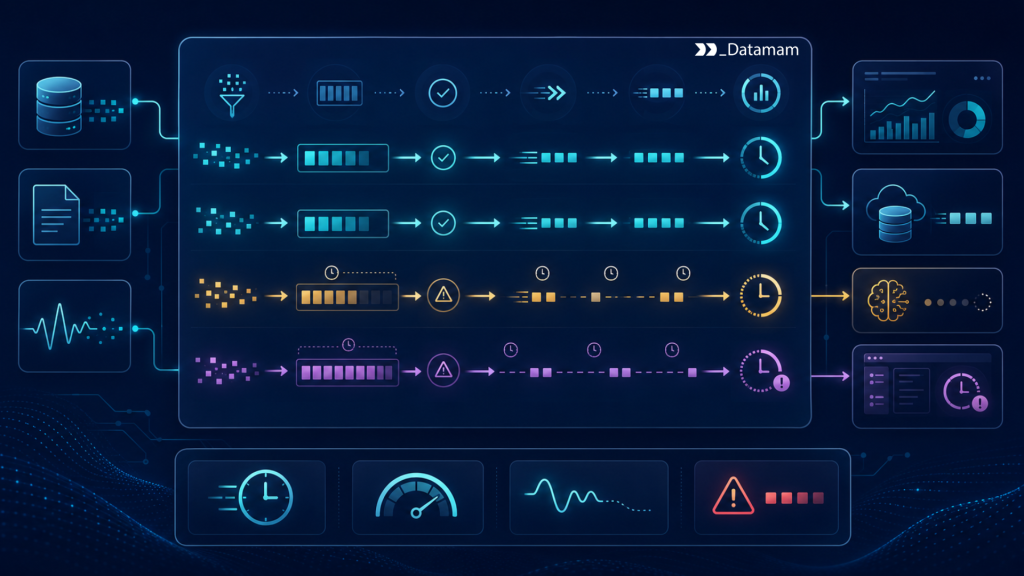
Data delivery latency is often treated as a performance metric, but at enterprise scale it becomes a decision constraint. When data arrives after the decision window has passed, accuracy alone is no longer enough. A dashboard may eventually refresh, an AI workflow may eventually receive the latest features, and an operational team may eventually see the updated feed. However, delayed delivery means the organization is responding to conditions later than the business requires.
Data Delivery Latency refers to the delay between data being produced, prepared, validated, delivered, and consumed by downstream systems. It affects dashboards, revenue operations, inventory updates, compliance reporting, procurement workflows, product catalog distribution, AI systems, and market intelligence. As enterprises depend more heavily on connected decision workflows, delayed data delivery reduces operational speed, weakens confidence, and increases the gap between event and response.
Data Delivery Latency Determines Whether Data Arrives Inside the Decision Window
Enterprise data is useful only when it arrives in time to influence the decision it supports. A daily executive dashboard may tolerate overnight delivery. A pricing workflow may require hourly updates. Inventory operations may need near-real-time delivery. A compliance report may require a fixed timestamped package before review. A product catalog update may need to reach marketplace channels before publication cutoffs.
McKinsey’s State of AI 2025 notes that many organizations use AI regularly, yet most have not embedded AI deeply enough into workflows and processes to realize material enterprise-level benefits. That gap matters because operational AI and analytics need data delivered into workflows at the speed those workflows require.
Low Latency Delivery Aligns Data Movement with Business Timing
Low latency delivery does not always mean real time. It means the delivery cadence is fast enough for the business process. A board dashboard and an inventory alert have different latency requirements. A compliance report and a pricing engine have different delivery windows. The strategic question is not whether data can move quickly in theory. It is whether it moves quickly enough for the decision.
For example, revenue operations may need account-level updates before forecast review. Procurement teams may need supplier-risk updates before purchase approvals. Product teams may need catalog changes distributed before marketplace synchronization. AI systems may need feature freshness before inference, not after model execution.
In practice, delivery latency should be measured against decision timing. Data delivered after the decision is made becomes historical evidence rather than operational input.
Delayed Data Delivery Creates a Gap Between Event and Response
Delayed data delivery widens the gap between an event and the enterprise response. A customer change occurs, but the customer success dashboard updates late. Inventory changes, but the replenishment workflow receives the update after stock conditions have shifted. A product attribute is approved, but the marketplace feed receives it after the distribution window. A risk signal appears, but the compliance workflow receives it after review begins.
This delay changes behavior across teams. Business users question whether reports are current. Analysts rerun extracts. Operations teams use manual confirmation. AI teams investigate whether model behavior reflects stale features. Executives interpret conditions from data that may no longer match the operating environment.
Consequently, delivery latency creates decision drag. The enterprise may still know what happened, but it knows too late to act at full speed.
Why Delivery Speed Is Different from Pipeline Performance
Pipeline performance and delivery speed are related, but they are not the same. A pipeline may process data efficiently while downstream delivery remains slow. Data may be transformed quickly but wait in a queue. A file may be produced on time but delivered late because an endpoint is unavailable. A warehouse table may update, but the consuming dashboard may refresh hours later.
Gartner’s 2025 Data and Analytics Predictions state that decision intelligence combines data, analytics, and AI to support or automate complex judgments. As more decisions become AI-supported or automated, delivery latency becomes more consequential because downstream systems may act before the latest data arrives.
Delivery Speed Optimization Requires End-to-End Visibility
Delivery speed optimization requires visibility from data production to downstream consumption. Teams need to know when data was generated, when validation passed, when delivery began, when it reached the endpoint, when the endpoint acknowledged receipt, and when the downstream system consumed it.
Without this visibility, teams may optimize the wrong layer. They may speed up transformation while endpoint delivery remains delayed. They may improve file generation while acknowledgement remains untracked. Also, they may reduce processing time while queue depth continues to grow.
A delivery event should therefore track validation, endpoint status, priority, and delivery timing before deciding whether to send, queue, or schedule the data.
def route_delivery_event(event):
    if event["validation_status"] != "passed":
        return {"status": "blocked", "reason": "validation_failed", "delivery_id": event["delivery_id"]}

    if event["endpoint_status"] != "available":
        return {"status": "queued", "reason": "endpoint_unavailable", "delivery_id": event["delivery_id"]}

    if event["priority"] == "critical":
        return {"status": "send_now", "delivery_id": event["delivery_id"]}

    return {"status": "scheduled", "delivery_id": event["delivery_id"]}


event = {
    "delivery_id": "DEL-884201",
    "dataset": "inventory-update-feed",
    "target_endpoint": "operations_dashboard",
    "validation_status": "passed",
    "endpoint_status": "available",
    "priority": "critical",
    "timestamp": "2026-06-17T09:30:00Z",
}

route_delivery_event(event)
This pattern shows how latency control becomes operational logic. Critical deliveries should not wait behind lower-priority distribution if the endpoint is available and validation has passed.
Slow Delivery Can Persist Even When Data Engineering Appears Healthy
Slow delivery often persists because organizations monitor pipeline success but not delivery completion. A job may finish successfully in Airflow. A table may be loaded into Snowflake, BigQuery, or Databricks. A DBT model may be complete. However, downstream delivery may still lag because dashboards refresh later, APIs are rate-limited, queues are backlogged, files wait for transfer, or endpoints fail to acknowledge.
This creates a misleading view of system health. Engineering metrics may show success while business users experience stale data. The gap appears because pipeline completion is not the same as data availability in the consuming system.
Accordingly, delivery latency metrics should include production time, validation time, queue time, transfer time, acknowledgement time, and consumption time. Without those measures, the organization cannot know where speed is being lost.
The Strategic Cost of Delayed Data Delivery
Delayed data delivery affects strategy because it reduces decision velocity. Leaders may receive accurate information after the opportunity to act has narrowed. Teams may respond to customer, market, inventory, or risk conditions later than competitors. AI workflows may operate from stale inputs while appearing technically functional.
IBM’s 2025 CDO Study emphasizes that driving value from data and AI is not about accessing more data, but using valuable data to deliver business outcomes. Delivery latency directly affects that value because data must reach the right workflow in time to influence the outcome. Effective datadriven decision making strategies can provide organizations with a competitive edge by enabling them to respond swiftly to emerging trends. When implemented correctly, these strategies align data analysis with actionable insights, fostering a culture of proactive engagement. As a result, businesses can adapt to changing conditions and seize opportunities more effectively than those relying on outdated information.
Operational Teams Lose Speed When Data Arrives After Process Cutoffs
Operational teams often work against process cutoffs. Revenue forecasts close at a set time. Procurement approvals run on scheduled cycles. Product catalog changes must be published before marketplace updates. Compliance teams prepare reports before review meetings. Inventory decisions are made before replenishment windows.
When data arrives after those cutoffs, teams either proceed without it or delay the process. Both outcomes are costly. Proceeding without current data increases decision risk. Waiting for late data slows the organization.
In practice, delivery latency creates a tradeoff between speed and confidence. Strong delivery systems reduce that tradeoff by making current data available before decisions must be made.
Latency Weakens Competitive Response in Fast-Moving Environments
Latency also weakens competitive response. Market prices can change quickly. Product availability can shift by channel. Competitor promotions can appear and disappear. Customer behavior can change after pricing, service, or product events. Supplier risk can increase before procurement teams update approvals.
If data delivery is delayed, teams may respond to an earlier version of the market. A pricing team may react after competitors have already shifted again. A product team may update channel data after customer-facing inconsistencies have appeared. A risk team may review exposure after the relevant signal has aged.
Ultimately, delayed data delivery increases the distance between external change and internal response. That distance becomes a performance disadvantage.
How Delivery Latency Affects AI, Analytics, and Business Workflows
AI, analytics, and business workflows depend on timely delivery in different ways. AI systems require feature freshness and monitoring signals. Dashboards require current data before reporting windows. Operational workflows require updates before process execution. Compliance workflows require timestamped delivery and evidence completeness.
NIST’s AI Risk Management Framework emphasizes governance, mapping, measurement, and management across AI systems. Those functions are relevant to delivery latency because AI systems inherit risk from stale, delayed, or poorly traced data movement.
AI Workflows Depend on Fresh Delivered Inputs
AI workflows can degrade when delivered inputs are stale. A demand forecast may miss recent inventory movement. A churn model may miss customer support activity. A pricing model may rely on outdated competitor or product data. A risk model may not receive the latest public-source signal before scoring.
The issue may not appear as an immediate failure. The model still produces output, but the inputs no longer reflect the current operating environment. This is why delivery latency should be monitored as part of AI reliability.
Low-latency delivery is especially important when models support near-term decisions. If features arrive after inference, the model is operating from yesterday’s business reality.
Analytics and Reporting Lose Authority When Freshness Is Unclear
Analytics and reporting lose authority when users do not know how current the data is. A dashboard may show clean visuals, but if delivery timing is unclear, business users question whether the numbers reflect the latest state. A compliance report may contain the right fields, but if the delivery timestamp is missing, audit confidence weakens. A revenue report may be accurate as of a prior cutoff but misleading if presented as current.
Freshness metadata helps solve this issue. Reports and dashboards should expose when data was generated, delivered, validated, and consumed. Delivery timestamps allow users to interpret outputs correctly.
In practice, data freshness is part of decision quality. Data that looks current but is delivered late can be more dangerous than data clearly labeled as historical.
The Infrastructure Layer Behind Low Latency Delivery
Low-latency delivery requires infrastructure that can prioritize critical data, monitor queues, validate quickly, route intelligently, and confirm downstream receipt. It is not only a matter of faster processing. It requires coordinated scheduling, endpoint health checks, retry handling, acknowledgement tracking, and observability across the delivery path.
The World Economic Forum’s 2025 analysis on scaling AI with strategy, data, and workforce readiness argues that strong data foundations are necessary for enterprise AI scale. Delivery latency is part of that foundation because AI and analytics systems need timely data movement to remain useful inside operational workflows.
Scheduling, Queue Management, and Endpoint Checks Reduce Latency Exposure
Scheduling ensures delivery occurs before downstream decision windows. Queue management prevents critical data from being delayed behind lower-priority jobs. Endpoint checks confirm that the receiving system is available before sending data. Retry logic reduces loss during temporary failures, while duplicate detection prevents retries from corrupting downstream systems.
A latency-aware delivery check should validate not only whether the endpoint is available, but also whether the delivery is still inside the useful time window. Data synchronization in multisystem environments is critical for maintaining data integrity across platforms. Organizations must implement robust protocols to ensure that data updates are consistent and timely throughout all systems involved. Additionally, employing monitoring tools can help identify potential issues in real-time, allowing for swift resolutions and minimizing disruption to operations.
def evaluate_delivery_latency(event):
    if event["minutes_until_cutoff"] <= 0:
        return {"status": "expired", "reason": "missed_decision_window", "delivery_id": event["delivery_id"]}

    if event["endpoint_status"] != "available":
        return {"status": "queued", "reason": "endpoint_unavailable", "delivery_id": event["delivery_id"]}

    if event["minutes_until_cutoff"] <= event["priority_threshold_minutes"]:
        return {"status": "expedite", "delivery_id": event["delivery_id"]}

    return {"status": "normal_delivery", "delivery_id": event["delivery_id"]}


event = {
    "delivery_id": "DEL-229104",
    "dataset": "pricing-intelligence-feed",
    "target_endpoint": "pricing_dashboard",
    "endpoint_status": "available",
    "minutes_until_cutoff": 12,
    "priority_threshold_minutes": 30,
    "timestamp": "2026-06-17T10:15:00Z",
}

evaluate_delivery_latency(event)
This structure connects latency to business timing. It distinguishes normal delivery, expedited delivery, queued delivery, and missed decision windows.
Observability, Lineage, and Metadata Make Latency Measurable
Observability systems such as Prometheus can monitor delivery latency, queue depth, endpoint availability, throughput, retry rates, failure rates, and acknowledgement delays. Great Expectations can validate schema, completeness, and anomaly patterns before delivery. Airflow can orchestrate scheduled delivery workflows. Kafka can support event-driven delivery. Spark can process large datasets before distribution. dbt can prepare delivery-ready models. Snowflake, BigQuery, and Databricks can serve governed data into downstream environments.
Lineage shows which dashboards, reports, models, applications, and workflows depend on each delivery path. Metadata records delivery cadence, endpoint requirements, freshness thresholds, data classification, owner, and usage constraints.
Together, these systems make latency visible. Teams can identify whether the delay comes from processing, validation, queuing, transfer, endpoint acceptance, or downstream consumption.
Governance and Compliance Depend on Timely Delivery
Governance is not only about controlling what data moves. It is also about knowing when data moved and whether it arrived within the required window. Compliance reporting, risk monitoring, financial workflows, customer operations, and AI governance may all depend on timely delivery.
The World Bank’s Digital Progress and Trends Report 2025 emphasizes foundational digital systems for responsible and scalable AI adoption. Within enterprises, timely delivery is part of that foundation because responsible decision systems require current, traceable, and governed data movement.
Delivery Timestamps and Audit Logs Make Timing Defensible
Delivery timestamps and audit logs help teams prove when data was produced, validated, delivered, acknowledged, and consumed. This matters for regulated workflows, compliance reporting, service obligations, AI monitoring, and executive reporting.
Without timing evidence, teams may know that data arrived but not whether it arrived on time. That distinction matters. A compliance dataset delivered after the review window may not satisfy the same operational requirement. A forecast feed delivered after planning decisions may be accurate but no longer useful.
Therefore, latency governance requires evidence. Timestamped delivery events, acknowledgement records, validation logs, and endpoint status history make timing defensible.
Cross-System Delivery Requires Freshness Standards
Cross-system delivery requires freshness standards because different systems need data at different speeds. A dashboard may allow a daily freshness threshold. An operational alert may require minutes. A product catalog feed may depend on channel cutoff times. An AI feature pipeline may require freshness before inference. A compliance report may require timestamped delivery before audit review.
Freshness standards should be defined by use case. They should specify acceptable latency, escalation thresholds, retry behavior, fallback options, and downstream notification requirements.
Without these standards, every delay becomes subjective. Teams debate whether data is late only after decisions have already been made.
Why Data Delivery Latency Is Becoming an Executive Governance Issue
Data Delivery Latency is becoming an executive governance issue because enterprise decision speed depends on timely distribution. Leaders rely on data flowing into dashboards, AI models, compliance reports, procurement workflows, inventory systems, product catalogs, and revenue operations. If delivery is delayed, decision speed declines even when data quality is high.
Executives do not need to manage delivery queues. However, they need visibility into which delivery flows support time-sensitive decisions, where latency risk exists, which endpoints create delay, and which workflows lack freshness standards. Organizations are increasingly turning to enterprise data distribution solutions to enhance their decision-making processes. These solutions optimize the flow of critical information, ensuring that executives receive real-time data necessary for quick and informed choices. As a result, businesses can effectively minimize latency and improve overall operational efficiency.
Leaders Need Visibility into Latency Across Critical Delivery Flows
Leadership visibility should focus on decision-critical delivery flows. Which feeds must arrive before executive reporting? Which deliveries support pricing decisions? Also, which inventory updates require low latency? Which AI feature pipelines depend on freshness? Which compliance reports require timestamped delivery before review?
This visibility helps leaders prioritize infrastructure investment. A low-risk research export may tolerate delay. A production delivery flow supporting pricing, compliance, AI, revenue operations, or customer-facing workflows requires stronger monitoring, prioritization, and recovery planning.
In this context, latency visibility becomes part of operational governance. Leaders cannot improve decision speed if they cannot see where data arrives too late.
Scalable Data Programs Require Latency Standards, Ownership, Monitoring, and Continuous Review
Scalable data programs require latency standards. These standards should define delivery windows, freshness thresholds, endpoint requirements, queue priorities, retry rules, acknowledgement expectations, escalation paths, and reporting on missed delivery windows.
Ownership must be clear. Data engineering may operate pipelines. Data operations may manage delivery queues. Business teams define decision timing. Analytics and AI teams define consumption needs. Governance teams define audit and access requirements. Compliance teams define evidence timing.
Ultimately, Data Delivery Latency undermines operational decision speed when enterprises treat delivery timing as a technical afterthought. Low-latency delivery aligns data movement with decision windows. Delivery speed optimization requires end-to-end visibility and prioritization. Delayed data delivery widens the gap between events and enterprise response.
Organizations that manage latency as part of data delivery infrastructure will make faster, more reliable operational decisions. Those that only measure pipeline completion may continue producing data, but they will struggle to ensure that data arrives while it can still change the outcome.