
Key Takeaways
- How Insurance Market Intelligence helps insurers monitor external risk conditions before they appear in claims or portfolio performance
- How external signals reveal changes in policy demand, regional exposure, and competitive positioning
- How competitor product shifts can inform underwriting, pricing, and product strategy decisions
- Why insurance teams need structured infrastructure to collect, normalize, validate, and govern external market data
- How market intelligence systems reduce manual research, improve decision timing, and strengthen enterprise risk visibility
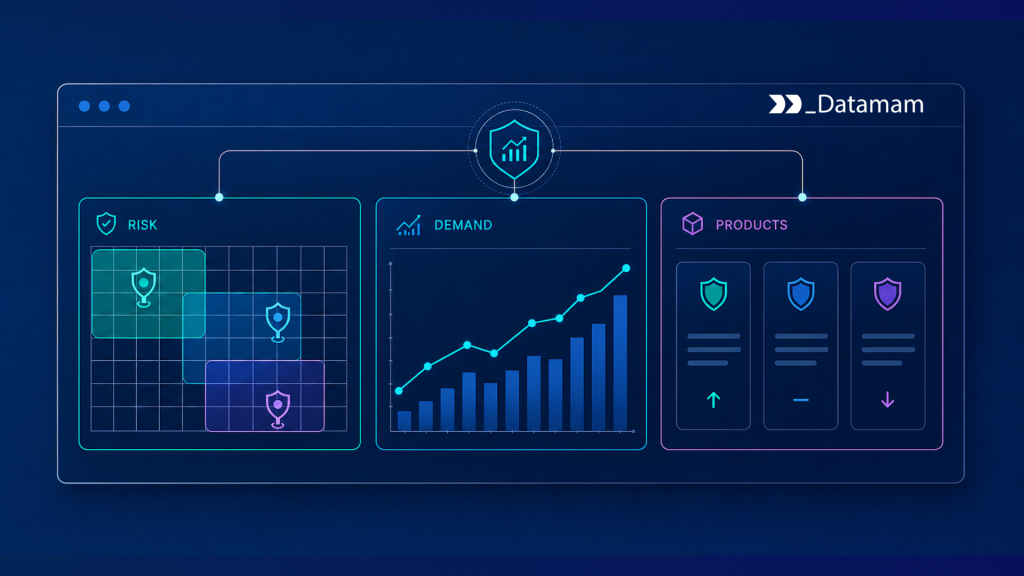
Insurance carriers increasingly operate in markets where risk conditions, customer expectations, and competitive product decisions change faster than traditional review cycles. Internal claims data, policy administration data, and actuarial history remain essential, but they often describe outcomes after risk has already materialized. Insurance Market Intelligence provides underwriting, pricing, risk, and product teams with a structured way to monitor external signals before they appear in portfolio performance, loss ratios, or renewal behavior. In practice, it converts fragmented public, commercial, and competitor signals into operational evidence for earlier decision-making.
The Insurance Visibility Gap in Volatile Markets
Insurance organizations are built to evaluate uncertainty, but the operating environment has become more dynamic than many internal reporting systems can support. Catastrophic events, inflationary repair costs, regional economic changes, broker consolidation, digital customer behavior, and new regulatory expectations all influence risk before they appear in internal reporting. Deloitte’s 2026 Global Insurance Outlook frames insurers as entering a period of uncertainty across economic, geopolitical, technological, customer, and catastrophe-related dimensions.
Why Internal Claims and Policy Data Lag Behind Market Reality
Claims, renewals, cancellations, quote volumes, and loss ratios are critical indicators, but they are primarily retrospective. They show what has already happened inside the book. By contrast, external signals can reveal movement earlier: regional construction activity, climate exposure, litigation patterns, business closures, vehicle repair costs, broker messaging, or competitor product shifts. As a result, insurers that rely only on internal data may detect risk deterioration after underwriting appetite, pricing assumptions, or product positioning have already become misaligned.
How External Signals Reveal Risk Before It Appears in Portfolios
External data helps insurers observe risk formation rather than only risk realization. Property insurers can monitor wildfire, flood, permitting, rebuilding, and local market signals. Commercial insurers can track business formation, employment shifts, legal filings, sector stress, and procurement activity. Auto insurers can monitor repair costs, vehicle availability, traffic patterns, and parts shortages. In practice, Insurance Market Intelligence connects these signals to underwriting, pricing, product, and claims planning so teams can respond before regional exposure becomes embedded in loss experience. As insurers expand their focus, understanding energy market trends in North America becomes increasingly vital. Changes in energy production and consumption patterns can significantly impact property valuations and risk assessments. By integrating insights from these trends, companies can enhance their predictive capabilities and develop more robust strategies for risk management.
External Data as a Risk Intelligence Layer for Insurance Teams
External data becomes commercially useful when it is organized into a repeatable intelligence layer rather than collected through scattered research. Insurance teams need market awareness that connects risk, policy demand, regional exposure, and competitor product shifts. This does not replace actuarial modeling or internal data science. Instead, it improves those functions by adding the current market context. EY’s 2025 Global Insurance Outlook emphasizes advanced data strategies and capabilities as important to capturing growth opportunities in turbulent insurance markets.
Monitoring Regional Risk Conditions Across Public and Commercial Sources
Regional exposure changes continuously. A county may experience rising property values, new construction density, worsening flood probability, wildfire risk, infrastructure development, crime pattern changes, or shifts in local business stability. External data pipelines can monitor public records, property portals, weather sources, local news, regulatory notices, and commercial activity to identify geographic risk movement. Accordingly, regional exposure becomes a monitored operational variable rather than a periodic underwriting review topic.
Tracking Policy Demand Signals Across Digital Markets
Policy demand often changes before it appears in quote volumes or bound policy counts. Search behavior, broker content, competitor landing pages, consumer reviews, local business formation, and digital discussions can indicate rising interest in specific coverage types. For example, growth in small-business cyber insurance searches, flood coverage discussion in newly exposed regions, or landlord insurance demand in changing rental markets can guide product strategy. Insurance Market Intelligence helps carriers detect policy demand earlier and evaluate where product positioning may need adjustment.
Identifying Competitor Product Shifts Across Markets
Competitor product shifts reveal how other insurers are adapting to risk, regulation, distribution changes, and customer expectations. These shifts may appear in policy wording, exclusions, deductible structures, regional availability, quote forms, bundled coverage, or broker-facing messaging. Continuous monitoring allows product and underwriting leaders to understand whether competitors are tightening appetite, entering underserved segments, or changing coverage design. By contrast, manual competitor reviews often detect these changes only after the market has already moved.
Infrastructure Requirements for Insurance Market Intelligence
Insurance Market Intelligence depends on an infrastructure that can collect, normalize, validate, and deliver external signals across business functions. The requirement is not more data in isolation. Insurance teams need reliable signals that can be traced, governed, and connected to underwriting, pricing, claims, compliance, distribution, and product workflows. OECD’s Global Insurance Market Trends 2025 provides comparable cross-country insurance market data, reinforcing the value of structured market visibility.
Continuous External Data Collection Across Dynamic Sources
Insurance-relevant signals originate across heterogeneous environments: regulator pages, court systems, real estate platforms, weather sources, business registries, broker portals, review ecosystems, and competitor websites. These sources change structure, cadence, and availability. Continuous collection systems use scheduled crawlers, browser automation frameworks, API ingestion, and change detection to capture relevant signals. At scale, this enables insurers to monitor risk, policy demand, regional exposure, and competitor product shifts without relying on slow manual research cycles.
Normalizing Risk, Product, and Market Signals Across Regions
External insurance data is rarely comparable in raw form. Region names differ, coverage categories vary, public records use inconsistent formats, and competitor policy information may not map neatly to internal taxonomies. Normalization converts these fragmented inputs into consistent analytical datasets. This may include geographic alignment, product taxonomy mapping, entity resolution, date standardization, and source-level metadata enrichment. Without normalization, insurance teams risk comparing signals that appear similar but represent different markets, products, or risk categories.
Validating Insurance Data Inputs Before Analytical Use
Validation is critical because inaccurate external signals can distort underwriting, pricing, and product decisions. Data quality controls should check schema consistency, missing fields, unusual volume changes, duplicate records, source freshness, and anomaly patterns. For example, a sudden decline in competitor product availability may reflect a website structure change rather than a true market withdrawal. Therefore, validation must occur before external signals enter dashboards, pricing analysis, product reviews, or AI-supported decision systems.
Technology Stack Behind Insurance Market Intelligence Systems
A mature insurance market intelligence system operates as a coordinated data pipeline. It collects signals, processes them into usable formats, stores them for analysis, and preserves governance evidence. The infrastructure must be practical for business use and defensible for regulated environments. KPMG’s 2025 Insurance CEO Outlook reports that insurance CEOs are prioritizing AI investments while also strengthening risk management and cyber resilience.
Collection and Orchestration Using Playwright, Airflow, and Kafka
Collection layers often use Playwright or headless Chromium to capture information from dynamic websites, broker portals, public records, and competitor product pages. Apache Airflow can orchestrate scheduled workflows, retries, dependencies, and source-specific monitoring jobs. Kafka may support streaming ingestion where signals need near-real-time movement into downstream systems. In practice, this stack helps insurers move from manual market checks to continuous monitoring across external sources that affect insurance risk, regional exposure, and product decisions.
Processing and Transformation Through Spark, dbt, and ETL Pipelines
Processing layers convert raw external data into structured datasets. Spark can support distributed processing when source volume is high, while dbt can manage transformations, standardized models, and documentation across analytical tables. ETL and ELT pipelines align location fields, coverage categories, competitor names, regulatory topics, and product attributes. This enables underwriting, pricing, and product teams to compare signals across markets instead of interpreting disconnected records from multiple sources manually.
Storage, Analytics, and Governance in Snowflake, BigQuery, or Databricks
Structured insurance intelligence datasets are commonly stored in Snowflake, BigQuery, or Databricks, where analytics teams can query historical trends, build dashboards, and feed modeling workflows. Governance controls should include access permissions, audit logs, lineage tracking, source documentation, and retention policies. These controls matter because insurance decisions may affect pricing fairness, underwriting eligibility, and claims expectations. In regulated environments, traceability is not an administrative extra. It is part of operational risk control.
Commercial Impact of Insurance Market Intelligence
The commercial value of Insurance Market Intelligence appears when external visibility changes decisions. Better signals can improve underwriting selection, pricing responsiveness, product positioning, claims planning, and market entry evaluation. The objective is not to automate every insurance decision. It is to give teams earlier and more reliable evidence. McKinsey’s Global Insurance Report 2025 frames profitable growth as an imperative for property and casualty insurers while life carriers adapt to changing consumer needs.
Improving Risk Selection and Market Responsiveness
External signals can help underwriting and portfolio teams adjust risk selection before losses accumulate. A commercial insurer may detect sector stress through bankruptcies, litigation activity, or local economic indicators. A property carrier may monitor construction density, flood exposure, wildfire risk, or rebuilding signals. Conservative impact ranges are typically measured through faster detection cycles, improved appetite review timing, stronger geographic prioritization, and reduced manual research effort rather than guaranteed loss reduction.
Strengthening Product Positioning with External Demand Signals
Product teams need to understand where customer needs are changing. External signals can show demand for specific coverage features, regional product gaps, broker messaging shifts, and competitor product shifts. For instance, changes in cyber coverage language, embedded insurance offers, climate-related exclusions, or small-business policy packaging may indicate how competitors are repositioning. When connected to policy demand and customer behavior, these signals help insurers refine coverage design, distribution priorities, and product communication with stronger market evidence.
Reducing Analyst Workload and Manual Market Research
Insurance analysts often spend significant time collecting market updates, reviewing competitor sites, checking regulatory pages, and reconciling fragmented sources. Continuous external data pipelines reduce this workload by automating collection and standardizing recurring analysis inputs. Realistic efficiency gains depend on source complexity and review requirements, but many teams can shift meaningful analyst time from gathering data to interpreting business implications. As a result, market research becomes a decision support function rather than a manual monitoring burden. The integration of pipeline visibility solutions for construction can further enhance operational efficiency by providing real-time insights into project statuses. By utilizing these technologies, teams can proactively address potential delays and resource mismatches, leading to more effective project management. Ultimately, this shift allows stakeholders to make informed decisions based on transparent data rather than assumptions about project progress.
Risk Exposure When Insurance Teams Lack External Market Visibility
Without structured external visibility, insurers face avoidable decision latency. They may continue writing business under outdated assumptions, miss emerging policy demand, misunderstand regional exposure, or respond slowly to competitor product shifts. The risk is not only financial. It can also affect governance, fairness, auditability, and customer trust. EIOPA’s 2025 Opinion on AI Governance and Risk Management emphasizes a risk-based and proportionate approach to balancing AI benefits and risks in the insurance sector.
Delayed Detection of Emerging Regional and Behavioral Risks
Delayed detection becomes expensive when risk conditions move faster than reporting cycles. If regional exposure changes because of climate events, rebuilding activity, crime patterns, litigation, or business closures, internal systems may not reflect the change until claims or losses appear. Similarly, behavioral changes may surface in search activity, complaints, broker conversations, or product comparison behavior before they appear in policy data. External monitoring reduces the gap between risk formation and management response.
Pricing and Product Misalignment Across Competitive Markets
Insurance products can become misaligned when competitors adjust terms, deductibles, exclusions, availability, or quote flows faster than an organization’s internal review cycle. If product teams miss these changes, they may overestimate competitiveness or underestimate market withdrawal by rivals. Pricing teams may also misread demand if they lack external context. Therefore, competitor product shifts should be monitored alongside policy demand and regional exposure so product and pricing decisions reflect current market conditions.
Governance Gaps in Cross-Border Insurance Data Monitoring
Cross-border insurance monitoring introduces governance complexity because data sources, privacy rules, consumer protections, and regulatory expectations vary by jurisdiction. External data systems should document source approval, collection purpose, access control, retention rules, and data lineage. This is especially important when external signals influence underwriting, pricing, fraud detection, or AI-assisted workflows. Without traceability, insurers may struggle to explain how data-informed decisions or whether sourcing practices met internal governance standards.
Institutional Validation for Data-Driven Insurance Decisions
The broader insurance sector is already moving toward data modernization, AI governance, and operational resilience. However, technology adoption alone does not create better decisions. Insurers need data foundations that are current, explainable, and governed. Deloitte’s 2026 Global Insurance Outlook directly asks whether insurers can scale artificial intelligence without fixing the foundations first. That question applies directly to Insurance Market Intelligence because collection, validation, governance, and decision integration must mature together.
How 2025 and 2026 Industry Research Frames Insurance Data Modernization
Recent industry research consistently frames insurance modernization around data, AI, customer expectations, risk complexity, and operational resilience. EY focuses on advanced technology and data capabilities. KPMG highlights AI investment in underwriting, claims, customer experience, and risk resilience. McKinsey frames profitable growth as a strategic imperative under volatility. Together, these sources support a practical conclusion: insurance data infrastructure must become more continuous, governed, and commercially connected.
Why Governance, Traceability, and Risk Controls Matter in Insurance Analytics
Insurance analytics can influence decisions that materially affect customers, pricing, access, claims, and risk classification. Therefore, governance is central to responsible use. For market intelligence systems, this means audit logs, lineage, source documentation, access controls, and validation checks must be designed into the pipeline from the beginning, not added after data becomes operationally important.
Evaluating Insurance Market Intelligence Readiness
Insurance Market Intelligence becomes valuable when it supports operational decisions across underwriting, product, pricing, claims, and distribution. The same external data infrastructure can monitor multiple signal categories, but each use case needs clear business logic. Risk teams need early warning. Product teams need demand and competitor visibility. Pricing teams need market context. Compliance teams need traceability. Accordingly, the infrastructure should be evaluated by outcome, not by the volume of data collected. Understanding market trends impacting enterprise decisions allows organizations to adapt proactively to changing conditions. By leveraging insights from these trends, companies can enhance their strategic planning and optimize resource allocation. Additionally, staying informed about competitor movements and consumer preferences is crucial for maintaining a competitive edge.
How Market Intelligence Services Support Risk, Pricing, and Product Teams
Market intelligence services can support insurance teams by turning fragmented external sources into governed datasets. For risk teams, this may mean regional exposure monitoring and early indicators of loss volatility. For pricing teams, it may mean competitor availability, coverage structure, and market movement signals. Also, for product teams, it may mean policy demand, broker messaging, consumer behavior, and competitor product shifts. The commercial value comes from making these signals reliable enough for recurring decision workflows.
When Insurance Organizations Need a Market Intelligence Infrastructure Review
An infrastructure review becomes useful when teams rely on manual monitoring, fragmented vendor feeds, inconsistent spreadsheets, or unclear sourcing documentation. A structured review should assess source coverage, collection reliability, normalization quality, validation controls, governance maturity, cross-border exposure, and integration readiness. The output should clarify where current intelligence systems create decision latency, where data quality risk enters the workflow, and which operational teams would benefit most from a more continuous market intelligence layer.
Conclusion: Insurance Market Intelligence as an Enterprise Decision Capability
Insurance markets are becoming more data-intensive, more exposed to external volatility, and more dependent on rapid interpretation of changing conditions. Internal data remains essential, but it is not sufficient to understand risk, policy demand, regional exposure, and competitor product shifts as they emerge. Insurance Market Intelligence gives carriers a structured way to convert external signals into operational awareness. Ultimately, the insurers best positioned for resilience will be those that treat external data as governed decision infrastructure, not occasional market research.