Key Takeaways
- API Integration Strategy is now an executive priority because APIs connect the systems that support revenue, operations, AI, analytics, and customer experience.
- Enterprise api strategy must define governance, access, reliability, versioning, observability, and ownership before integrations scale.
- Cross-system integration fails when APIs move data without preserving meaning, approval status, source context, or downstream requirements.
- API integration planning helps enterprises reduce fragmentation, integration debt, data quality risk, and operational dependency on brittle connections.
API integration strategy has moved from a technical planning topic to an executive operating concern. Enterprises now depend on APIs to connect CRM, ERP, product information management, billing, ecommerce, analytics, AI workflows, external data sources, and customer-facing applications. When those integrations are weak, the problem is not limited to engineering rework. It becomes slower decision-making, inconsistent reporting, operational fragmentation, and reduced confidence in the systems leaders rely on.
API Integration Strategy defines how systems expose, exchange, validate, secure, monitor, and govern data across the enterprise. It includes enterprise api strategy, cross-system integration, api integration planning, ownership, versioning, authentication, access control, schema stability, event routing, error handling, and downstream observability. As AI, automation, and connected data infrastructure become more central to enterprise performance, API strategy increasingly determines whether data can move with enough reliability to support business execution.
API Strategy Now Defines How Enterprise Systems Operate Together
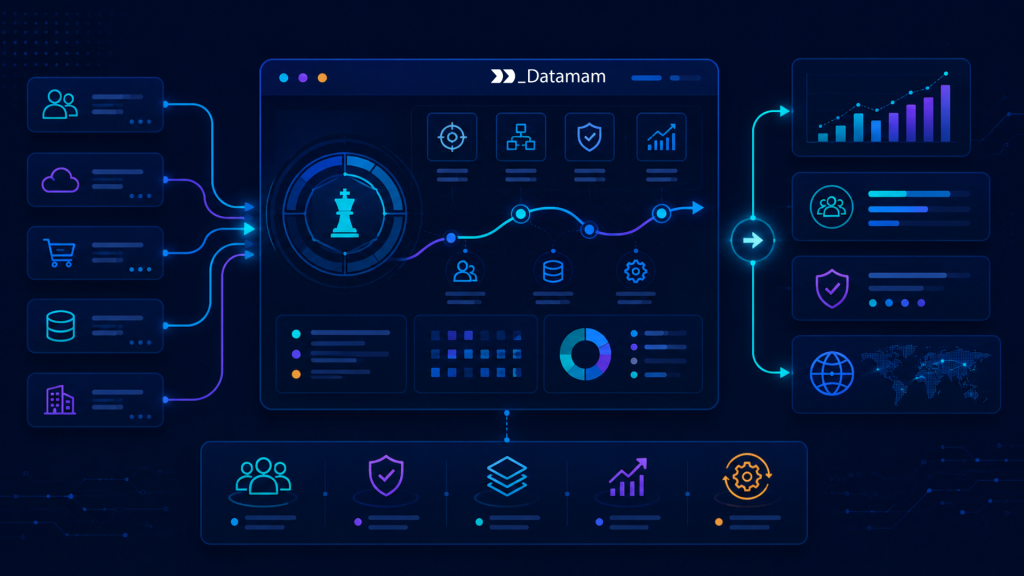
Most enterprises no longer operate through one system of record. They operate through networks of systems. Customer information may originate in CRM, billing status may sit in ERP, product attributes may be controlled in PIM, customer interactions may live in support platforms, and external signals may enter through public or commercial data sources. APIs become the connective layer between those environments.
McKinsey’s State of AI 2025 notes that many organizations use AI regularly, yet most have not embedded it deeply enough into workflows and processes to realize material enterprise-level benefits. That gap matters because AI and analytics cannot scale reliably when the APIs connecting data flows remain fragmented, undocumented, or weakly governed.
Enterprise API Strategy Connects Data Movement to Business Execution
An enterprise api strategy should not be limited to endpoint availability. It should define which systems exchange data, what data is allowed to move, who owns the integration, how errors are handled, how schemas are versioned, and how downstream impact is monitored.
For example, a product update from a PIM may need to reach ecommerce, marketplaces, sales portals, and internal analytics systems. However, the update should not publish automatically if the compliance review is incomplete or required attributes are missing. A customer update from CRM may need to sync with billing and support systems, but legal name or tax region changes may require finance review before downstream publication.
In practice, API strategy connects system design to business control. The goal is not only to connect applications. The goal is to make sure connected applications behave safely, predictably, and consistently.
Cross System Integration Requires Shared Meaning, Not Only Connectivity
Cross-system integration fails when systems exchange data without sharing meaning. A field named customer_status may mean one thing in CRM and another in billing. A product record may be approved for e-commerce but not for a marketplace. A billing address update may affect tax logic, finance workflows, and compliance reporting. If API integrations do not preserve context, downstream systems may receive technically valid data that is operationally unsafe.
This is where API strategy becomes an executive concern. APIs can move data quickly, but speed without control can spread errors faster. A weak API layer can turn one source-system issue into a multi-system problem affecting reporting, AI models, customer experience, or financial operations.
Accordingly, cross-system integration must preserve meaning, timing, approval state, validation results, and ownership across every handoff.
Why API Integration Planning Reduces Enterprise Integration Debt
Integration debt accumulates when teams connect systems quickly without defining long-term standards. A point-to-point API connection solves an immediate workflow problem, but the enterprise may later discover that authentication models differ, schemas are unstable, logging is incomplete, and ownership is unclear. The integration works until a source changes, a downstream system expands, or governance teams need evidence.
Gartner’s 2025 Data and Analytics Predictions state that by 2027, half of business decisions will be augmented or automated by AI agents for decision intelligence. As decision systems become more automated, weak API planning becomes more consequential because integration defects can influence decisions before teams detect the underlying issue.
API Integration Planning Clarifies Ownership Before Dependencies Grow
API integration planning should define ownership before systems depend on the connection. Every integration needs a source owner, target owner, technical owner, data owner, and escalation path. Without ownership, incidents become slow to resolve because teams disagree on where responsibility sits.
Consider a product attribute update that needs to move from PIM into multiple channels. The integration should check whether the update is approved before publishing it downstream. Api governance best practices for development ensure that standards are consistently applied across all integrations. Establishing clear guidelines helps teams avoid ambiguity and confusion. By prioritizing these best practices, organizations can streamline their processes and improve the overall quality of their integrations.
def route_product_update(event):
    if event["approval_status"] != "approved":
        print(f"Blocked: {event['sku']} pending approval")
        return

    for channel in event["target_channels"]:
        print(f"Publishing {event['sku']} to {channel}")


event = {
    "event_type": "product.attribute_updated",
    "source_system": "pim",
    "sku": "SKU-48192",
    "gtin": "09506000134352",
    "updated_fields": ["product_title", "material", "care_instructions"],
    "approval_status": "approved",
    "target_channels": ["ecommerce", "marketplace_us", "sales_portal"],
    "timestamp": "2026-06-17T11:15:00Z",
}

route_product_update(event)
This is a small example, but it shows the larger principle. API integrations should not simply transmit changes. They should route changes according to approval state, target channel, source context, and downstream readiness.
Poor Planning Turns APIs Into Hidden Business Dependencies
APIs often become hidden dependencies. A customer sync endpoint may start as a support workflow and later feed customer health reporting, renewal forecasting, account scoring, and finance reconciliation. A product API may begin with e-commerce publishing and later support marketplaces, inventory analysis, and pricing intelligence.
When planning is weak, these dependencies grow without visibility. Teams may not know which dashboards, models, applications, or workflows rely on a specific API. This creates risk when the endpoint changes, performance degrades, or access controls are modified.
API integration planning reduces this risk by documenting dependency, versioning, usage, expected latency, validation rules, error handling, and downstream consumers before the connection becomes business-critical.
The Strategic Risk of Weak API Integration Strategy
A weak API integration strategy creates risk because APIs sit at the boundary between systems. They determine which data moves, how quickly it moves, how errors are handled, and whether downstream systems receive enough context to act safely. If this boundary is unmanaged, the enterprise may have connected systems but unreliable operations.
IBM’s 2025 CDO Study emphasizes that many organizations are still working to make data ready for AI and enterprise value creation. API integration strategy is part of that readiness gap because data cannot become decision-ready if the connections moving it are unstable, undocumented, or weakly governed. Effective api integration solutions for businesses can significantly enhance operational efficiency and data reliability. By investing in robust APIs, companies can ensure seamless data flow and better context for decision-making processes. Ultimately, a strong integration strategy will not only mitigate risk but also support innovation and agility within the organization.
Weak APIs Spread Data Quality Problems Across Systems
A weak API can distribute bad data faster than a manual process. If required fields are missing, duplicate events are not detected, reference IDs do not match, or blocked records are published, downstream systems may treat the data as valid because it arrived through an authorized integration.
This is why API-level validation matters. Product catalog integrations, for example, should test required fields, uniqueness, blocked publication conditions, and channel-specific requirements before data is pushed into downstream systems.
PRODUCT_CATALOG_RULES = {
    "required_fields": ["sku", "product_name", "category", "unit_of_measure", "publication_status"],
    "uniqueness_checks": ["sku", "gtin"],
    "channel_requirements": {
        "marketplace_us": ["main_image_url", "brand", "package_weight", "return_policy_code"],
    },
    "blocked_conditions": {
        "publication_status": "draft",
        "compliance_review_status": "pending",
    },
}

def validate_product(record, channel=None, existing_skus=None):
    missing = [f for f in PRODUCT_CATALOG_RULES["required_fields"] if not record.get(f)]
    if missing:
        return {"valid": False, "reason": "missing_required_fields", "fields": missing}

    if existing_skus:
        for field in PRODUCT_CATALOG_RULES["uniqueness_checks"]:
            if record.get(field) in existing_skus:
                return {"valid": False, "reason": "duplicate_value", "field": field}

    for field, blocked_value in PRODUCT_CATALOG_RULES["blocked_conditions"].items():
        if record.get(field) == blocked_value:
            return {"valid": False, "reason": "blocked_condition", "field": field}

    if channel and channel in PRODUCT_CATALOG_RULES["channel_requirements"]:
        channel_missing = [f for f in PRODUCT_CATALOG_RULES["channel_requirements"][channel] if not record.get(f)]
        if channel_missing:
            return {"valid": False, "reason": "missing_channel_fields", "fields": channel_missing}

    return {"valid": True}
This pattern shows why API strategy is not only about connectivity. It is about deciding what should be allowed to move, what should be blocked, and what should be reviewed before downstream systems depend on the data.
API Failures Can Look Like Business Signals
Poor API reliability can distort decision systems. A delayed API response may look like reduced activity. A failed sync may look like a customer status change. A duplicate event may inflate sales activity. A missing field may distort product availability. A schema change may break a dashboard or model feature without immediately stopping the workflow.
These failures are especially dangerous because downstream systems may continue running. Dashboards refresh. AI models generate outputs. Operational workflows execute. However, the evidence behind those systems may be incomplete or misaligned.
Therefore, the API integration strategy must include observability, validation, error routing, and business-impact monitoring. The enterprise needs to distinguish real business movement from integration behavior.
API Strategy Shapes AI, Analytics, and Operational Reliability
AI and analytics systems depend on reliable APIs because APIs often control the movement of training data, feature inputs, real-time events, customer records, product attributes, transaction updates, and external signals. If APIs are unstable, downstream decision systems become unstable.
NIST’s AI Risk Management Framework emphasizes governance, mapping, measurement, and management across AI systems. Those same principles apply to API integration because APIs influence what data enters AI workflows, how it is transformed, and whether it can be traced back to controlled sources.
AI Workflows Depend on API Stability and Traceability
AI systems require stable data movement across source, feature, model, monitoring, and feedback layers. APIs may feed feature stores, customer profiles, product catalogs, pricing signals, event streams, and model monitoring systems. If those APIs are not versioned, monitored, and governed, model behavior may change for reasons teams cannot explain.
For example, a customer scoring model may rely on CRM, billing, support, and product usage APIs. If one API changes its schema or stops updating, the model may degrade. A pricing model may rely on product, inventory, margin, and competitor signal APIs. If those flows fall out of sync, the model may recommend actions based on stale or incomplete evidence.
In this context, API strategy becomes part of AI governance. It determines whether AI teams can trust the data moving into and out of model environments.
Analytics and Reporting Require Consistent API Contracts
Analytics teams need API contracts that define field meaning, update frequency, expected schema, authentication requirements, error codes, and versioning rules. Without consistent contracts, reports become unstable because teams cannot determine whether metric changes reflect the business or the integration.
For example, if an order API changes how it returns canceled transactions, revenue dashboards may shift. If a CRM API changes account status definitions, customer reporting may become inconsistent. If a product API changes category structure, margin or marketplace reporting may break.
API contracts reduce this risk. They give downstream consumers a stable expectation of what data will arrive, how it will be structured, and how changes will be communicated.
The Infrastructure Layer Behind Enterprise API Strategy
Enterprise api strategy requires infrastructure that can orchestrate API workflows, validate data, manage schemas, monitor performance, preserve lineage, and route exceptions. APIs do not operate in isolation. They are part of a broader data architecture connecting applications, pipelines, event systems, warehouses, lakehouses, and decision environments.
The World Economic Forum’s 2025 analysis on scaling AI with strategy, data, and workforce readiness argues that strong data foundations are necessary for enterprise AI scale. API integration strategy is part of that foundation because API reliability influences whether data can move through enterprise workflows with the stability AI and analytics require.
Orchestration, Streaming, Transformation, and Storage Must Work Together
Airflow can orchestrate API-based ingestion, validation, transformation, and delivery workflows. Kafka can support event-driven integration when systems need real-time or near-real-time updates. Spark can process high-volume API payloads across distributed environments. dbt can structure API-derived data into governed analytical models.
Storage and analytics platforms such as Snowflake, BigQuery, and Databricks provide scalable environments where API data can be joined, analyzed, and operationalized. However, these systems only produce value when API inputs are validated, documented, versioned, and monitored.
External data can complicate this further. Playwright and browser automation frameworks may be needed when important external signals are unavailable through stable APIs. Those data flows still need API-like discipline: schema checks, metadata, source documentation, validation, governance review, and downstream delivery controls.
Error Handling and Observability Prevent Silent Integration Failure
Silent integration failure occurs when APIs continue operating but deliver weakened data. The response succeeds, but fields are missing. The payload arrives, but the source system changed definitions. A retry creates duplicate events. An unauthorized request is ignored. A reference mismatch sends data to the wrong downstream entity.
A mature API strategy classifies errors and routes them appropriately.
def route_exception(record, validation_result):
    if validation_result.error_type == "missing_required_field":
        send_to_quarantine(record, reason=validation_result.message)
    elif validation_result.error_type == "duplicate_event":
        mark_as_duplicate(record, event_id=record["event_id"])
    elif validation_result.error_type == "reference_mismatch":
        send_to_manual_review(record, owner="data_operations")
    elif validation_result.error_type == "unauthorized":
        send_to_access_review(record, reason=validation_result.message)
    elif validation_result.error_type == "schema_violation":
        escalate_to_producer(record, reason=validation_result.message)
    else:
        send_to_error_queue(record, reason="unclassified_exception")
This pattern is important because not every failure should be handled the same way. Missing required fields may require quarantine. Unauthorized access may require security review. Schema violations may require producer escalation. Reference mismatches may require manual data operations review. Error handling becomes part of governance, not just technical recovery.
Governance and Compliance Depend on API Control
APIs govern the movement of data across internal systems, cloud platforms, vendors, external sources, and customer-facing environments. If the API layer is weakly controlled, governance becomes difficult because data can move faster than policies can be enforced.
The World Bank’s Digital Progress and Trends Report 2025 emphasizes the importance of foundational digital systems for responsible and scalable AI adoption. Within enterprises, API control is part of that foundation because connected systems require traceable and governed data movement. Crossplatform api coordination challenges arise when attempting to synchronize data across various systems and platforms. Effective management of these challenges is crucial to ensure a seamless user experience and reliable data integrity. Organizations need to establish robust frameworks that facilitate communication and data sharing among diverse applications while maintaining strict governance.
Access, Authentication, and Usage Rules Must Be Designed Early
API governance should define who can call an API, which systems are authorized, what scopes are permitted, how credentials are managed, how requests are logged, and what usage limits apply. Authentication and authorization are not enough by themselves. Enterprises also need usage governance that clarifies whether data can be used for analytics, AI training, operational workflows, external reporting, or customer-facing automation.
This is especially important for customer data, regulated data, vendor data, and external data sources. A dataset may be appropriate for internal reporting but not for automated decision-making. A source may be permitted for analytics but not redistribution. A cross-border integration may require residency, retention, or access restrictions.
Accordingly, API integration planning must include legal, sourcing, security, and compliance requirements before APIs become production dependencies.
Lineage, Metadata, and Audit Logs Make API Movement Defensible
API movement becomes defensible when teams can trace what data moved, where it came from, how it changed, who accessed it, and which systems consumed it. Metadata should record source system, event type, payload schema, update timestamp, approval status, ownership, quality expectations, and downstream consumers. Lineage should show how API data moved through pipelines, transformations, warehouses, models, dashboards, and operational applications.
Audit logs provide evidence of access and change. They help teams respond to incidents, regulatory questions, model reviews, and executive reporting challenges.
Without lineage and auditability, API integrations may work technically but remain difficult to defend. This becomes a serious issue when APIs support AI systems, financial reporting, compliance monitoring, or customer-impacting workflows.
Why API Integration Strategy Is Becoming an Executive Priority
API Integration Strategy is becoming an executive priority because APIs now support critical decisions and operational workflows. They connect revenue systems, customer platforms, product catalogs, financial systems, AI pipelines, external intelligence, and analytics environments. If APIs are unstable, ungoverned, or poorly planned, the business becomes slower, less reliable, and more exposed to decision risk.
Executives do not need to manage endpoint design. However, they do need visibility into the API dependencies behind critical systems. Which APIs support revenue reporting? Which connects CRM and ERP workflows? Also, which product APIs are published to marketplaces? Which integrations feed production AI models? Which external data flows support market intelligence or risk monitoring?
Leaders Need Visibility into Critical API Dependencies
Leadership visibility should focus on API dependencies that affect critical decisions. A pricing workflow may depend on product, inventory, margin, and competitor signal APIs. A customer health workflow may depend on CRM, billing, support, and product usage APIs. A finance workflow may depend on ERP and CRM synchronization. A market intelligence workflow may depend on external data APIs and internal performance systems.
If those APIs fail, slow down, or change unexpectedly, business decisions are affected. Leaders need to know which integrations are critical, which are fragile, which lack ownership, and which require stronger governance.
In practice, API strategy becomes part of executive risk management. The enterprise cannot scale decision systems on top of API connections it cannot see, measure, or trust.
Scalable Data Programs Require API Standards, Ownership, and Continuous Review
Scalable data programs require shared API standards. These standards should define endpoint ownership, schema rules, versioning, authentication, authorization, rate limits, validation requirements, observability thresholds, lineage capture, error routing, audit logging, and deprecation processes.
Ownership must be cross-functional. Engineering teams manage implementation. Business teams define meaning. Data teams define quality and transformation expectations. Security teams define access controls. Legal and compliance teams define usage boundaries. AI and analytics teams define downstream requirements.
Ultimately, API Integration Strategy has become an executive priority because APIs determine whether enterprise systems can operate as a connected decision environment. Enterprise api strategy aligns technical integration with business control. Cross-system integration preserves meaning across workflows. API integration planning reduces hidden dependency, governance exposure, and downstream reliability risk.
Organizations that treat APIs as strategic infrastructure will build more reliable AI, analytics, reporting, and operational systems. Those that treat APIs as isolated technical connectors may continue connecting platforms, but they will struggle to prove that the data moving across those connections remains complete, current, governed, and fit for decision-making.