Key Takeaways
- Data Quality Remediation turns detected defects into governed resolution workflows with ownership, severity, root-cause analysis, and closure evidence.
- A data remediation process should classify defects by type, business impact, affected systems, remediation owner, and downstream risk.
- Data quality issue resolution requires more than correcting records. It must address source causes, pipeline logic, reference data, governance rules, and monitoring gaps.
- Data defect remediation should preserve audit trails showing what failed, who resolved it, what changed, and whether downstream systems were affected.
- Strong remediation workflows connect data quality rules, observability, metadata, stewardship, platform engineering, and business domain ownership.
Enterprise data quality programs often detect defects faster than they resolve them. A validation rule fails, a dashboard shows inconsistent numbers, a customer record is duplicated, a product category is invalid, or a finance dimension is missing. The issue is visible, but ownership is unclear, severity is debated, and remediation depends on manual follow-up.
Data Quality Remediation creates the operating workflow for resolving these defects. It defines how data issues are classified, routed, corrected, validated, documented, and prevented from recurring.
In enterprise data platforms, remediation is not cleanup after the fact. It is a control process that protects analytics, AI systems, CRM workflows, finance reporting, product operations, healthcare analytics, and executive decision systems from repeated data failure.
Why Data Quality Remediation Matters at Enterprise Scale
Data Quality Remediation matters because detection alone does not improve quality. Enterprises can run hundreds of validation checks and observability alerts, but if defects are not assigned, resolved, and reviewed, the same issues keep returning.
Gartner’s 2025 data and analytics trends emphasize that governance and AI-ready data are becoming more important as data and analytics become embedded across enterprise operations. That raises the importance of remediation because unresolved quality defects can affect automated decisions, reporting confidence, and operational workflows.
Why Detection Without Remediation Fails
Detection identifies that something went wrong. Remediation determines what happens next. Without remediation workflows, quality issues become dashboard noise, Slack alerts, backlog tickets, or manual analyst corrections.
This creates recurring failure. A missing customer country field may be corrected in a warehouse table but remain broken in the CRM source. An invalid product category may be patched for reporting but continue entering the catalog. A duplicate supplier record may be merged once but not prevented from reappearing.
A data remediation process should therefore separate symptom correction from root-cause correction. The immediate defect may need repair, but the source, rule, pipeline, or ownership gap must also be addressed.
How Weak Remediation Creates Enterprise Risk
Weak remediation creates risk because defects remain active inside downstream systems. A finance defect may affect reporting. A CRM defect may affect segmentation and sales operations. A product defect may affect e-commerce publication. A healthcare data defect may affect analytics and compliance review. An AI feature defect may affect model output.
The OECD’s work on data flows and governance highlights the need to enable data movement and use while maintaining oversight, protection, and trust. Remediation belongs in that lifecycle because defects must be controlled after detection and before reuse becomes unsafe.
Designing the Data Remediation Process
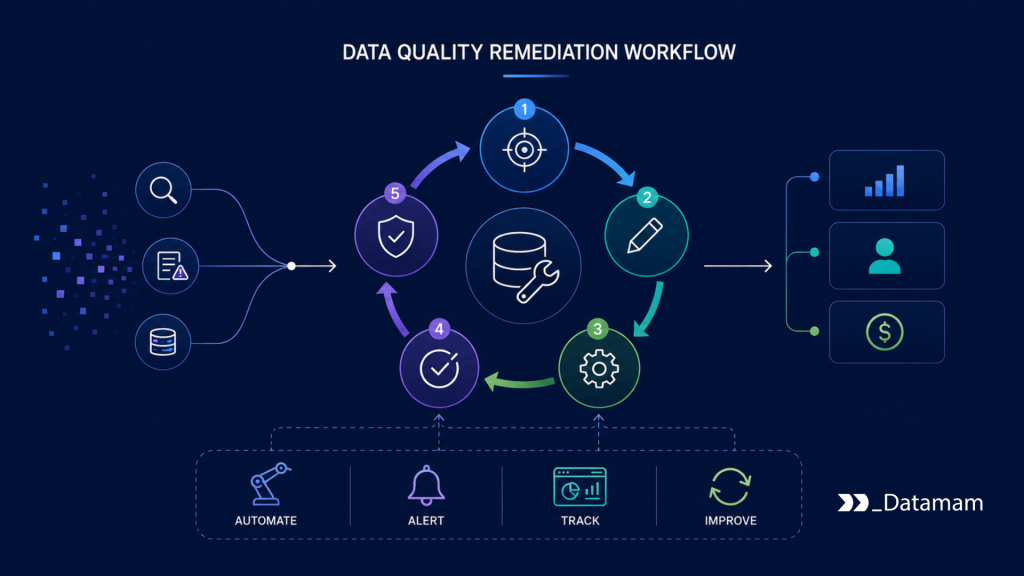
A data remediation process defines how quality issues move from detection to resolution. It should include intake, classification, severity assessment, ownership assignment, correction path, validation, closure, and prevention review.
The process should be standardized enough to scale across domains while allowing different remediation paths for customer, product, finance, healthcare, reference, and operational data.
Classifying Data Defects
Defect classification should describe what failed. Common categories include missing required field, duplicate record, invalid reference value, stale data, schema drift, reconciliation variance, orphaned relationship, incorrect business rule, source incompleteness, and unauthorized value.
Classification matters because each defect type requires a different owner and response. A schema drift issue may belong to data engineering. A missing source field may belong to a source system owner. An invalid reference code may belong to a reference data steward. A business-rule conflict may require domain owner review.
Without classification, every issue becomes a generic data quality ticket, and remediation slows down.
Defining Severity and Business Impact
Severity should reflect downstream risk. A missing optional description may be low severity. A duplicate customer ID in a CRM master may be high severity. An invalid ledger account in finance reporting may be critical. A stale feature table used for AI scoring may require immediate escalation.
Severity should also consider affected systems, record count, business process impact, regulatory relevance, and whether the defect has already reached downstream consumers.
In practice, severity should be decided before incidents occur. If teams debate priority during every defect, resolution becomes inconsistent.
Routing Defects to Owners
A simple remediation routing model can look like this:
REMEDIATION_RULES = {

    "missing_required_field": {"owner": "data_steward", "action": "complete_source_record"},

    "duplicate_customer": {"owner": "customer_data_owner", "action": "merge_or_review_duplicate"},

    "invalid_reference_code": {"owner": "reference_data_owner", "action": "correct_reference_value"},

    "schema_drift": {"owner": "data_engineering", "action": "review_pipeline_contract"},

}


def route_data_quality_defect(defect):

    route = REMEDIATION_RULES.get(defect.get("defect_type"))


    if not route:

        return {"owner": "data_operations", "action": "manual_triage"}


    return {

        "asset": defect.get("asset"),

        "defect_type": defect.get("defect_type"),

        "severity": defect.get("severity"),

        "owner": route["owner"],

        "action": route["action"],

    }
This pattern turns a defect into an operational workflow. The goal is not only to flag bad data, but to assign the correct owner and action.
Data Quality Issue Resolution Across Enterprise Platforms
Data quality issue resolution must account for where the defect originated and where it has propagated. A defect may appear in a dashboard, but the cause may sit in a source application, transformation rule, reference table, data contract, or manual business process.
Resolution should therefore include both correction and impact analysis. Reference data strategies for enterprises play a crucial role in ensuring data integrity across systems. Implementing these strategies can help identify discrepancies early in the data lifecycle. By leveraging robust reference data management solutions, organizations can enhance their overall data governance and drive better decision-making processes.
Correcting the Immediate Data Issue
Immediate correction addresses the visible defect. This may include completing missing values, merging duplicates, correcting reference codes, reloading a failed partition, fixing an invalid status, repairing a broken relationship, or rerunning a transformation.
However, immediate correction should be controlled. Teams need to know whether the correction is made in the source system, staging layer, warehouse, downstream mart, or consuming application.
Source-level correction is usually stronger because it prevents repeated propagation. Downstream correction may be necessary when urgent reporting or operational use is affected, but it should not replace root-cause remediation.
Identifying the Root Cause
Root-cause analysis determines why the defect appeared. The cause may be source-system entry rules, missing validation, schema changes, reference data drift, bad transformation logic, duplicate ingestion, delayed source delivery, weak stewardship, or unclear ownership.
This analysis is essential because repeated defects are often process failures, not isolated record failures.
For example, repeated invalid product categories may indicate weak catalog governance. Repeated customer duplicates may indicate identity resolution gaps. Repeated finance mapping errors may indicate reference data ownership problems.
Validating the Remediation
A defect should not be closed when someone says it is fixed. It should be closed when the corrected data passes validation, and downstream impact has been reviewed.
Validation may include rerunning data quality rules, checking affected records, confirming reference values, comparing source and target values, reviewing downstream tables, and confirming that dashboards or reports no longer show the defect.
A simple closure check can look like this:
REMEDIATION_CLOSURE_RULES = {

    "required_evidence": ["root_cause_recorded", "fix_applied", "validation_passed"],

    "blocked_statuses": ["open", "failed_validation", "owner_unassigned"],

}


def approve_remediation_closure(issue):

    missing = [item for item in REMEDIATION_CLOSURE_RULES["required_evidence"] if item not in issue.get("evidence", [])]


    if missing:

        return {"closed": False, "reason": "missing_closure_evidence", "evidence": missing}


    if issue.get("status") in REMEDIATION_CLOSURE_RULES["blocked_statuses"]:

        return {"closed": False, "reason": "blocked_remediation_status"}


    return {"closed": True}
This keeps remediation closure evidence-based. The issue is not finished until the fix, validation, and root-cause record are complete.
Data Defect Remediation Workflows
Data defect remediation workflows should connect detection systems, metadata, owners, remediation queues, validation checks, and audit trails. The workflow should reduce ambiguity and preserve evidence.
This is especially important when defects affect multiple systems.
Intake From Quality Rules and Observability
Defects may come from data quality rules, observability alerts, user reports, reconciliation checks, pipeline failures, schema monitoring, or downstream reporting variance.
The intake process should capture enough context for triage. This includes asset name, source system, defect type, severity, affected records, rule ID, detected timestamp, downstream consumers, owner, and current status.
If defect intake lacks context, teams waste time rediscovering basic facts before remediation can begin.
Triage and Prioritization
Triage determines which defects require immediate action, which can enter planned remediation, and which need business review. High-severity issues affecting finance, healthcare, regulated reporting, customer operations, AI scoring, or executive dashboards should move faster than low-risk descriptive defects.
Triage should also identify whether data should be quarantined, publication paused, downstream consumers notified, or access restricted.
This is where remediation connects to operational risk control.
Remediation Execution and Revalidation
Execution may involve source correction, transformation update, reference data update, pipeline rerun, duplicate merge, relationship repair, schema contract review, or downstream table refresh.
After execution, the issue should re-enter validation. A remediation workflow that does not revalidate can create false closure. The corrected data must pass the relevant rule, and affected downstream systems should be checked where impact exists.
Governance and Ownership in Data Quality Remediation
Data Quality Remediation requires governance because defects often cross team boundaries. Engineering may detect the issue, but the business domain may own the rule. A platform team may control the pipeline, but a source system owner may control the input.
Governance defines accountability.
Assigning Remediation Ownership
Each defect category should have a default owner. Customer identity issues may belong to customer data owners. Product hierarchy issues may belong to product operations. Ledger mapping issues may belong to finance data owners. Reference code issues may belong to master data or stewardship teams.
Deloitte’s enterprise data management guidance connects high-quality data with information governance, stewardship, regulatory compliance, business process support, data risk assessment, and remediation recommendations. That reinforces the need for remediation ownership beyond technical correction alone.
Managing Exceptions and Risk Acceptance
Some defects cannot be remediated immediately. A source system may require a longer change cycle. A business rule may need policy review. Historical records may be incomplete but acceptable for archive-only use.
Exceptions should be controlled. They should include owner, reason, expiration date, affected data, downstream impact, and risk acceptance. Permanent exceptions should be reviewed carefully because they can weaken the quality model.
Uncontrolled exceptions turn remediation into an informal bypass.
Preserving Remediation Audit Trails
Audit trails should capture detection, classification, severity, owner, root cause, remediation action, validation result, exception approval, downstream notification, and closure decision.
NIST defines data governance as authority, control, and shared decision-making over data assets. Remediation audit trails provide evidence that this authority was exercised when data defects appeared.
Technology and Operating Considerations
Data Quality Remediation workflows require technology support, but they should not depend on tooling alone. The operating model determines whether issues are actually resolved.
The architecture should connect quality checks, observability platforms, metadata systems, issue trackers, catalogs, pipeline orchestration, and remediation queues.
Connecting Remediation to Metadata and Lineage
Metadata helps remediation teams understand who owns an asset, what domain it belongs to, how it is classified, and which rules apply. Lineage helps identify upstream causes and downstream impact.
If a defect appears in a reporting table, lineage should show which source feeds, transformations, reference tables, and downstream consumers are involved. Without lineage, remediation becomes manual investigation.
This is especially important for distributed platforms using Snowflake, BigQuery, Databricks, dbt, Airflow, Spark, Kafka, catalogs, and observability systems.
Integrating With Issue Management
Remediation workflows should integrate with issue management systems. A quality defect should become a trackable item with owner, severity, status, evidence, and due date.
However, generic ticketing is not enough. The ticket should include data-specific context such as rule ID, asset, failed fields, affected record count, source system, lineage impact, and validation status.
This makes remediation actionable instead of administrative.
Using Remediation Metrics
Remediation should be measured. Useful metrics include open defects, critical defects, mean time to resolution, recurring defect rate, defects by domain, defects by source, overdue exceptions, validation pass rate after remediation, and downstream incidents caused by quality issues.
These metrics help governance teams identify weak domains, unstable sources, recurring rule failures, and capacity constraints.
Remediation metrics should inform quality improvement, not only status reporting.
Risk Containment Through Data Quality Remediation
Data Quality Remediation reduces risk by turning quality defects into controlled resolution workflows. It prevents defects from remaining unresolved, spreading downstream, or recurring without accountability.
This is where quality management becomes operational. Data quality solutions for enterprises are essential for maintaining the integrity of business processes. These solutions allow organizations to ensure their data is accurate, consistent, and reliable, which is crucial for informed decision-making. By implementing robust data quality practices, enterprises can enhance efficiency and optimize performance across various departments. Data quality metrics in production play a crucial role in identifying anomalies and ensuring compliance with established standards. Regularly monitoring these metrics enables organizations to proactively address issues before they escalate. Consequently, businesses can maintain high standards of reliability and foster trust in their data-driven strategies.
Preventing Repeat Defects
Repeat defects often signal process weakness. If the same issue returns, the organization should review source validation, rule design, ownership, pipeline logic, reference data governance, or user entry controls.
Remediation should include prevention. Otherwise, teams spend effort fixing the same issue repeatedly.
Protecting Downstream Consumers
Downstream consumers need to know when quality defects affect them. A finance report may need a caveat. A dashboard refresh may need to pause. An AI feature pipeline may need to skip a scoring run. A customer operations workflow may need manual review.
Remediation workflows should define when and how consumers are notified.
Strengthening Quality Governance
Strong remediation creates evidence for governance review. It shows which domains produce the most defects, which sources are unstable, which rules generate recurring failures, and which owners need support.
Over time, remediation evidence helps improve rules, ownership, source controls, and platform standards.
Conclusion: Turning Remediation Into a Quality Control Workflow
Data Quality Remediation gives enterprises a structured way to resolve data defects after detection. It connects the data remediation process, data quality issue resolution, data defect remediation, ownership, severity classification, root-cause analysis, validation, lineage, and audit evidence.
Strong remediation prevents quality programs from stopping at alerts. It ensures defects are routed, corrected, validated, documented, and reviewed for recurrence. It also helps protect analytics, AI systems, CRM workflows, finance reports, product operations, healthcare analytics, and executive reporting from unresolved data issues.
The capability matters because enterprise data quality cannot improve through detection alone. When remediation is weak, defects repeat. When remediation is governed and operationalized, quality issues become visible, owned, resolved, and auditable.
A structured review can help evaluate whether current workflows have reliable Data Quality Remediation, a data remediation process, data quality issue resolution, and data defect remediation. You can run an external data infrastructure audit with our team to review your current setup and understand what is required to build reliable, enterprise-scale data quality infrastructure.